 Sudden Valley
 Why Bellingham Homes Need Siding Built for This Climate
Bellingham sits close enough to the water that salt-laden air is a daily fact of life for exterior materials, not an occasional nuisance. Add Whatcom County's long wet season, driving rain that comes in sideways off Bellingham Bay and the Strait, and months of low sun angles that keep north- and west-facing walls damp, and you have a climate that is genuinely hard on siding. Moss and algae don't need much encouragement here — a shaded wall with any organic buildup or a poorly flashed seam will host green growth within a season or two if the material and the installation don't account for it.
This isn't a climate where you can install siding "close enough" and expect it to perform for twenty years. Water finds every gap, salt air accelerates corrosion on fasteners and trim, and moss holds moisture against the wall assembly long after a storm has passed. Homes in Bellingham need a siding system that resists moisture intrusion at the material level and a crew that details every seam, corner, and penetration correctly the first time.
Why We Install Only James Hardie Fiber Cement
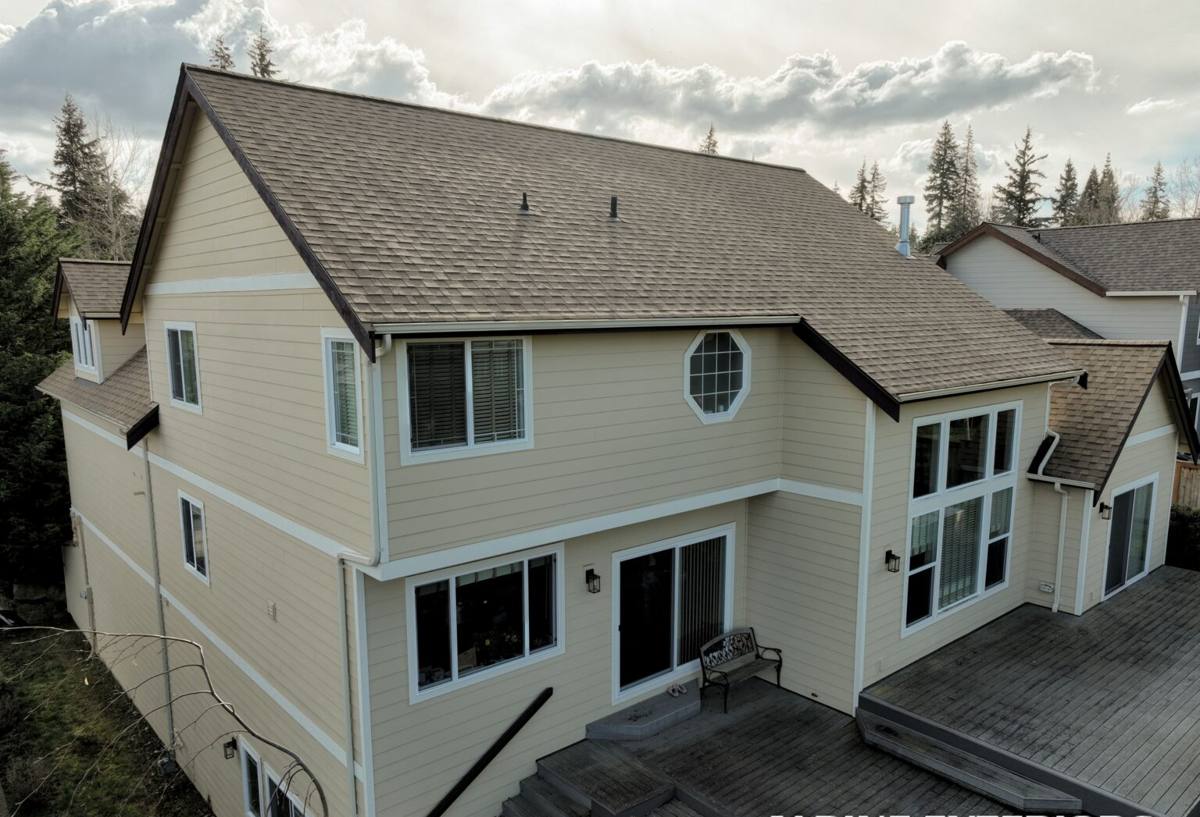
We standardized on James Hardie fiber cement siding for every home we work on, including here in Bellingham, and we don't install vinyl, LP SmartSide, Cemplank, Allura, or raw wood siding. That's not a marketing position — it's a practical one built around what actually holds up in this climate.
Fiber cement is a mix of cement, sand, and cellulose fibers, engineered to be dimensionally stable in wet-dry cycles. It doesn't absorb and swell the way wood-based products can, and it doesn't soften or warp from prolonged moisture contact the way some engineered wood siding does if a seal ever gets compromised. James Hardie also builds region-specific product lines (their "HZ" designations) engineered for different climate zones, and manufactures with a factory-applied ColorPlus finish that's baked on and warranted, rather than a field-applied paint job that starts weathering the day it's installed. For a wall that's going to face salt air and months of rain every year, that combination of moisture stability and finish durability matters more here than almost anywhere else we work.
It's also non-combustible, which matters given Washington's increasingly active wildfire seasons even on the west side of the Cascades, and it carries a strong transferable warranty when installed to manufacturer specification — which is the operative phrase, because installation quality determines whether that warranty (and the siding's real-world performance) means anything at all.
What We Don't Install, and Why
- Vinyl siding: Lightweight and inexpensive, but it expands and contracts significantly with temperature swings, can crack in cold snaps, and doesn't offer the impact resistance or paintable, factory-finished durability that fiber cement does.
- LP SmartSide and other engineered wood products: Wood-strand composites perform reasonably well when the seal stays intact, but any breach — a missed caulk joint, a woodpecker hole, a poorly lapped seam — lets moisture into the substrate, and once that happens the material can swell and deteriorate from the inside out.
- Cemplank and Allura: Both are fiber cement products and share some of the same core advantages Hardie offers. We simply standardized on James Hardie specifically for its ColorPlus finish system, its HZ climate-zone engineering, and the depth of its installation network and warranty backing.
- Primed spruce or cedar: Beautiful when new, but real wood siding demands an ongoing maintenance commitment — refinishing, caulking, moisture monitoring — that most homeowners underestimate until they're a decade in and facing rot repair.
What Correct Fiber Cement Installation Actually Requires
James Hardie siding performs the way it's designed to only when it's installed to the manufacturer's specifications, and in a climate like Bellingham's, the details that get skipped on a rushed job are exactly the details that cause failures. A correct installation isn't just nailing boards to a wall — it's a moisture-management system.
The Elements That Matter Most Here
- Weather-resistant barrier and rainscreen gap: A proper water-resistive barrier behind the siding, ideally with a drainage gap, lets any moisture that does get past the cladding drain and dry instead of sitting against the sheathing.
- Flashing at every penetration: Windows, doors, hose bibs, light fixtures, and vents all need correctly lapped flashing so water sheds outward and down, never inward.
- Proper fastener placement and type: Hardie specifies fastener size, spacing, and embedment depth precisely. Over-driven or under-driven nails compromise the board's ability to expand and contract normally and can crack the material over time.
- Correct clearances: Minimum gaps from grade, roof lines, decks, and patios keep siding from sitting in standing water or trapped moisture — a common cause of premature failure at the bottom courses of a wall.
- Caulked and painted cut edges: Factory edges come sealed, but every field cut exposes raw material that must be sealed per manufacturer instructions before it's closed up.
- Butt joint and seam treatment: Poorly sealed seams are the single most common entry point for water intrusion on any siding job, and they're also the first place moss and algae take hold on a shaded wall.
Skipping any one of these doesn't necessarily cause an immediate problem — it causes a slow one. Water finds the gap, sits against the sheathing through a wet Bellingham winter, and by the time staining or soft spots show up on the interior or exterior, the damage is already done.
Moss, Algae, and Salt Air: The Bellingham-Specific Maintenance Picture
Even a correctly installed fiber cement wall needs some baseline care in this climate, and it's worth being upfront about what that looks like rather than pretending siding here is maintenance-free.
What to Expect and Watch For
- North- and west-facing walls, and any area shaded by trees or a neighboring structure, will accumulate moss and algae faster than sun-exposed walls. A soft wash on a normal schedule keeps growth from taking hold and staining the ColorPlus finish.
- Salt air near the bay can accelerate corrosion on unprotected metal trim, fasteners, and flashing. Hardie's fiber cement itself isn't affected by salt the way metal or some composite trims are, but the fasteners and flashing details around it need to be corrosion-resistant materials to match.
- Gutters and downspouts need to actually work. A clogged gutter during a heavy Bellingham rain event doesn't just overflow — it can send a sheet of water directly down a wall section that wasn't detailed to handle that volume.
- Caulked joints and butt seams should be inspected periodically, especially after the first couple of winters, since that's when any settling or minor gaps tend to show up.
Our Process for a Bellingham Siding Project
| Step | What Happens |
|---|---|
| Site walk and assessment | We look at existing siding condition, moisture damage risk areas, roofline and grade clearances, and shaded/exposed wall sections specific to your lot |
| Product and color selection | Choose the Hardie board profile (lap, shingle, panel) and ColorPlus finish that fits the home and neighborhood context |
| Tear-off and substrate check | Remove old siding, inspect sheathing for hidden rot or moisture damage before anything new goes up |
| Weather barrier and flashing installation | Install water-resistive barrier, drainage plane, and flashing at every window, door, and penetration |
| Siding installation to spec | Correct fastener schedule, clearances, seam sealing, and joint treatment per Hardie's published installation guidelines |
| Final inspection and walkthrough | Verify seams, caulking, trim, and clearances before we consider the job complete |
Every step in that sequence matters more in a climate that gets as much sustained rain as Bellingham does. Skipping the substrate check, in particular, is how hidden rot behind old siding gets sealed up and forgotten instead of fixed.
Cost Factors for Fiber Cement Siding in This Area
Every home is different, but a few factors consistently move the price on fiber cement projects in Whatcom County. We won't quote a number without seeing the home, but it's worth understanding what drives the range.
| Factor | Why It Matters |
|---|---|
| Existing siding removal and disposal | Tear-off adds labor and disposal cost, and reveals whether substrate repair is needed |
| Substrate or sheathing repair | Hidden moisture damage from old siding sometimes isn't visible until tear-off begins |
| Home size and wall complexity | Dormers, multiple gables, and cut-up wall lines increase labor time and material waste |
| Siding profile and trim details | Shingle-style or mixed-profile designs take longer to install correctly than straight lap siding |
| Site access | Steep lots, tree cover, or limited staging space common around Lake Whatcom-area properties can affect crew efficiency |
Why Hiring a Crew That Already Works This Area Matters
Bellingham and the surrounding Whatcom County communities have their own microclimate patterns — closer to salt water in some areas, shaded by dense tree cover in others, exposed to steady onshore weather in others still. A crew that installs siding across a wide range of climates might get the general Hardie installation steps right and still miss the local judgment calls: which walls need extra attention to drainage detailing because they're perpetually shaded, which flashing details need to be more robust given driving rain patterns, or how much clearance to leave near a wall that regularly deals with splash-back from heavy runoff.
That local pattern recognition doesn't come from a manual — it comes from having done this work on homes in this specific climate, season after season, and having seen what holds up and what doesn't. That's the standard we hold every Bellingham installation to.
Signs Your Current Siding May Already Be Failing
- Soft or spongy spots when you press on the siding, especially near the bottom courses or below windows
- Visible moss or algae staining that keeps returning shortly after cleaning
- Paint or finish that's peeling, bubbling, or chalking heavily
- Gaps or separation at seams and corner trim
- Interior signs like musty odor, staining, or peeling paint on walls that back up to exterior siding
- Visible warping, cracking, or cupping of individual boards
Any one of these is worth a professional look before it becomes a larger repair. In a climate this wet, small gaps don't stay small.
Get a Straightforward Estimate
If your Bellingham home needs new siding, or you want a second opinion on a job someone else quoted, we're happy to take a look and walk you through exactly what your home needs and why. Reach out for a free, no-pressure estimate using the form below.