 Sudden Valley
 Cedar Has Real Appeal — And Real Costs
Cedar siding shows up on a lot of homes around Sudden Valley, and it's easy to understand why. Fresh cedar has a warmth and natural grain that manufactured products spend a lot of marketing budget trying to imitate. It's a renewable material, it's been used in the Pacific Northwest for well over a century, and when it's brand new, nothing else quite looks like it.
We're not going to pretend otherwise. But we stopped installing cedar siding because of what happens after year one, and especially what happens to cedar siding in a climate like ours — one with salt-laden air off the lake and the Sound, driving rain for months at a stretch, and a moss season that can run from October through May. Cedar is a wood product, and wood products in this environment need a level of ongoing homeowner commitment that most people don't sign up for when they picture "new siding."
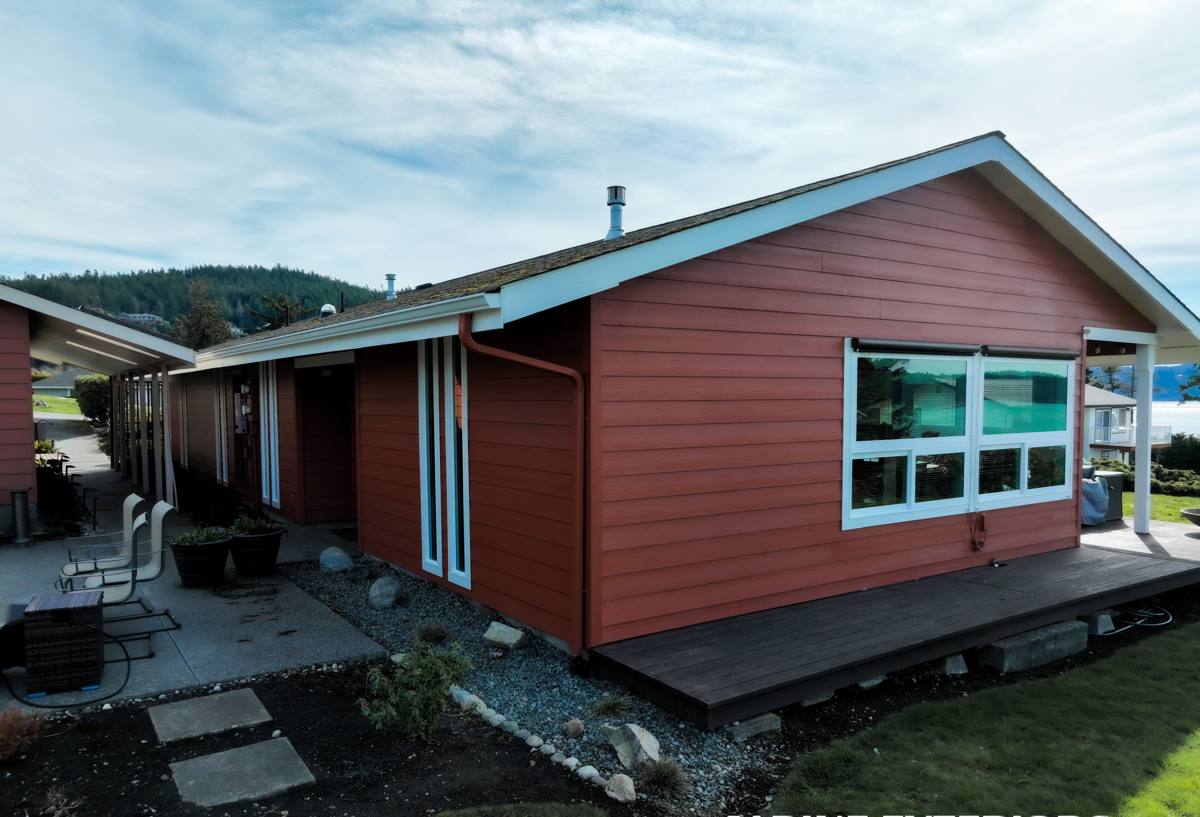
What Cedar Actually Needs to Last
Cedar siding isn't a install-it-and-forget-it product. To get anywhere near its potential lifespan, it needs an ongoing maintenance schedule that most other siding materials simply don't require.
Refinishing on a Clock
Whether it's stained or painted, cedar's finish is the only thing standing between the wood and the weather. In our climate, that finish doesn't last as long as it does in a drier region. Semi-transparent stains often need reapplication every 2-4 years; solid-body stains and paint can stretch longer, but even those typically need attention within 5-7 years, sooner on south- and west-facing walls that take the brunt of driving rain. Skip a cycle and the wood starts absorbing moisture directly.
Caulking and Joint Maintenance
Every seam, corner, and butt joint on a cedar installation is a place water can find its way behind the boards. Caulk dries out, shrinks, and cracks well before most homeowners think to check it. Once that seal fails, moisture gets behind the siding where it doesn't dry out quickly — especially under a Whatcom County cloud cover that can sit for weeks.
Moss, Mildew, and Constant Cleaning
This is the one that catches people off guard the most. Cedar's texture and the amount of shade many Sudden Valley lots get from surrounding trees create ideal conditions for moss and mildew growth. Left alone, organic growth holds moisture against the wood surface, which accelerates rot from the outside in. Keeping cedar siding clean isn't a once-a-decade pressure wash — it's a recurring task, and pressure washing itself has to be done carefully, because too much force strips the finish and drives water into the grain.
Where Cedar Fails, and Why It's Hard to Catch Early
The trouble with cedar isn't that it fails quickly — it's that it fails quietly, in the places you're least likely to look.
- Bottom edges and butt joints — end grain soaks up water far faster than the face of the board, so rot often starts at cut edges long before the rest of the board shows any sign of trouble.
- Behind trim and at penetrations — around windows, light fixtures, and hose bibs, water intrusion can travel behind the siding and cause damage that's invisible from the outside until the board is soft to the touch.
- North-facing and shaded walls — the sides of a house that get the least sun dry out the slowest after rain, which in our region can mean staying damp for days, not hours.
- Ground-level boards — splash-back from landscaping and snowmelt keeps the lowest courses wetter than the rest of the wall, accelerating deterioration right where it's hardest to see without getting down and looking closely.
By the time cedar rot is visible from the street or from inside a room, the damage is usually well established. Replacing individual boards is possible, but matching weathered cedar color and grain is difficult, and rot rarely stays confined to just the board where it started.
The Insurance and Wildfire-Adjacent Conversation
Wood siding is a combustible material, full stop. That's not a knock on cedar specifically — it's physics. As wildfire smoke seasons have become a more regular part of summer in Whatcom County and across Western Washington, more homeowners are asking about non-combustible exterior materials, and some insurance carriers have started factoring exterior cladding into underwriting decisions. Fiber cement siding carries a noncombustible rating that wood siding, treated or not, cannot match. For some homeowners this is a minor factor; for others, especially those insuring a home near dry brush or timber, it's become a deciding one.
Cost Over Time: Cedar vs. Fiber Cement
The sticker price on cedar siding installation can look competitive with fiber cement, sometimes even lower depending on the grade of cedar. That comparison only tells part of the story. The real cost difference shows up over the 20-30 year window most homeowners actually care about.
| Factor | Cedar Siding | James Hardie Fiber Cement |
|---|---|---|
| Refinishing cycle | Every 2-7 years depending on finish and exposure | ColorPlus factory finish; touch-up only, no full refinish for 15+ years |
| Caulking/joint maintenance | Ongoing inspection and resealing required | Minimal; engineered joints hold up with routine checks |
| Moss/mildew cleaning | Regular cleaning needed to prevent moisture retention | Occasional rinse; surface doesn't feed organic growth the way wood does |
| Combustibility | Combustible | Noncombustible fiber cement |
| Typical manufacturer warranty | Varies by finish; often limited or unavailable on labor | 30-year non-prorated limited warranty on the substrate, transferable |
| Rot risk | Present if maintenance lapses | Engineered to resist moisture-driven decay |
None of this means cedar is a bad material in the abstract — it means cedar asks for a level of upkeep that doesn't fit how most homeowners actually want to spend their weekends, and in a wet, mossy, salt-air climate like ours, the maintenance clock runs faster than it would somewhere drier.
Why We Standardized on James Hardie
We made a decision as a company to install one siding system, and only one: James Hardie fiber cement. That's not because we don't respect cedar as a material — it's because we got tired of watching beautiful cedar installations turn into maintenance headaches for homeowners who were told "just seal it every few years" and then, understandably, didn't keep up with a schedule that demanding.
James Hardie's fiber cement is engineered specifically for climates like the Pacific Northwest. The HZ5 product line is formulated for wetter, harsher weather conditions, which matters directly here given the driving rain and lake-effect moisture Sudden Valley gets for a good chunk of the year. The ColorPlus factory finish is baked on under controlled conditions, not brushed on in the field, which means better adhesion and a finish that holds its color far longer than field-applied stain or paint. It's noncombustible. It doesn't feed moss and mildew growth the way exposed wood grain does. And it carries a 30-year, non-prorated, transferable warranty on the material itself — something wood siding manufacturers generally can't offer, because they're not the ones responsible for whatever finish gets applied after installation.
We install it correctly to spec — proper flashing, correct fastener placement, manufacturer-specified clearances from grade and roofing — because even the best material fails early if it's installed wrong. That's true of any siding, cedar included. But it's a lot easier to get consistent, lasting results out of an engineered product than out of a natural material that varies board to board.
What to Ask If You're Still Considering Cedar
If you're set on a wood look, or you already have cedar siding and are weighing repair versus replacement, a few honest questions are worth asking any contractor:
- Who is actually going to keep up the refinishing schedule, and is that realistic for your household over the next 10-15 years?
- What does the labor warranty cover if a finish fails early — and is that separate from any material warranty?
- Has the current siding been inspected at butt joints, bottom edges, and shaded walls specifically, not just from a ladder at the front of the house?
- If you're replacing sections, how will the contractor handle color and grain matching against weathered existing boards?
- Does your homeowner's insurance carrier ask about exterior cladding material, and would a noncombustible option change your premium or coverage terms?
Get an Honest Look at Your Siding
If you're weighing cedar against a fiber cement replacement, or your current cedar siding is starting to show its age around Sudden Valley, we're happy to come take a look and give you a straight answer — no pressure, no sales script. Reach out for a free estimate and we'll walk the exterior with you, point out anything worth watching, and explain exactly what a James Hardie installation would involve for your home.