 Sudden Valley
 Ferndale's Exterior Challenge: Salt Air, Rain, and a Long Moss Season
Ferndale sits close enough to saltwater and the Nooksack lowlands that homes here deal with a combination of weather stresses that inland Whatcom County towns don't see in the same mix. Marine air carries salt and moisture that settles on exterior surfaces year-round. Add Western Washington's long wet season — months of low-intensity rain punctuated by driving, wind-blown storms — and you get siding that rarely gets a real chance to dry out between October and May. Add the shade from mature trees on many lots and the humidity that lingers close to the ground in this part of the county, and you have ideal conditions for moss, algae, and mildew to take hold on anything that isn't built to shed water and resist organic growth.
None of this is unusual for the Pacific Northwest. But it's a real, measurable load on a home's siding, and it's the reason material choice matters more here than it does in drier climates. Some products tolerate this environment well. Others need a level of maintenance most homeowners don't sign up for, or start showing problems within a handful of years. We've built our business around installing one product system because, after years of doing exterior work throughout Whatcom County, it's the one that consistently holds up to what Ferndale weather does to a house.
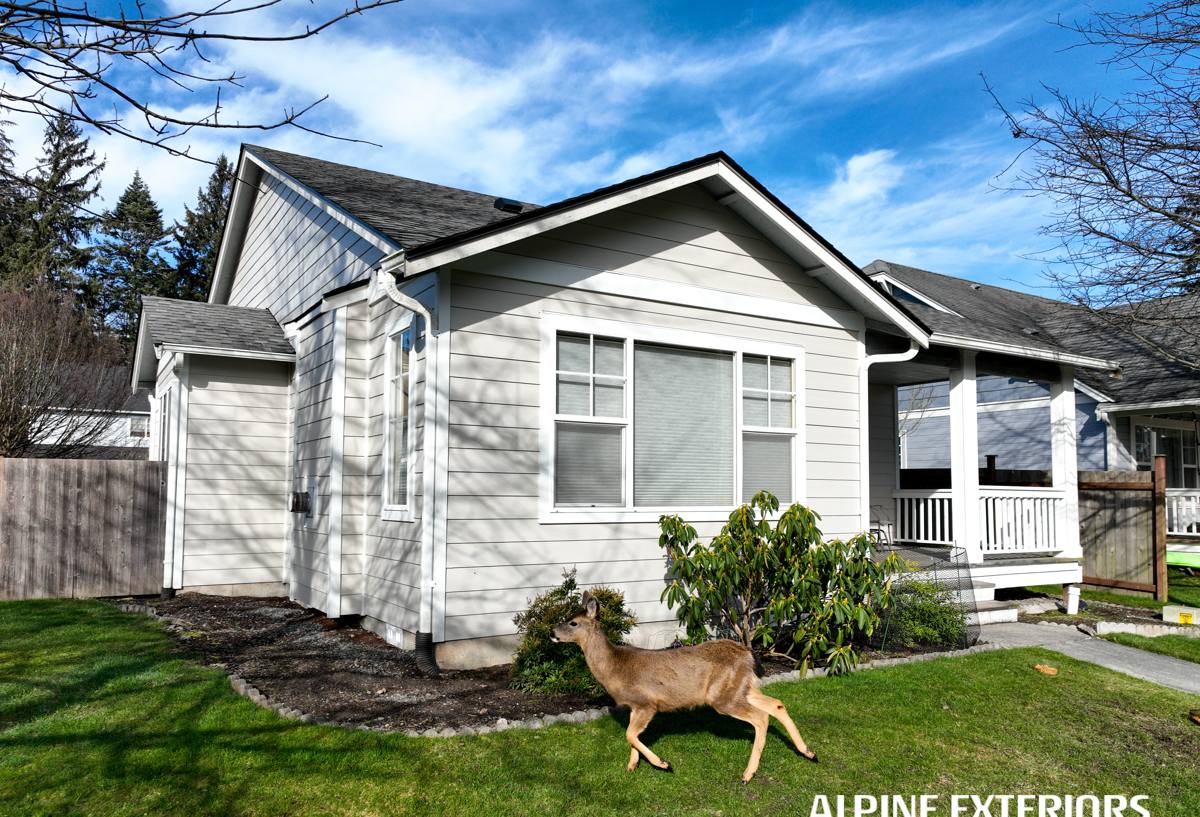
What Salt Air and Moisture Actually Do to Siding
It helps to understand the mechanisms, not just the symptoms:
- Salt air accelerates corrosion on fasteners, flashing, and any exposed metal trim, and it can degrade paint and coatings faster than inland exposure.
- Driving rain pushed by wind off the water finds every gap in a siding system — seams, butt joints, and poorly flashed penetrations are where water gets behind the cladding, not usually the face of the material itself.
- Persistent moisture and shade create the conditions moss, algae, and mildew need to establish. Once organic growth takes hold on a porous or textured surface, it holds even more moisture against the wall.
- Freeze-thaw cycles, while less severe here than in the Cascades foothills, still happen enough winters to stress any material that absorbs water and swells.
The common thread: water management and moisture resistance matter more than color or texture. A siding product that looks good on day one but swells, delaminates, or feeds mold growth by year eight is a bad fit for this climate, no matter what it costs up front.
Why We Install James Hardie Fiber Cement — and Only That
We made a deliberate decision to install James Hardie fiber cement siding exclusively. We don't install vinyl, LP SmartSide, Cemplank, Allura, primed spruce, or cedar. That's not a marketing position — it's a standard we hold because of what we've seen happen to other products in this exact climate.
Fiber cement is a mix of cement, sand, and cellulose fibers, cured into a dense, stable board. It doesn't absorb water the way wood-based products do, it won't warp or rot, and it's non-combustible — a genuine advantage given how many Whatcom County properties border trees and brush. James Hardie engineers specific product lines (HZ5 and HZ10) for different climate zones, and Western Washington's wet, moderate-temperature exposure is exactly what those lines are built around.
The factory-applied ColorPlus finish is a big part of why we standardized on this brand specifically, not just fiber cement in general. It's baked on in a controlled environment rather than field-applied, which means better adhesion, more even coverage, and a finish that resists the fading and moisture intrusion that plague field-painted siding. In a climate where the paint job is constantly under assault from rain and salt air, that matters.
What We're Saying No To, and Why
| Product | Where it struggles in this climate |
|---|---|
| Vinyl siding | Can warp or crack in temperature swings; seams and panels give wind-driven rain a path behind the cladding; doesn't hold paint if a color change is ever wanted |
| LP SmartSide (engineered wood) | Wood-based core is vulnerable to moisture intrusion at cut edges and seams if caulking and flashing aren't maintained precisely; long wet seasons leave little margin for error |
| Cedar | Beautiful material, but needs ongoing sealing and maintenance to resist moisture, moss, and rot in a climate this wet; upkeep cost is real and easy to underestimate |
| Primed spruce / other primed wood | Primer is a base coat, not a finish system; field paint and caulk joints degrade faster under sustained coastal moisture |
| Cemplank / Allura (other fiber cement brands) | Reasonable fiber cement products, but without factory ColorPlus finishing, and without the climate-specific HZ engineering James Hardie backs with its product line and warranty structure |
None of these are bad products in every application. But we install one thing on Ferndale homes, and we stand behind it, because it's the one we've seen perform without excuses over time.
Beyond Siding: Roofing, Windows, and Decks
Siding is only one piece of a home's defense against this climate. We also handle roofing, windows, and decks, because a house is a system — a weak point in any one of those areas undermines the others. A roof that's shedding granules or has failing flashing sends water down behind otherwise sound siding. Windows with failed seals let moist air into wall cavities. A deck built without attention to ledger flashing and moisture separation from the house rots the band board it's attached to.
When we're on site for a siding estimate in Ferndale, we look at the whole envelope — roof condition, window flashing, deck attachment points — because that's where problems actually originate, even when the siding gets blamed for it.
Why a Local Crew Matters Here
Whatcom County's microclimates aren't uniform. A crew that mostly works drier, inland areas can underestimate what coastal exposure and long moss seasons do to a building envelope. Working throughout this region means knowing which details actually matter here: proper rain-screen gaps behind siding to let it dry, correct flashing at every window and door opening, fastener spacing that accounts for real wind exposure, and trim details that don't trap water against the wall.
James Hardie siding is a durable product, but it's also installation-sensitive. Butt joints, fastener placement, clearance from grade, and flashing at penetrations all affect how the system performs over 20-plus years. A rushed or generic installation can undercut even the best material. That's why installation quality — not just product choice — is the other half of what determines whether siding holds up in this climate.
What Ferndale Homeowners Should Watch For
If you're deciding whether it's time to look at your siding, a few signs are worth taking seriously rather than waiting on:
- Moss or dark streaking that keeps returning to the same areas of the wall, even after cleaning
- Soft spots, visible swelling, or delaminating panels — especially near the ground or under downspouts
- Paint that's peeling, chalking heavily, or showing bare wood underneath
- Gaps opening up at seams, corners, or trim boards
- Visible warping or bowing in panels, particularly on the sides of the house that face prevailing wind and rain
- Rising heating bills or drafts that suggest the wall assembly behind the siding isn't sealed the way it should be
Cost Factors for a Ferndale Siding Project
Every home is different, but the factors that move a siding project's cost up or down are consistent:
| Factor | Why it matters |
|---|---|
| Home size and complexity | More square footage and more corners, gables, and rooflines mean more material and labor |
| Existing siding removal | Tear-off and disposal of old material adds cost versus siding over a properly prepped surface (which we generally don't recommend anyway) |
| Substrate condition | Rot or water damage found under old siding needs to be repaired before new siding goes on — this is common on older Whatcom County homes |
| Trim and accessory selection | HardieTrim boards, soffit, and fascia choices add to material cost but improve the finished look and durability |
| Panel profile and color | Lap siding, shingle-style panels, and panel-and-batten all price differently; ColorPlus premium colors carry a modest upcharge over standard options |
| Access and site conditions | Steep lots, limited staging area, or landscaping that needs protection can affect labor time |
We give straightforward, itemized estimates so you can see exactly what's driving the number — not a lump-sum figure that hides where the money is going.
Our Process for a Ferndale Siding Project
We start with an on-site inspection of the current siding, trim, and any areas showing moisture damage, along with a look at the roof and window flashing where it interfaces with the siding. From there we walk you through product and color options, give you a detailed estimate, and — if you move forward — schedule the work around a realistic weather window, since fiber cement installation goes best with a few consecutive dry days for sealing and finishing details.
During installation, we follow manufacturer flashing and clearance specifications closely, not as a minimum, because those details are what determine whether the siding is still performing well in fifteen or twenty years. We also stand behind our labor, separate from the manufacturer's product warranty, so you have accountability on both the material and the installation.
If your Ferndale home's siding is showing its age, or you're planning ahead rather than reacting to a problem, we're happy to come take a look. There's no cost and no pressure to move forward — just a straightforward assessment and an honest recommendation, using the form below to get started.