 Sudden Valley
 Exterior Work Built for the Alger and Sudden Valley Climate
Alger sits along the I-5 corridor between Bellingham and Mount Vernon, in the mix of forest, lake, and farmland that defines this stretch of Northwest Washington. Homes here share the same weather pattern that drives so much of our work across Whatcom County: long, wet winters, a marine air mass that never fully dries out, and enough shade from mature conifers that north- and west-facing walls rarely get a real chance to dry between storms. It's a beautiful place to live and a demanding place to own a house.
We've built our business around exteriors for exactly this kind of climate. Siding, roofing, windows, and decks all take a beating from the same three things — moisture, salt-laden air moving in off the Sound, and moss that doesn't quit from October through May. A house that looks fine from the street can be hiding soft trim, saturated sheathing, or a roof that's lost its granule protection, simply because the symptoms show up slowly out here.
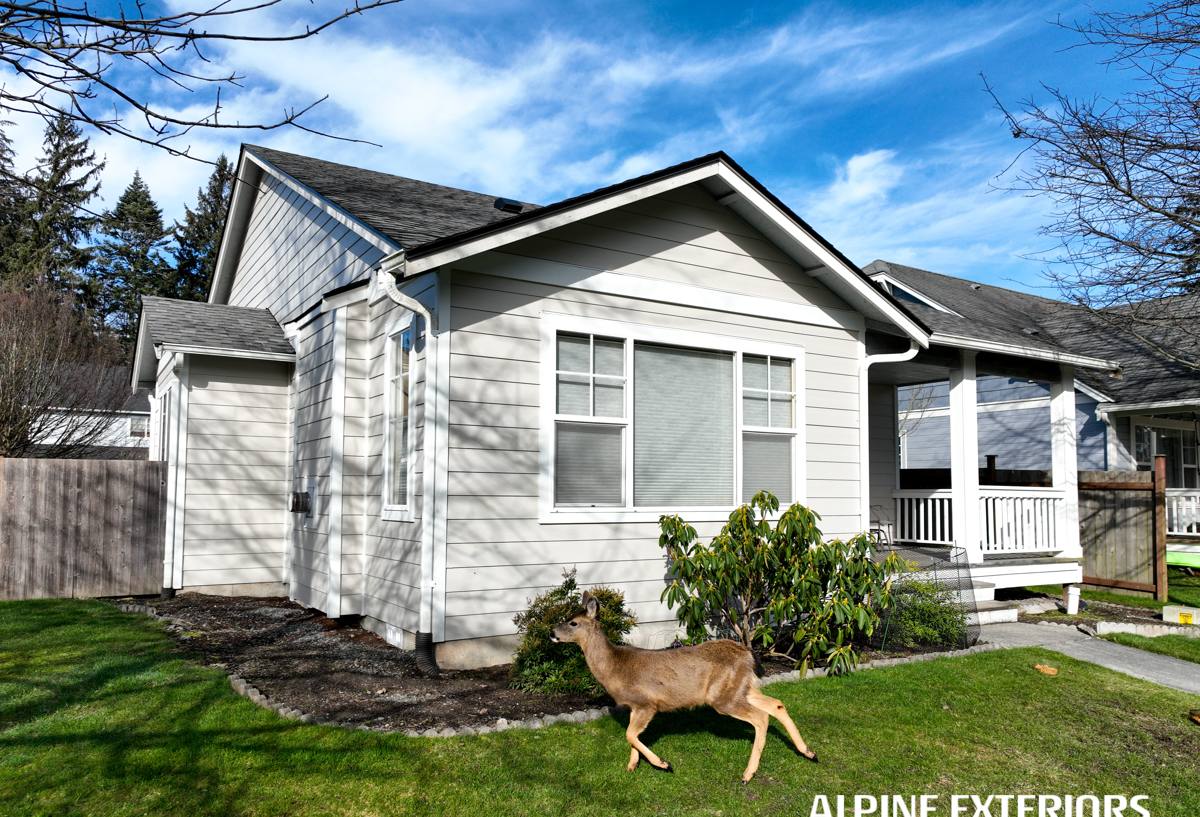
What Salt Air, Driving Rain, and Moss Actually Do to a House
Salt Air
Homes closer to the water, and even ones set back a few miles inland like much of Alger and Sudden Valley, still pick up salt-laden moisture carried on Pacific storm systems. Over years, that salt content accelerates corrosion on fasteners, flashing, and any exposed metal trim. It also speeds up the breakdown of lower-quality paint films, which is part of why we care so much about factory-cured finishes rather than field-applied paint that has to fight the elements from day one.
Driving Rain
This isn't gentle Pacific Northwest drizzle. Fall and winter storms here regularly bring wind-driven rain that hits siding sideways, not straight down. That matters because it pushes water into every seam, lap joint, and butt joint that isn't detailed correctly. Wall assemblies that rely on face-sealing rather than proper drainage planes and flashing are the ones that eventually show rot at the bottom courses, around window sills, and at deck ledger connections.
Moss and Prolonged Dampness
Between the tree cover and the rain, north-facing siding, roof valleys, and shaded decking can stay damp for weeks at a stretch. Moss and algae take hold anywhere organic material and moisture linger, and on the wrong substrate that biological growth holds water against the surface, which accelerates rot underneath. It's a slow, quiet kind of damage — by the time it's visible, it's usually been building for a while.
Why We Standardized on James Hardie Fiber Cement
We install James Hardie fiber cement siding exclusively. That's not a marketing position — it's a decision we made after years of seeing how different materials actually perform in this exact climate, not in a showroom or a warmer, drier region.
Fiber cement is non-combustible and dimensionally stable, meaning it doesn't swell, cup, or delaminate the way some wood-based and engineered wood products can when they take on repeated moisture exposure. Hardie's ColorPlus finish is baked on at the factory under controlled conditions, which gives it far better adhesion and fade resistance than field-applied paint — a real advantage in an area where the exterior rarely gets a long dry stretch to cure a fresh paint job properly. Hardie also engineers regional product lines (HZ5 for our zone) specifically for climates with heavy moisture exposure, which is the kind of detail that matters more here than in most parts of the country.
We don't install vinyl, LP SmartSide, Cemplank, Allura, primed spruce, or cedar. Each of those has legitimate uses elsewhere, but we've made a professional call that Hardie is the product that holds up best, looks best longest, and comes with the strongest transferable warranty for homes dealing with what Alger and Sudden Valley throw at them year-round.
How Common Siding Materials Compare in This Climate
| Material | Moisture Behavior | Finish Durability | Long-Term Maintenance |
|---|---|---|---|
| James Hardie Fiber Cement | Dimensionally stable, engineered for wet climates | Factory-baked ColorPlus finish | Low — periodic cleaning, no repainting cycle for the finish |
| Vinyl | Doesn't rot, but can warp and lets moisture track behind it at seams | Color molded in, fades unevenly over time | Low, but replacement rather than repair when damaged |
| LP SmartSide / Engineered Wood | Vulnerable at cut edges and joints if moisture gets in | Factory or field finish, edge sealing is critical | Moderate — edge and seam inspection matters |
| Cedar / Primed Spruce | Absorbs moisture, prone to cupping and rot in shaded, damp areas | Field-applied, needs recoating | High — regular repainting and moisture monitoring |
The Full Exterior Picture: Roofing, Windows, and Decks
Siding doesn't work in isolation. A house is one connected system, and in a climate like this, the weak point is usually where two systems meet — a window flashing detail, a roof-to-wall transition, a deck ledger bolted into the rim joist. We work all four trades — siding, roofing, windows, and decks — because getting those transitions right is what actually keeps water out, and it's hard to guarantee that when different contractors are handling each piece separately with no one accountable for how they tie together.
On roofing, that means correct underlayment and valley flashing for a climate that sees sustained rain events, not just occasional showers. On windows, it means proper flashing integration with the new siding assembly rather than just caulking around the old opening. On decks, it means ledger flashing and structural connections that account for a structure that will be wet, in some capacity, for a majority of the year.
Why a Local Crew Matters Here
A crew that works Whatcom County day in and day out knows the difference between a normal amount of moss on a north wall and a sign that something underneath is failing. They know which details tend to fail first in this weather — usually butt joints, kick-out flashing at roof-to-wall intersections, and anywhere caulk was asked to do a job that flashing should be doing. That local pattern recognition is hard to replace with a crew that mostly works drier inland climates or does a handful of jobs a year in this region.
It also matters for scheduling and sequencing. Exterior work in this part of Washington has a real weather window, and a local crew plans around it — knowing when to push a project up before the fall rains set in and when a delay actually protects the work rather than rushing it into a bad stretch of weather.
What to Expect From an Alger or Sudden Valley Project
Every project starts with an honest look at what's actually going on behind the existing exterior, not just what's visible from the driveway. On older homes especially, that means checking for soft spots, prior water intrusion, and whether the underlying sheathing needs attention before new siding goes up. Installing James Hardie over compromised substrate doesn't solve anything — it just hides the problem for a while longer.
From there, the process includes removing the old siding (or trim and problem sections, depending on scope), addressing any water damage or code-required weather barrier updates, and installing Hardie panels or planks to manufacturer specifications — correct fastener spacing, proper clearances at grade and roof lines, and flashing at every penetration and transition.
Questions Worth Asking Before You Hire Anyone for Exterior Work Out Here
- Are they installing to the manufacturer's written specifications, including fastener type and spacing, or just "how they've always done it"?
- Do they inspect and address sheathing and moisture barrier condition before new siding goes up, rather than covering over it?
- Do they handle the flashing details at windows, roof lines, and deck ledgers themselves, or is that left to whoever else is on site?
- Are they licensed and insured for work in Washington, and can they explain the warranty — both on materials and on their labor?
- Do they have real experience with this specific climate, not just exterior work in general?
Living With Your Exterior After the Work Is Done
Even the right materials installed correctly benefit from a little seasonal attention in this climate. A yearly check for moss buildup on shaded roof and siding areas, keeping gutters clear so water isn't backing up against fascia and trim, and a periodic rinse of siding to clear off accumulated grime all go a long way. Hardie fiber cement doesn't need repainting on the same cycle that wood siding does, but it still benefits from being checked after major storm events, especially around any penetration points.
Get a Straightforward Estimate
If you're dealing with siding, roofing, window, or deck concerns on a home in Alger, Sudden Valley, or anywhere nearby, we're happy to take a look and give you an honest read on what's actually going on and what it would take to fix it right. The estimate is free, there's no pressure, and you'll get a clear explanation of what we find — use the form below to get started.