 Sudden Valley
 Cordata's Exterior Challenge: A Climate That Never Really Lets Up
Cordata sits inside the broader Whatcom County weather pattern that every siding contractor in this part of Washington has to reckon with: long stretches of driving rain, heavy marine air moving in off the Puget Sound region, and a moss and algae season that can run nearly year-round on shaded, north-facing walls. It's not dramatic weather — no hurricanes, no hail the size of golf balls — but it's relentless. Homes here don't fail because of one big event. They fail slowly, from decades of moisture sitting where it shouldn't, wood swelling and shrinking with the seasons, and biological growth breaking down whatever's on the exterior wall.
That combination of salt-laden air, sustained rainfall, and low winter sun angles (which means less drying time between storms) is exactly the kind of environment where the wrong siding choice turns into a maintenance headache within a few years, not a few decades. It's also why we don't treat siding as a cosmetic decision — for a Cordata home, it's a building-envelope decision.
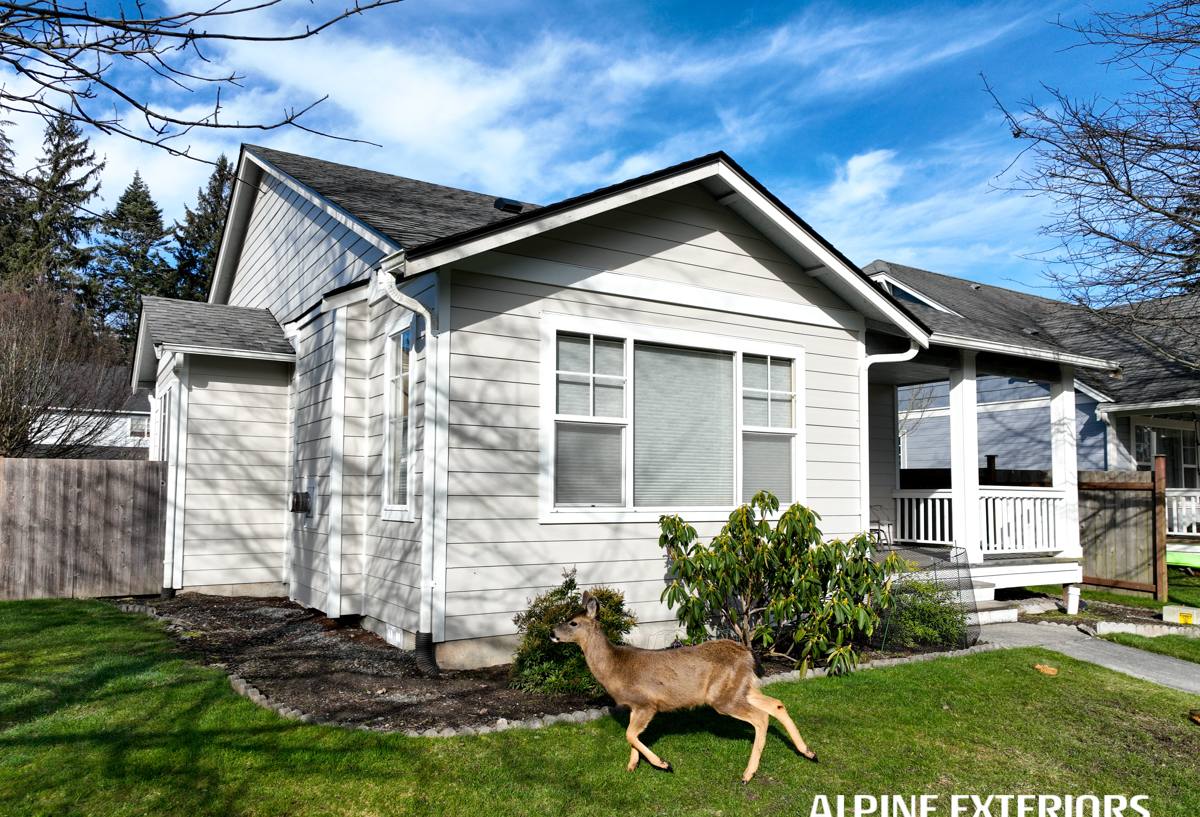
What We See on Cordata Homes
Every neighborhood has its own mix of housing stock, but across Cordata and the surrounding Bellingham-area communities we consistently run into the same handful of issues when we're called out for an inspection or estimate:
- Moss and algae staining on shaded siding, especially under eaves and on north- or east-facing walls
- Paint failure and visible wood grain telegraphing through on older wood or engineered wood siding
- Soft or delaminating panels where caulking has failed at seams and butt joints
- Trim and window casings that have absorbed moisture at end cuts and corners
- Vinyl siding that's warped, faded, or pulled away from fastening points after years of temperature cycling
None of this is unusual for the region — it's just what happens when a product isn't matched to the climate, or when installation shortcuts leave water a way in. It's also entirely preventable with the right material and the right details at every seam, corner, and penetration.
Why We Install Only James Hardie Fiber Cement
We made a decision as a company to install one siding system: James Hardie fiber cement. We don't offer LP SmartSide, vinyl, Cemplank, Allura, or primed wood as alternatives, even though all of those products have a place in the market and plenty of installers who stand behind them. Our reasoning is specific to what we see holding up — and what we see failing — in Whatcom County's climate:
Moisture Behavior
Fiber cement is made from cement, sand, and cellulose fibers. It doesn't absorb and swell the way wood-based products can, and it doesn't have the thermal expansion and contraction range that causes vinyl to buckle or pull loose over time. In a climate defined by sustained dampness rather than dry heat, that stability matters more than almost any other spec on the sheet.
Factory-Applied Finish
James Hardie's ColorPlus finish is baked on in a controlled factory environment, not brushed or sprayed on-site. That means better adhesion, more consistent coverage, and a finish that's engineered to resist the fading and cracking that field-applied paint struggles with after a few Northwest winters.
Non-Combustible Material
Fiber cement doesn't burn. That's a genuine safety advantage over wood-based and some engineered wood siding products, and it's increasingly reflected in insurance considerations for homeowners in Washington.
Climate-Engineered Product Lines
James Hardie makes region-specific HZ (HardieZone) products, engineered for different moisture and temperature profiles across the country. That's a level of climate-matching that generic fiber cement or one-size-fits-all siding lines don't offer.
We're not saying every other product is a bad product in every application. We're saying that after years of doing exterior work in this specific climate, this is the one system we're willing to put our name behind — and the one we believe holds up the way homeowners expect a 15- or 20-year siding investment to hold up.
More Than Siding: The Whole Exterior Envelope
Siding doesn't work in isolation. Water that gets past a roof edge, a window flashing detail, or a deck ledger board ends up in the same wall cavity siding is supposed to protect. That's why we handle roofing, windows, and decks alongside siding rather than treating them as separate trades:
- Roofing — the first line of defense against the driving rain this region is known for; roof-wall intersections and flashing are frequent failure points
- Windows — proper flashing and integration with the siding plane is where a huge share of hidden water intrusion actually originates
- Decks — ledger board attachment and flashing against the house wall is one of the most commonly overlooked moisture entry points on Northwest homes
- Siding — the visible, weather-facing skin that ties it all together
When one crew is responsible for how these systems meet — rather than four separate contractors each assuming someone else handled the transition — the details that actually keep water out get the attention they need.
Why a Local Crew Matters for Cordata Homes
| Factor | Local Whatcom County Crew | Out-of-Area / Traveling Crew |
|---|---|---|
| Familiarity with regional moisture patterns | Built into daily practice | Often generic, one-size-fits-all approach |
| Warranty follow-up | Based nearby, reachable for years | May have moved on by the time issues surface |
| Permitting and local code knowledge | Established relationships and familiarity | Learning curve on each new region |
| Material lead times | Established supplier relationships | Variable |
| Accountability if something goes wrong | Reputation is local and long-term | Limited local exposure |
Siding is a long-term investment, and the value of a warranty or a workmanship guarantee depends entirely on whether the contractor who wrote it is still around — and still local — when you need them. That's a real consideration for any homeowner comparing bids.
What Correct Installation Actually Involves
James Hardie siding performs the way it's rated to perform only when it's installed to the manufacturer's specifications. Skipping details doesn't show up on day one — it shows up in year six or seven, as moisture finds its way behind panels that were never sealed correctly. The details that matter most in a climate like ours:
- Correct water-resistive barrier and rain-screen or drainage plane behind the siding
- Proper fastener type, spacing, and placement per Hardie's installation guide
- Correct gaps and sealant at butt joints, corners, and penetrations
- Flashing integration at every window, door, and roof-wall intersection
- Clearance from grade, decks, patios, and roof lines to keep siding out of standing water and splash-back
These aren't optional upgrades — they're the difference between siding that lasts the decades it's designed for and siding that needs premature repair. Installation quality, more than the brand on the box, is usually what separates a good outcome from a disappointing one.
What Affects Cost on a Cordata Project
| Factor | Why It Matters |
|---|---|
| Home size and wall complexity | More corners, dormers, and transitions mean more labor and material detail work |
| Existing siding removal | Tear-off and disposal of old material adds time versus a straightforward re-side |
| Underlying sheathing condition | Rot or water damage found during removal may need repair before new siding goes on |
| Siding profile and color | Lap width, shingle-style panels, and custom ColorPlus finishes vary in material cost |
| Trim, fascia, and soffit scope | A full exterior refresh costs more than siding alone but avoids mismatched materials later |
| Access and site conditions | Steep lots, mature landscaping, or tight setbacks affect staging and labor time |
We give straightforward, itemized estimates rather than vague lump-sum numbers, so homeowners can see exactly what they're paying for and why.
A Homeowner's Checklist Before Committing to a Siding Project
- Ask what siding material is being proposed, and why it was chosen for this climate specifically
- Ask whether the contractor removes old siding to inspect sheathing, or sides over existing material
- Confirm whether roof, window, and deck flashing details are part of the scope or left to other trades
- Get the manufacturer warranty terms in writing, not just a verbal summary
- Ask how long the company has operated in Whatcom County, and how workmanship issues get handled after the job is done
- Compare bids on scope and detail, not just the bottom-line number
A siding project is one of the more consequential exterior decisions a homeowner in this region will make. The right questions up front save a lot of frustration later.
Ready When You Are
If you're weighing a siding, roofing, window, or deck project for a Cordata home, we're happy to take a look and walk through what we're seeing and what we'd recommend — no pressure, no obligation. Whatcom County's climate is tough on exteriors, but a well-built James Hardie installation, done right the first time, is built to handle exactly what this weather throws at it. Reach out for a free estimate using the form below.