 Sudden Valley
 Siding in Sunnyland: A Neighborhood That Tests Every Exterior Product
Sunnyland sits in the kind of Whatcom County microclimate that separates good siding jobs from bad ones within a handful of years. Close enough to Bellingham Bay to catch salt-laden air, shaded by mature trees that hold moisture against exterior walls, and squarely in the path of the driving, wind-pushed rain that defines a Pacific Northwest winter, homes here don't get the luxury of a forgiving building envelope. Whatever goes on the walls has to handle damp for months at a stretch, resist a moss and algae season that can run from October well into spring, and do it all without babying from the homeowner every summer.
We're a Sudden Valley-based exterior contractor working throughout Whatcom County, and Sunnyland is one of the areas where we see the clearest evidence of what different siding materials actually do over time — not in a brochure, but on real houses a few miles from our own shop. That's a big part of why we standardized on James Hardie fiber cement siding and stopped installing vinyl, LP SmartSide, primed wood, and other engineered wood or composite products. This page walks through what Sunnyland's climate does to a house, how our siding process works, and why the material choice matters as much as the installation crew.
What the Local Climate Actually Does to a House
Salt Air and Metal Fasteners
Proximity to Bellingham Bay means airborne salt is a real factor for Sunnyland exteriors, even a few miles inland. Salt air accelerates corrosion on exposed fasteners, flashing, and any metal trim components. It also interacts with certain paint and coating systems, causing chalking and premature fading faster than the same product would experience further from the water. Siding systems need to be paired with corrosion-resistant fasteners and flashing details that account for this, not generic hardware pulled off a shelf.
Driving Rain and Wind-Driven Moisture
Whatcom County storms rarely fall straight down. Wind pushes rain sideways into wall assemblies, which puts real pressure on seams, laps, and butt joints — the places where water intrusion actually starts. A siding product's water-resistance rating on paper matters less than how it behaves at the joints after fifteen winters of that kind of weather.
The Long Moss Season
Shaded lots, tree cover, and consistent moisture mean moss and algae aren't a once-a-year nuisance here — they're a standing condition for much of the year on north-facing walls and anywhere airflow is limited. Some siding materials resist this better than others simply because of how they're manufactured and finished; others develop a chalky or porous surface over time that gives moss and mildew something to grip.
Why We Install Only James Hardie Fiber Cement
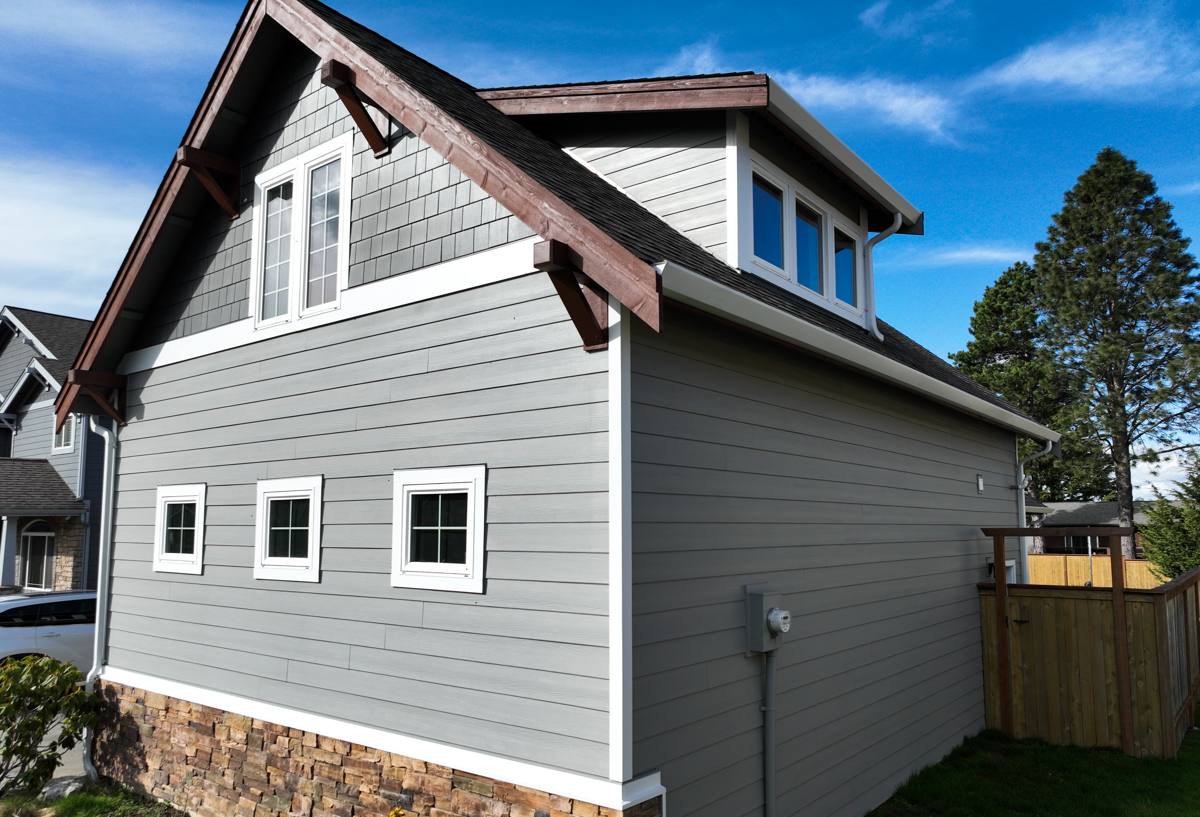
Fiber cement is cement, sand, and cellulose fiber, engineered and cured into planks and panels. It doesn't absorb water the way wood-based products can, it doesn't expand and contract with humidity the way vinyl does, and it's non-combustible — a genuine advantage in a region where wildfire smoke and drought summers have become more common even on the wet side of the state. James Hardie's HZ5 product line is specifically engineered for climates like ours: freeze-thaw cycles, sustained damp, and coastal exposure.
We used to install a broader range of products. We stopped installing LP SmartSide, vinyl siding, Cemplank, Allura, and primed wood or cedar siding because we kept getting called back to the same types of problems — moisture intrusion at seams, coating failure, warping, or moss and mildew that no amount of homeowner maintenance seemed to keep ahead of, especially on shaded, damp lots exactly like the ones common in Sunnyland. That's not a knock on every homeowner who has one of those products; plenty of installations hold up fine for years. It's a statement about which product gives us the best odds of a siding job that still looks and performs correctly in twenty years, on this specific coastline, without asking the homeowner to fight the climate every summer.
ColorPlus Factory Finish
Most of our Hardie installations use the ColorPlus finish — a factory-applied, baked-on coating that's more UV- and moisture-resistant than field-applied paint, and that comes with its own finish warranty separate from the substrate warranty. In a neighborhood dealing with salt air and long damp stretches, a factory finish that doesn't rely on perfect field conditions during application is a real advantage.
Our Services in Sunnyland
We work as a full exterior contractor, not a siding-only outfit, which matters because siding, roofing, windows, and decks all interact at the same weak points — flashing, transitions, and water paths. Treating them separately is how gaps get missed.
- Siding: James Hardie lap, shingle, and panel systems, including full tear-off and re-side, moisture-damage repair, and trim work
- Roofing: Roof replacement and repair, with attention to how roof-to-wall flashing ties into new siding
- Windows: Replacement windows installed with proper flashing integration so the window opening doesn't become the next leak point after new siding goes on
- Decks: Deck construction and repair built for the same wet-climate durability standard we apply to siding
On a lot of Sunnyland homes, especially older ones, siding replacement surfaces problems in the roofline, window flashing, or deck ledger connections that were hidden behind the old cladding. Having one crew that can address all of it means fewer subcontractor handoffs and fewer chances for something to fall between two companies' scopes of work.
How a Sunnyland Siding Project Typically Goes
- On-site assessment: We look at existing siding condition, moisture damage, trim, and how the house's flashing details are currently handled
- Product and color selection: Walking through Hardie's HZ5 lines and ColorPlus color options against the home's exposure and the neighborhood's general character
- Tear-off and inspection: Removing old siding reveals the sheathing and framing underneath — this is where hidden rot or moisture damage gets caught before it's covered up again
- Weather barrier and flashing: Proper house wrap, window and door flashing, and kick-out flashing at roof intersections, all installed to manufacturer spec
- Hardie installation: Correct fastener spacing, gapping, and caulking per James Hardie's published installation guidelines, which is what keeps the manufacturer warranty valid
- Final walkthrough: Trim, caulking, and touch-up review before we call the job done
Comparing Siding Options for a Coastal, Shaded Climate
| Factor | James Hardie Fiber Cement | Vinyl | LP SmartSide / Wood-Based |
|---|---|---|---|
| Moisture behavior | Does not absorb water; dimensionally stable | Can warp/buckle with heat cycling; seams are leak points | Wood fiber substrate can swell or delaminate if moisture reaches raw edges |
| Salt air exposure | Engineered for coastal/HZ5 conditions | Can chalk and fade faster near salt air | Coating and edge sealing become critical maintenance points |
| Moss/algae resistance | Factory finish resists surface buildup better over time | Prone to algae staining, especially in shade | Porous cut edges and coating wear invite growth |
| Fire rating | Non-combustible | Combustible, can melt/deform near heat | Combustible |
| Typical warranty structure | Long transferable warranty on product + separate finish warranty | Varies widely by manufacturer/grade | Varies; often shorter or with stricter maintenance conditions |
What It Costs, and What Drives the Number
| Cost Factor | Why It Matters |
|---|---|
| Home size and wall complexity | More corners, dormers, and trim detail mean more labor and cut waste |
| Existing siding removal | Full tear-off costs more than installing over acceptable existing sheathing, but reveals hidden damage |
| Hidden repairs | Rot or moisture damage found during tear-off adds cost but prevents covering up a bigger future problem |
| Product line and profile | Lap, shingle-style, and panel Hardie products carry different material and labor costs |
| Trim and flashing scope | Window, door, and roofline flashing detail work is where quality separates from cost-cutting |
We don't quote a job without seeing the house. Broad ranges from a website are close to meaningless once tear-off reveals actual wall condition — an honest estimate comes from an in-person look.
Maintaining Hardie Siding in a Damp, Shaded Climate
- Rinse siding annually to clear pollen, dust, and early moss growth before it sets in
- Keep gutters clear so overflow doesn't run down wall sections repeatedly
- Trim back vegetation and tree limbs that keep siding shaded and damp
- Inspect caulking at trim and window joints yearly and re-caulk as needed
- Address any impact damage or chipped finish promptly so moisture can't get behind the panel
Why a Local Crew Matters Here
A crew that works Whatcom County year-round knows what a Sunnyland winter actually does to an exterior — not from a spec sheet, but from callbacks and warranty visits on real houses in this climate. That shows up in small decisions during installation: how tight to run caulking joints given our humidity, which flashing details actually hold up against wind-driven rain off the bay, and where to add extra attention on shaded, north-facing walls where moss pressure is highest. Being based in Sudden Valley means we're not driving in from out of the area for warranty work either — if something needs a look years down the road, we're close by.
If you're weighing a siding, roofing, window, or deck project in Sunnyland, we're happy to walk the property, explain what we're seeing, and lay out honest options — including why we'd recommend James Hardie for your specific exposure. Reach out for a free, no-pressure estimate using the form below.