 Sudden Valley
 The Real Question Sudden Valley Homeowners Are Asking
Almost every siding conversation in Sudden Valley eventually comes down to the same choice: vinyl or fiber cement. Both products are sold by contractors throughout Whatcom County, both come with warranties, and both can look decent on a sales brochure. But a brochure doesn't have to survive a Pacific Northwest winter pressed up against your walls. Homes here deal with driving rain off the water, long stretches of damp, shaded weather that grow moss on anything that holds moisture, and salt-laden air that works its way inland more than people expect. That combination is harder on exterior materials than most homeowners realize until they've lived with a siding choice for ten or fifteen years.
This page lays out how vinyl and James Hardie fiber cement actually perform under those conditions — not marketing claims, but the practical differences that show up over time. We only install James Hardie products, and we want to explain why in plain terms rather than just asserting it.
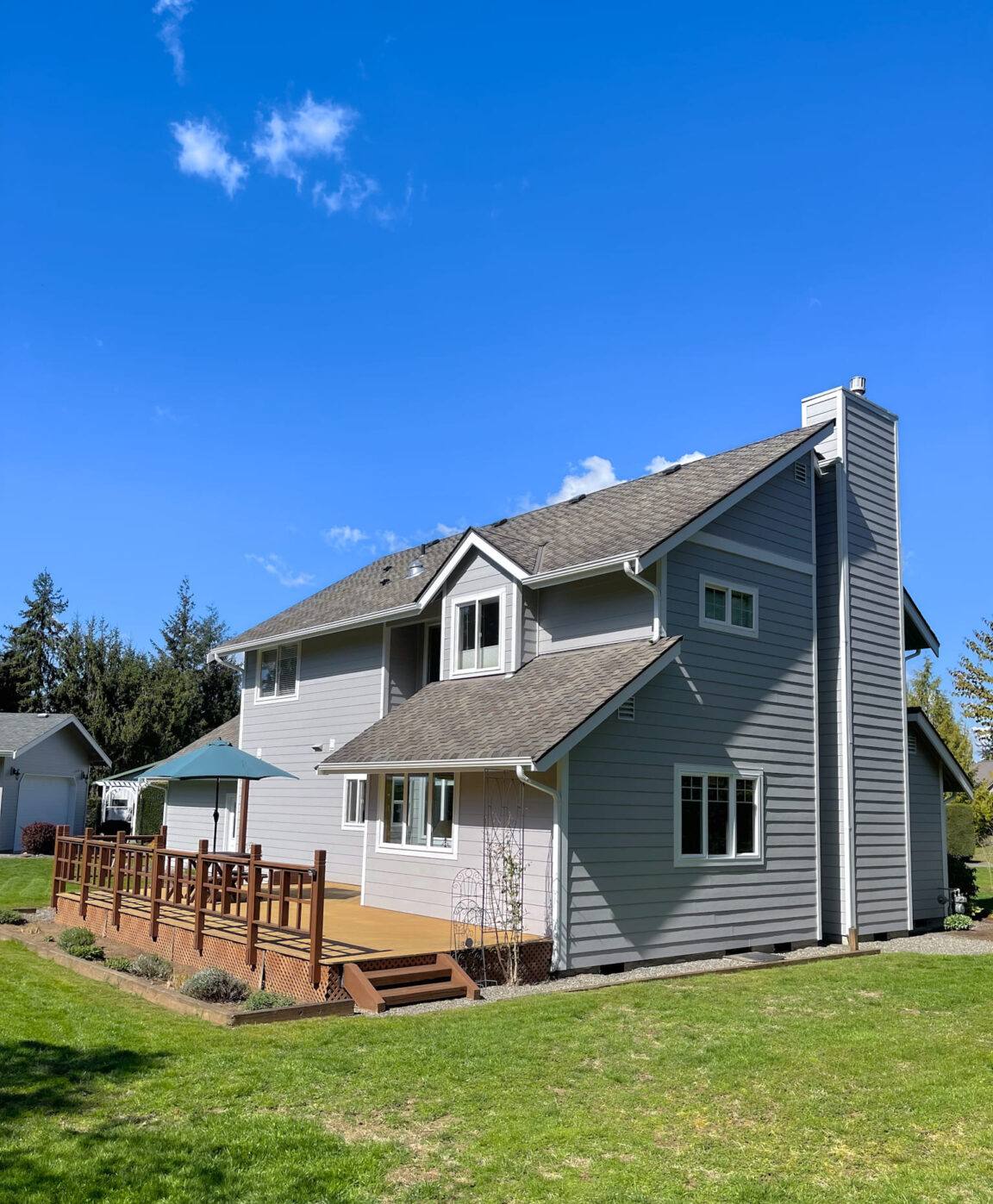
How Vinyl Siding Performs in This Climate
What Vinyl Gets Right
Vinyl siding earned its popularity honestly. It's lightweight, relatively inexpensive to purchase, and doesn't need to be painted. For a homeowner on a tight budget who needs to cover a wall quickly, vinyl is a reasonable, functional product. It sheds water reasonably well when installed correctly, and modern formulations resist fading better than older vinyl from decades past.
Where It Struggles Here
The problems with vinyl in this region aren't about the material failing outright — they're about how it ages under sustained damp and temperature swings. Vinyl is a thin plastic product that expands and contracts with temperature, and it's installed with a hanging, overlapping method that relies on gaps and slip joints to accommodate that movement. Over years of driving rain and wind exposure common around Lake Whatcom and the surrounding hills, those joints can loosen, panels can rattle or bow, and moisture can work behind the panels where it has little chance to dry out in our long wet season. Vinyl also softens and can crack in sustained cold snaps, and it's vulnerable to impact damage that's expensive to color-match years later since manufacturers change their color runs. None of this means vinyl is a bad product everywhere — it just means it's a compromise-heavy choice in a climate that punishes compromises.
How James Hardie Fiber Cement Compares
Material Composition
James Hardie siding is made from cement, sand, and cellulose fiber, pressed and cured into dense, rigid boards. It doesn't expand and contract with temperature the way vinyl or wood does, it doesn't soften in heat, and it holds a screw or nail line far more securely over time. Because it's a rigid board product rather than a hung, floating panel, a correctly installed Hardie wall behaves more like armor than like cladding — it doesn't rattle, warp, or telegraph every gust off the lake.
The HardieZone System
James Hardie engineers its products by climate zone rather than selling one universal board everywhere in the country. Western Washington falls into their HZ5 zone, which accounts for our combination of sustained moisture, moderate freeze-thaw cycling, and coastal-influenced weather patterns. The HZ5 formulation is engineered for that moisture exposure specifically, rather than being a generic product stretched to fit every region in the country.
Side-by-Side: Vinyl vs. James Hardie
| Factor | Vinyl Siding | James Hardie Fiber Cement |
|---|---|---|
| Core material | PVC plastic | Cement, sand, cellulose fiber |
| Rigidity | Flexes, hangs on a track system | Rigid board, fastened directly |
| Moisture behavior | Sheds water on face; can trap moisture behind panels | Engineered for HZ5 moisture exposure; resists moss/mildew growth |
| Fire performance | Combustible plastic | Non-combustible |
| Color/finish | Color molded through; fades over time, fewer refinishing options | ColorPlus factory finish, baked-on, field-repaintable later |
| Cold/impact durability | Can crack in hard cold snaps or impacts | Resists cracking from cold; more impact-resistant |
| Typical warranty structure | Prorated after early years, often non-transferable | Long-term, transferable limited warranty on the substrate |
| Upfront material cost | Lower | Higher |
Moss, Moisture, and Salt Air: The Whatcom County Factor
Sudden Valley's setting is beautiful and it's also demanding on building materials. Shaded elevations near the tree line stay damp for extended stretches, which is exactly the environment moss and mildew favor. Vinyl's overlapping panel design creates small ledges and channels where organic growth can take hold, especially on north-facing walls that don't get much direct sun to dry them out. Fiber cement has a denser, less hospitable surface for that kind of growth, and the factory ColorPlus finish resists the kind of surface staining that makes moss and mildew more visible over time.
Salt-laden air moving in off the water is a slower, quieter problem. It doesn't announce itself the way a leak does — it just steadily works on fasteners, seams, and any exposed edges over years. Materials and fastening systems engineered with that kind of long-term moisture and salt exposure in mind hold up noticeably better than products designed for a drier, more uniform climate.
Fire Resistance and Wind Exposure
Wildfire risk in Whatcom County isn't the same conversation as in drier parts of the state, but insurance underwriting and building codes increasingly weight non-combustible materials favorably regardless of region, and it's a factor worth knowing about regardless of your fire risk exposure. James Hardie siding is non-combustible by composition. Vinyl, being a petroleum-based plastic, is combustible and can soften or deform under heat exposure that wouldn't affect a fiber cement board.
Wind is the more everyday concern here. Storms moving through the county can produce sustained gusts, and a rigid, mechanically fastened board resists wind-driven rain intrusion and panel lift better than a hung panel system relying on interlocking edges.
Cost Over the Life of the Siding
Comparing sticker price alone misses the point. Vinyl costs less to purchase and install initially, but homeowners often end up dealing with panel replacement after impact damage, fading that makes color-matching difficult, or moisture issues behind the wall that aren't visible until they've caused damage to sheathing. James Hardie costs more upfront, but the rigid board construction, factory finish, and climate-engineered formulation are built to reduce those long-term maintenance and repair costs. When you weigh purchase price against expected maintenance, repainting or refinishing cycles, and how each material tends to hold up over quarter-century timeframes, the total cost picture narrows considerably — and often favors fiber cement once you own the home long enough to see the difference.
Installation Sensitivity — Why the Installer Matters as Much as the Product
Both products can underperform badly if installed poorly, but they fail in different ways. Vinyl installed too tight (without allowing for expansion) will buckle; installed too loose, it rattles and lets water behind it. Fiber cement has its own installation requirements — proper fastener spacing, correct clearances from grade and roofing, sealed joints where the manufacturer specifies, and factory-primed cut edges. Getting Hardie installation wrong doesn't just look bad, it can void the manufacturer's warranty and let moisture into places it's expensive to fix later.
Here's a short checklist worth using when you're evaluating any siding quote, regardless of which contractor you're talking to:
- Ask whether the crew is factory-trained and how many Hardie installations they've completed locally
- Confirm they follow manufacturer-specified fastener type, spacing, and clearance requirements
- Ask how cut edges and joints will be sealed and primed
- Get the warranty terms in writing — both the manufacturer's and the installer's workmanship warranty
- Ask how they handle moisture management behind the siding, not just the visible finish
What We Install and Why
We install James Hardie exclusively — not LP SmartSide, not vinyl, not Cemplank or Allura, not primed spruce or cedar. That's a deliberate standard, not a default. After years of seeing how different products hold up in this specific climate, fiber cement engineered for our moisture zone, backed by a factory finish and a strong transferable warranty, is what we're willing to stand behind on a home in Sudden Valley. We install Hardie's ColorPlus finish boards in the lines and colors suited to each home, following the manufacturer's installation specifications so the warranty stays intact and the wall performs the way it's engineered to.
If you're weighing a siding replacement and want a straight answer about what will actually hold up on your specific home, we're happy to take a look and walk you through it. Reach out for a free, no-pressure estimate — there's no obligation, and we'll tell you honestly what we see.