 Sudden Valley
 What Bellingham's Climate Does to a House
Homes in and around Bellingham sit in a genuinely tough spot for exterior materials. You've got proximity to salt water pushing airborne salt onto siding and trim, long stretches of driving, wind-blown rain coming off the Sound, and a wet season that runs far longer than most of the country ever deals with. Add in the shade from mature evergreens that never really dries out, and you get conditions that are close to ideal for moss, algae, and mildew growth on anything with the wrong surface or the wrong installation behind it.
None of this is exotic knowledge to anyone who's lived in Whatcom County for a while. But it matters enormously when you're choosing what to put on the outside of your house, because the materials that perform fine in a drier climate can struggle here. Salt air accelerates corrosion on fasteners and hardware. Sustained moisture pressure finds every gap in flashing and caulking. And moss doesn't just look bad — it holds water against a wall system and can work its way into seams over time.
Why This Isn't Just "More of the Same" Weather
A lot of siding products are engineered and tested against general Pacific Northwest rain totals, but the combination of coastal salt exposure and shaded, slow-drying lots that's common around Bellingham is a narrower and harder problem. It's the reason we pay close attention to product lines that are specifically engineered for high-moisture, marine-influenced regions rather than a generic "rain-resistant" rating.
Why a Local Crew Matters More Than People Think
Anyone can drive a nail gun. What actually protects a house is understanding how water moves across a wall in this specific climate, and building the flashing, drainage plane, and joint details to match. A crew that works in Whatcom County day in and day out has already seen what happens when a house is under-flashed at the window heads, when butt joints aren't properly sealed and gapped, or when siding is installed too close to grade and wicks moisture from splashback.
That local pattern recognition is worth more than any brochure. It's the difference between a crew that installs siding by the book everywhere they go, and one that installs it correctly for a wall that will spend a third of the year under damp, low-light, slow-drying conditions.
Our Services in the Bellingham Area
We handle the full building envelope, not just one piece of it, because on an older or weather-worn home, siding problems are rarely isolated:
- Siding replacement and repair — full re-siding projects and targeted repairs where moisture or impact damage has taken a toll
- Roofing — because a compromised roof and failed flashing details are one of the most common hidden causes of siding damage below them
- Windows — window replacement done with proper flashing integration into the surrounding wall assembly, not just a swap of the sash
- Decks — built and finished to hold up to the same rain and moss exposure that affects the rest of the exterior
Treating these as one connected system is important. A new roof with poor kickout flashing will rot the siding beneath it within a few seasons. A deck ledger board attached without proper flashing can rot the wall it's attached to. We look at the whole envelope, not just the piece you called about.
Why We Install Only James Hardie Fiber Cement
We made a deliberate decision as a company to install James Hardie fiber cement siding exclusively — not vinyl, not LP SmartSide, not Cemplank or Allura, not primed spruce or cedar lap. That's a real trade-off we're upfront about, and it's worth explaining honestly rather than just asserting it.
What the Alternatives Get Right
Vinyl is inexpensive and low-maintenance in dry climates. Engineered wood products like LP SmartSide have a warmer look and are lighter to install. Cedar has genuine aesthetic appeal that some homeowners specifically want. None of these are bad products in the abstract — they're just not what we choose to stand behind on homes in a climate like this one.
Where They Fall Short Here
Vinyl expands and contracts with temperature swings and can warp or crack under impact, and it's not a fire-resistant material. Wood-based products, even engineered ones with resin treatments, remain organic material at their core — moisture intrusion at a compromised seam or fastener point can lead to swelling and rot, and that risk compounds in a climate as consistently damp as ours. Cedar is beautiful when new but demands a maintenance schedule (staining, sealing, inspection) that most homeowners underestimate, and it's especially vulnerable to the moss and mildew growth that's common on shaded Bellingham lots.
Why Hardie
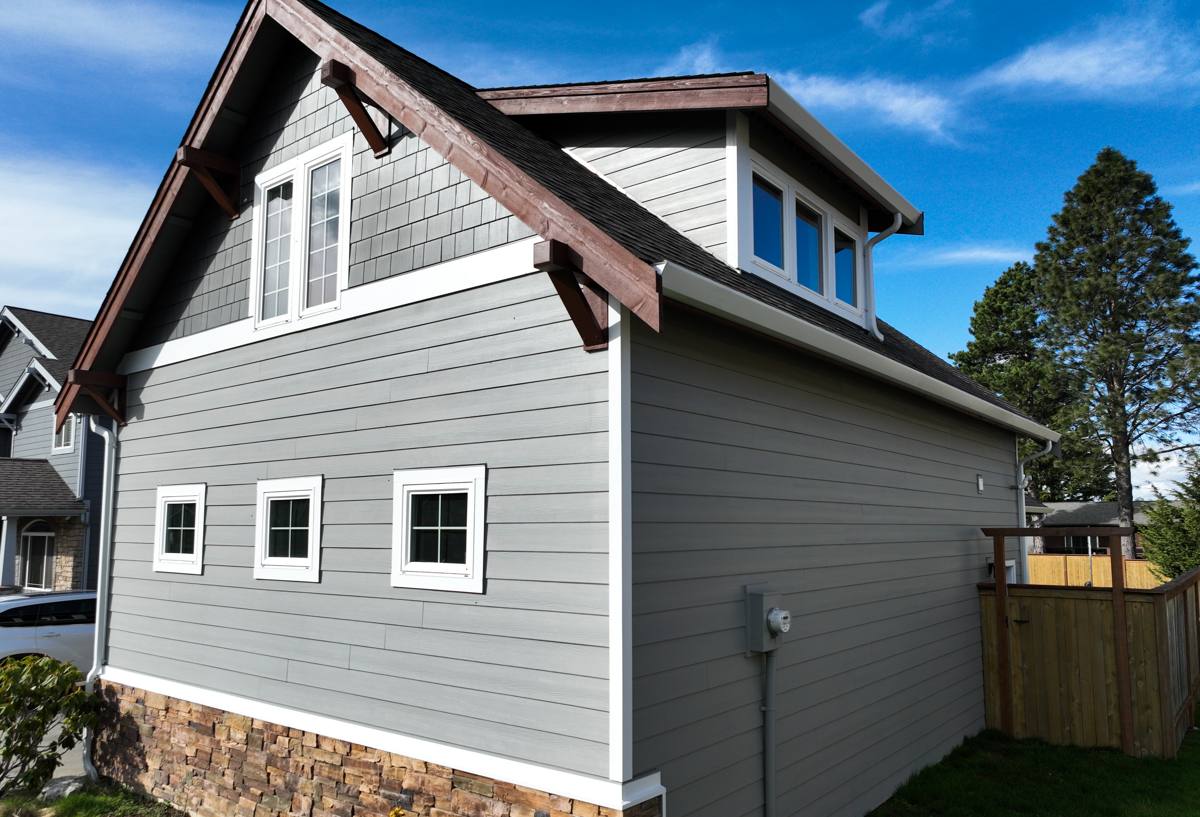
James Hardie fiber cement is non-combustible, doesn't rot or support insect damage the way wood-based products can, and holds its shape and finish under the freeze-thaw and constant-damp cycles typical here. The ColorPlus factory finish is baked on and warrantied against fading and peeling, which removes the recurring repaint cycle that wood and some engineered products require. Hardie's HZ5 product line in particular is engineered for climates with more moisture exposure, which lines up directly with what a Bellingham exterior actually experiences.
We're not going to tell you another product is garbage — that's not honest, and it's not our call to make about someone else's home. What we will say is that after years of doing this work in this specific climate, Hardie is the product we're willing to put our name behind and back with a real installation warranty.
What Correct Installation Actually Involves
Fiber cement siding is only as good as the installation behind it. Hardie's own specifications call for particular gaps, fastener patterns, and clearances that are easy to shortcut and hard to notice once the wall is closed up.
| Detail | Why it matters in this climate |
|---|---|
| Proper weather-resistive barrier and flashing integration | Directs the inevitable moisture behind the siding back out instead of trapping it against the sheathing |
| Correct ground clearance | Reduces splashback moisture and soil contact, both common on landscaped lots with heavy rain |
| Sealed and gapped butt joints | Prevents water from wicking into panel ends, a common failure point in wet climates |
| Proper fastener type and placement | Corrosion-resistant fasteners matter more near salt air exposure and in constant damp conditions |
| Kickout flashing at roof-wall intersections | One of the most common sources of hidden rot when omitted or installed wrong |
We follow Hardie's published fastening and clearance specs as a baseline, not a suggestion, because deviating from them is exactly how a good product ends up with a bad reputation on a specific job.
Living With Moss and Wet-Season Buildup
Even the right siding still needs some basic homeowner attention in a climate that grows moss on driveways, roofs, and fences. A few habits go a long way toward keeping an exterior looking good and performing well:
- Keep gutters clear so overflow doesn't run down the face of the siding
- Trim back vegetation and tree limbs that keep a wall section shaded and slow to dry
- Rinse siding periodically to remove pollen, moss spores, and organic buildup before it takes hold
- Have caulking and sealant joints inspected every couple of years, since UV and moisture cycling break them down over time
- Address roof and flashing issues promptly — siding damage often starts as a roofing problem
What to Look for When Hiring an Exterior Contractor
Whatcom County has plenty of contractors, and not all of them specialize in exterior envelope work in this specific climate. Some things worth checking before you hire anyone:
- Manufacturer certification or documented training on the specific siding product being installed
- Willingness to explain flashing and moisture-management details, not just color and style options
- Proper licensing, bonding, and insurance in Washington State
- A written installation warranty separate from the manufacturer's material warranty
- References or completed local work you can actually go look at
A contractor who can't explain how they're managing water at your windows, roof lines, and ground clearance is a contractor who hasn't thought carefully about a climate like this one.
Cost Factors to Expect
| Factor | How it affects the project |
|---|---|
| Home size and wall complexity | More corners, dormers, and roof intersections mean more flashing detail and labor time |
| Existing siding removal and any rot repair | Hidden sheathing damage is common on older homes with a history of moisture intrusion |
| Siding profile and finish selection | Lap width, panel vs. plank systems, and trim details affect material cost |
| Access and site conditions | Steep lots, limited access, or heavy vegetation can add time and equipment needs |
| Scope beyond siding | Combining roofing, window, or deck work can create efficiencies but adds to overall project cost |
Every home is different, and the only way to get real numbers is a walkthrough of your specific house and its condition.
Let's Take a Look at Your Home
If you're in the Bellingham area and dealing with aging siding, moss buildup, water staining, or you're simply planning ahead for a home that can handle what this climate throws at it year after year, we're happy to come take a look. We'll give you a straightforward, no-pressure estimate and an honest read on what your exterior actually needs — request one using the form below.