 Sudden Valley
 Exterior Work Built for Fairhaven's Coastal Conditions
Fairhaven sits close to the water, and that proximity to Bellingham Bay shapes everything about how a home's exterior ages here. Homes in this part of Whatcom County deal with a combination most inland neighborhoods don't have to think about as much: salt-laden air off the bay, wind-driven rain that hits siding at an angle instead of falling straight down, and a moss season that can stretch for the better part of the year on shaded or north-facing walls. We work on homes throughout Sudden Valley and the surrounding Whatcom County area, and Fairhaven's mix of older housing stock and newer infill construction gives us a good cross-section of what holds up out here and what doesn't.
This page covers how we approach siding, roofing, windows, and decks for homes in and around Fairhaven, and why we standardized on one siding product rather than offering the usual lineup of options.
What the Coastal Climate Actually Does to a House
Salt Air and Corrosion
Salt air doesn't just affect boats and railings. Airborne salt settles on exterior surfaces, on fasteners, on trim, and on anything metal that isn't rated for a marine environment. Over years, that accelerates corrosion on lower-grade hardware and can contribute to premature failure at joints, fastener heads, and flashing details — the places where water intrusion tends to start.
Driving Rain
Whatcom County gets a lot of rain, but the rain that matters most for siding performance is the wind-driven kind that comes off the water sideways rather than straight down. That kind of rain finds its way into lap joints, butt seams, and poorly sealed penetrations that would stay dry in a calmer climate. It's one of the main reasons installation quality matters as much as the product itself — a good product installed with sloppy flashing and gaps will still let water in.
Moss and Shade
Between tree cover and the number of overcast, damp days in a typical Whatcom County year, moss and algae growth on north-facing and shaded walls is a near-constant maintenance issue for a lot of siding materials. Some materials resist it better than others, and the finish on top of the material matters just as much as the base material itself.
Siding: Why We Only Install James Hardie
We install James Hardie fiber cement siding exclusively. We don't install vinyl, LP SmartSide, Cemplank, Allura, primed spruce, or cedar. That's not a marketing position — it's a decision we made after years of seeing how different siding materials actually perform on homes exposed to a lot of moisture and salt air, and we think homeowners deserve a straight explanation of why.
Vinyl
Vinyl is inexpensive and low-maintenance in a general sense, but it's a thin plastic product that expands and contracts significantly with temperature swings, can crack in impacts, and tends to fade or chalk over time under UV exposure. In a coastal, wind-exposed setting, vinyl's looser fit system and lap joints are also more prone to water getting behind the panels than a properly caulked and flashed fiber cement installation.
LP SmartSide, Cemplank, and Allura
LP SmartSide is an engineered wood product — it performs reasonably well when maintained but is fundamentally a wood-based substrate, which means edge swelling and moisture sensitivity are real long-term risks in a wet climate, especially at cut ends and seams if caulking isn't kept up. Cemplank and Allura are both fiber cement products like James Hardie, and they're not bad materials in a vacuum — but we've standardized on one system so our crews have deep, repeated expertise with one set of installation specs, one warranty structure, and one finish system, rather than spreading that expertise thin across several product lines with different quirks.
Primed Spruce and Cedar
Solid wood siding has real aesthetic appeal, and cedar in particular has a long track record in the Pacific Northwest. But both primed spruce and cedar require an ongoing maintenance commitment — periodic refinishing, caulking, and inspection — that most homeowners underestimate when they choose it. In a moss-prone, damp climate like Whatcom County's, untreated or under-maintained wood siding is also more susceptible to rot and moisture damage at end grain and fastener penetrations than fiber cement.
Why James Hardie
James Hardie fiber cement is non-combustible, dimensionally stable across our temperature and humidity swings, and comes with a factory-applied ColorPlus finish that holds color far better than field-applied paint over the long run. Hardie also engineers specific product lines (their HZ5 line, for example) for regions with more moisture exposure, which fits a coastal Whatcom County application well. The backed warranty on both the substrate and the finish is transferable, which matters to homeowners thinking about resale. None of that means Hardie is maintenance-free — it still needs to be installed to spec, with correct flashing, clearances, and caulking — but it gives us one system we can install consistently well and stand behind.
Roofing for a Wet, Wind-Exposed Neighborhood
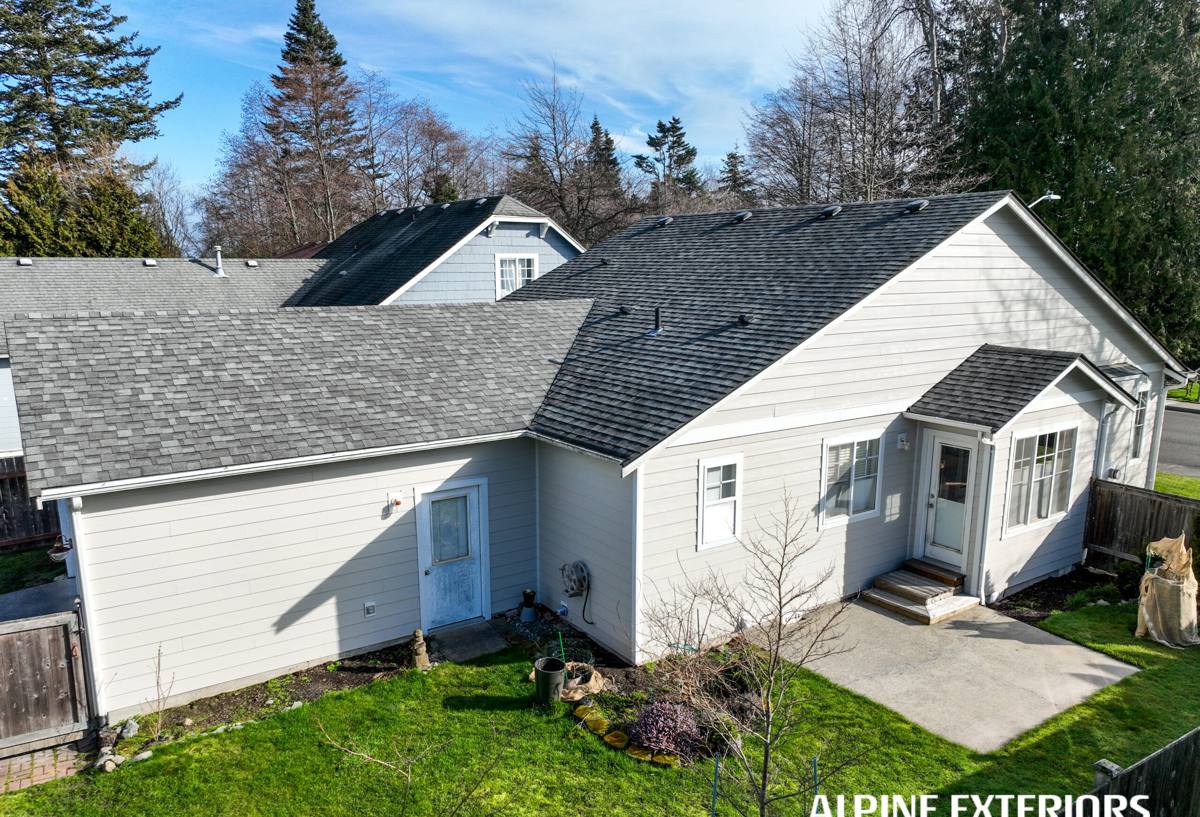
Roofs in Fairhaven take a beating from the same conditions that affect siding — driving rain, wind off the bay, and moss that establishes itself quickly on north-facing and shaded roof planes. Roof moss isn't just cosmetic; left alone, it holds moisture against roofing material and can work its way under shingle edges and around flashing, shortening the life of the roof. Regular moss treatment and clear valleys and gutters matter more here than in a drier inland climate. We handle roof repair and full roof replacement, and we pay close attention to flashing details around chimneys, vents, and valleys, since that's where most leaks in this climate actually originate.
Windows: Sealing Out Wind-Driven Moisture
Older windows in coastal homes are a common source of drafts and slow water intrusion, especially where seals have degraded or where original flashing wasn't detailed for the amount of wind-driven rain this area sees. When we replace windows, we're not just swapping glass — we're re-flashing the opening correctly so the window integrates with the surrounding siding as a single water-management system. A new window installed with poor flashing can still leak; the installation detail matters as much as the window unit itself.
Decks: Built to Handle Moisture and Shade
Decks in a damp, moss-prone climate face two main enemies: standing moisture where boards don't drain or dry properly, and slippery moss or algae buildup on shaded surfaces. Materials, board spacing, and structural details that promote airflow underneath the deck all affect how well it holds up and how much upkeep it needs. We build and repair decks with those conditions in mind rather than defaulting to whatever spec works fine in a drier region.
Why a Local Crew Matters
A crew that works Whatcom County regularly knows which details actually matter here — where flashing tends to fail, which wall orientations need extra attention for moss, and how to sequence work around the region's rain patterns so materials aren't compromised mid-installation. That local, repeated experience is different from a crew that installs siding in a dozen different climates and applies the same generic approach everywhere.
Cost Factors for Exterior Projects in This Area
| Factor | Why It Matters Here |
|---|---|
| Home exposure (wind/water side) | Walls facing the bay or prevailing wind need more attention to flashing and sealant detail |
| Existing moisture damage | Rot or hidden water damage behind old siding adds repair scope before new siding goes on |
| Roof and gutter condition | Poor drainage above siding accelerates staining and moss growth below |
| Shade and tree cover | Heavily shaded walls need more moss-resistant detailing and may need more frequent maintenance |
| Scope (siding only vs. siding + trim + flashing) | Full envelope work costs more upfront but reduces future water-intrusion risk |
What to Check Before Hiring Anyone for Exterior Work
- Confirm the contractor is licensed and insured in Washington State
- Ask specifically how they detail flashing around windows, doors, and roof-to-wall transitions
- Ask what siding, roofing, and decking materials they actually install — and why
- Get a clear, written scope of work, not just a price
- Ask how they handle moss and moisture-prone areas of the home specifically
- Confirm whether warranties are manufacturer-backed, installer-backed, or both
Get a Free, No-Pressure Estimate
If you're dealing with aging siding, a roof that's showing its age, drafty windows, or a deck that's seen better days, we're happy to take a look and give you an honest assessment — no pressure, no obligation. Use the form below to request a free estimate for your Fairhaven-area home.