 Sudden Valley
 What Sehome's Climate Does to a Wall
Homes in and around Sehome sit inside the same weather pattern that shapes the rest of Whatcom County: damp air pushing in off Bellingham Bay, long stretches of driving rain through fall and winter, and shaded, moisture-holding conditions that keep moss and algae active for most of the year. None of that is unusual for this part of Washington — but it is hard on exterior siding, and it punishes the wrong material or a sloppy install faster than most homeowners expect.
Salt-tinged marine air accelerates corrosion on exposed fasteners and metal trim. Wind-driven rain doesn't just fall straight down — it gets pushed sideways into laps, seams, and butt joints, which is exactly where cheap installation shows up first as staining, swelling, or rot. And the long wet season means anything organic on a wall — wood fiber, cellulose-based trim, untreated cut edges — gets a running start on moss and mildew growth that a drier climate would never allow. A siding system for this neighborhood has to be built for all three problems at once, not just one of them.
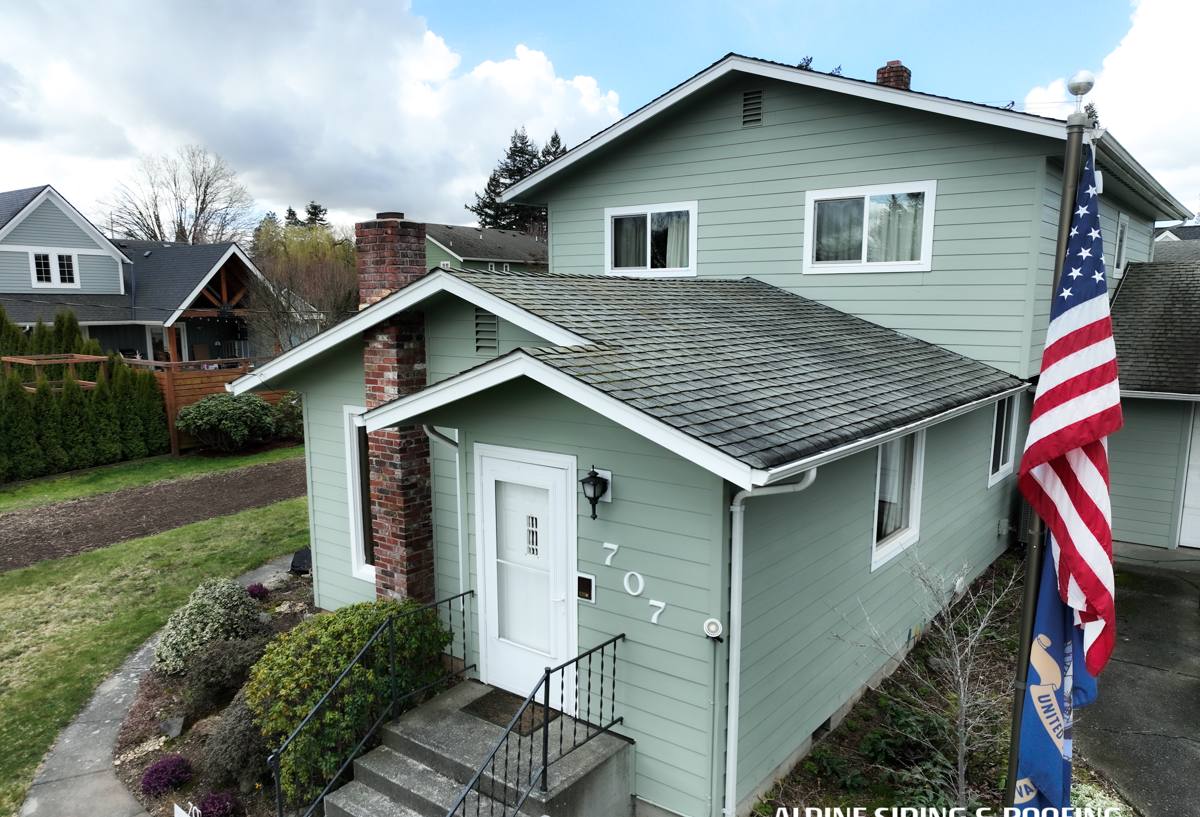
Why We Install James Hardie and Nothing Else
We standardized on James Hardie fiber cement siding because it's engineered around exactly the conditions Sehome deals with. It's non-combustible, dimensionally stable across wet-dry cycles, and doesn't rely on paint alone to keep water out — the board itself is a cement-based composite that doesn't rot, swell, or feed mold the way wood-based products can.
The ColorPlus Factory Finish
Most Hardie siding we install carries the ColorPlus finish — a baked-on, multi-coat color applied at the factory under controlled conditions, not brushed or sprayed on site. In a climate where field-applied paint is fighting rain and humidity before it even cures, a factory finish is a real advantage: better adhesion, more consistent coverage, and a longer stretch before repainting becomes a conversation.
HZ5 Engineered for This Region
James Hardie makes climate-specific product lines, and the HZ5 line is built for regions with freeze-thaw cycles and sustained moisture exposure — which describes Whatcom County well. It's formulated to resist moisture-related damage better than the HZ product lines designed for milder, drier climates. Specifying the right HZ line isn't a cosmetic choice — it's the difference between siding that's actually matched to this weather and siding that technically fits but wasn't built for it.
Comparing Siding Materials for a Sehome Home
Homeowners researching siding usually run into the same short list of materials. Here's how they stack up against the conditions this neighborhood actually deals with:
| Material | Moisture Behavior | Salt Air / Coastal Exposure | Moss & Algae Resistance | Long-Term Maintenance |
|---|---|---|---|---|
| James Hardie fiber cement | Dimensionally stable, doesn't swell or rot | Holds up well; factory finish resists fading and chalking | Doesn't feed organic growth like wood fiber does | Occasional wash and repaint of caulk lines over decades |
| Vinyl | Can warp or buckle with heat/cold cycling; seams trap water | Can fade and become brittle over time | Vulnerable to buildup in shaded, damp areas | Low upfront upkeep, but limited repair options once damaged |
| Primed spruce or cedar | Absorbs moisture; prone to swelling, cupping, rot at joints | Cut edges and end grain are especially vulnerable | Wood fiber is an active food source for moss and mildew | Regular repainting and caulk maintenance required |
| LP SmartSide (engineered wood) | Better than raw wood, but still wood-fiber based; edge sealing is critical | Reasonable, if installation details are followed exactly | Still more susceptible than a cement-based board | Ongoing attention to caulking, touch-ups, and edge seals |
Every one of these products has legitimate uses somewhere. We don't install vinyl, LP SmartSide, primed spruce, or cedar on the homes we work on — not because they're worthless products, but because we've made a professional call that in this specific climate, fiber cement gives homeowners a better long-term outcome with fewer moisture-related surprises. That's the whole reason we standardized on one product line instead of offering several.
What a Correct Installation Actually Requires Here
Hardie siding is only as good as the installation behind it. In a wet climate like this one, a handful of details separate a wall that performs for decades from one that develops problems in five to eight years.
Drainage Gap Behind the Siding
A rain screen or drainage gap between the siding and the water-resistive barrier lets any moisture that gets past the cladding drain and dry out instead of sitting against the wall assembly. This matters more here than in drier regions, because Sehome's siding spends a much larger share of the year wet.
Flashing and Clearances
Every window, door, and roof-to-wall transition needs flashing detailed to shed water outward, not into the wall cavity. Siding also needs proper clearance above grade, decks, and roof lines — skipping that clearance is one of the most common causes of rot at the bottom courses, and it's invisible until the damage is already done.
Fastening, Gaps, and Caulk Joints
James Hardie publishes specific fastener patterns, gap tolerances at butt joints, and caulking requirements for a reason — get them wrong and you create entry points for wind-driven rain, which this area gets plenty of. Butt joints in particular need to be caulked or flashed per spec, not just butted tight and hoped for.
- Drainage gap or rain screen installed behind the cladding, not siding fastened directly to the barrier
- Flashing at every window, door, and roof-to-wall intersection
- Minimum clearance maintained above grade, decks, patios, and roofing
- Fasteners driven to manufacturer spec — not overdriven, not underdriven
- Butt joints and penetrations properly sealed or flashed, not just butted and caulked over
- Factory-cut edges used wherever possible; field-cut edges primed and sealed
Moss, Algae, and the Long Wet Season
Whatcom County's moss season isn't a minor annoyance — on shaded walls and north-facing elevations, it can be close to year-round. Moss and algae themselves don't destroy fiber cement the way they can degrade wood, but they do trap moisture against the surface and, over time, that constant damp layer stresses caulk joints and trim. Good design choices — adequate roof overhangs, proper grading away from the foundation, and keeping vegetation trimmed back from walls — do more to control moss than any siding material alone. Fiber cement's advantage is that it isn't feeding the growth the way wood fiber does, and a factory finish resists staining better than field-applied paint, so periodic washing keeps walls looking clean instead of fighting a losing battle.
Our Process, Start to Finish
We walk every job the same way, whether it's a full re-side or a section replacement:
- On-site assessment. We look at the existing siding, sheathing condition, flashing details, and any signs of past moisture intrusion before quoting anything.
- Product and line selection. We spec the right Hardie profile and HZ line for the home's exposure — a shaded, moss-prone north wall and a wind-exposed south wall aren't always treated identically.
- Prep and moisture barrier work. Damaged sheathing gets addressed, the water-resistive barrier and drainage gap go in correctly, and flashing gets detailed before a single board goes up.
- Installation to manufacturer spec. Fastener patterns, gaps, and clearances are followed exactly — not approximated.
- Final walk-through. We go over the finished work with the homeowner and cover care and warranty registration.
Signs Your Current Siding Is Already Losing the Fight
A lot of homeowners call us after noticing something small that turns out to point at a bigger moisture problem. Worth checking for:
- Soft or spongy spots when you press on siding near the bottom courses or under windows
- Persistent dark staining or streaking that comes back soon after cleaning
- Paint that's peeling, bubbling, or chalking faster than it used to
- Visible gaps opening up at butt joints or trim corners
- Moss or algae that seems to be thickening rather than washing off
- Any siding sitting close to grade, decking, or roofing with little to no clearance
Any one of these on its own isn't necessarily an emergency, but they're worth a professional look before the underlying sheathing is affected.
Why It Matters That We Already Work This Neighborhood
A crew that's already familiar with the wind exposure, moss patterns, and typical home construction around Sehome and Sudden Valley isn't guessing at how a wall assembly will hold up here — they've seen how it plays out over multiple wet seasons. That familiarity shows up in the small decisions: which elevations get extra flashing attention, where moss buildup tends to concentrate, and how local wind-driven rain actually behaves against a wall, versus how a generic installation manual assumes it will. Combined with a single-product focus on James Hardie, it means every recommendation on your home is based on what we've actually seen work in this specific climate, not a one-size-fits-all national script.
If you're weighing a siding project in Sehome or anywhere around Sudden Valley, we're happy to take a look and give you a straightforward, no-pressure estimate — use the form below to get started.