 Sudden Valley
 Siding Repair Built for Geneva's Lake Whatcom Microclimate
Geneva sits close to the water on Lake Whatcom, and that proximity shapes everything about how siding ages here. Homes get a steady dose of moisture off the lake, shade from mature evergreens, and long stretches of the year where surfaces simply don't dry out fast. If you've noticed soft spots near the bottom courses of your siding, dark streaking under the eaves, or paint that's failing years earlier than it should, that's not bad luck — it's the local climate doing what it does to siding that wasn't built for it, or wasn't installed quite right the first time.
We work throughout Sudden Valley and the Geneva area regularly, which matters more than it sounds. Siding repair isn't a one-size-fits-all trade — a crew that mostly works dry inland neighborhoods approaches a repair differently than one that understands what a lakeside, tree-shaded lot does to wall assemblies over time. Knowing the pattern of failure before we even pull the first board saves time and saves you from paying twice for the same fix.
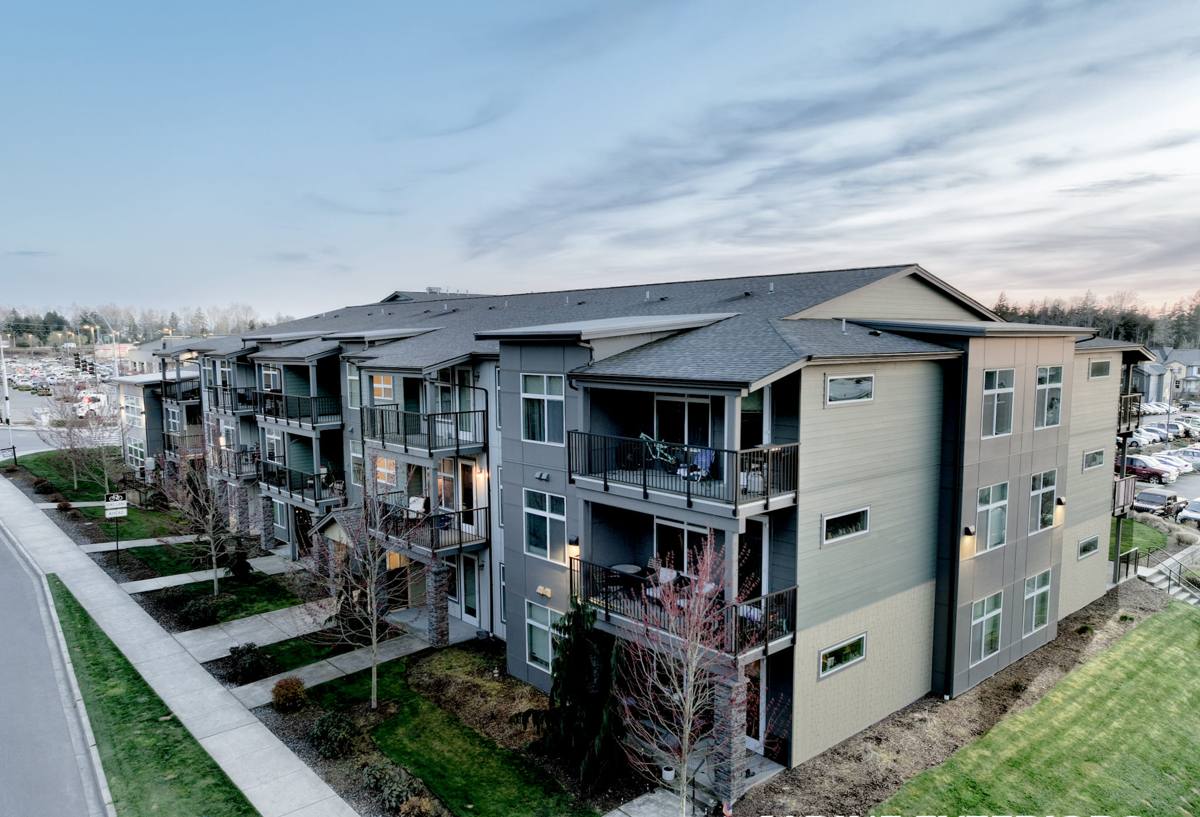
Why Siding Fails Faster Near Geneva
Moisture That Doesn't Get a Break
Whatcom County gets a lot of rain in a normal year, but the driving rain that comes off the lake during fall and winter storms hits Geneva-area homes at an angle that pushes water into laps, seams, and butt joints that face the water or open exposure. Add tree cover that keeps walls shaded and slow to dry, and you get siding that stays damp longer than the manufacturer ever accounted for.
A Long Moss and Algae Season
Where sun exposure is limited and humidity is high, moss and algae don't just grow on roofs — they colonize siding too, especially on north-facing walls and under overhangs. Moss holds moisture directly against the siding surface, which accelerates rot in wood-based products and can degrade paint film on almost anything if it's left to sit season after season.
Salt Air and Coastal Influence
While Sudden Valley isn't right on saltwater, the broader Whatcom County air carries enough marine influence to matter for fasteners, flashing, and trim metal. Corroding nail heads and rusting flashing show up as rust streaks bleeding through paint or siding that's failed right at a fastener line — a telltale sign the repair needs to address the hardware, not just the surface.
What "Correct" Siding Repair Actually Involves
A lot of siding repair in this region is done as a patch: cut out the bad piece, nail in a new piece, caulk the edges, paint over it. That approach almost always fails again within a couple of years in a spot like Geneva, because it doesn't address why the damage happened in the first place. A repair that's going to last needs to look past the visible damage.
- Remove enough surrounding material to find the actual extent of moisture intrusion — rot and delamination usually travel farther than what's visible from outside
- Inspect the water-resistive barrier (house wrap) and flashing behind the damaged siding, and repair or replace anything compromised
- Check and correct the drainage plane so water has a path out from behind the siding instead of getting trapped
- Replace fasteners with corrosion-resistant hardware rated for the exposure
- Match the replacement material's profile, reveal, and finish so the repair doesn't stand out or create a new water trap
- Re-seal and re-caulk only where the manufacturer's install spec calls for it — over-caulking traps moisture just as badly as leaving gaps
Skipping the barrier and flashing check is the single most common reason siding repairs fail early. The new siding can look perfect for a season or two while the same underlying moisture path keeps working behind it.
Signs a Geneva Home Needs Siding Repair Now
| What You See | Likely Cause | Urgency |
|---|---|---|
| Soft or spongy siding near the bottom courses | Trapped moisture, rot starting behind the board | High — spreads if untreated |
| Dark streaking or green film on north-facing walls | Moss/algae growth holding moisture against the surface | Moderate — treat before it reaches the substrate |
| Paint peeling in sheets rather than fading evenly | Moisture pushing out from behind the siding | High — indicates active water intrusion |
| Rust streaks running from fastener points | Corroding nails or trim hardware | Moderate — worsens with each wet season |
| Visible gaps or warping at butt joints and corners | Movement, poor original installation, or swelling | Moderate to high depending on exposure |
| Cracking or splitting on wood-based siding | Expansion/contraction cycling and moisture absorption | High — cracks are an open door for water |
Repair vs. Replacement: Making the Right Call
Not every damaged wall needs a full re-side, and we're not going to tell you it does. The decision usually comes down to how widespread the damage is and what's causing it.
Repair Usually Makes Sense When:
- Damage is isolated to one or two walls or a specific section, like an area under a leaking gutter
- The underlying sheathing and framing are still sound once opened up
- The rest of the siding is holding up well and simply needs the compromised section addressed
Replacement Should Be on the Table When:
- Rot or moisture damage shows up in multiple areas, suggesting a systemic problem with the original installation or material
- The siding is an older wood-based or vinyl product nearing the end of its practical service life
- Repeated repairs to the same areas haven't held
We'll tell you honestly which category your home falls into. A homeowner who only needs a repair shouldn't be sold a full re-side, and one whose siding is failing in five different places shouldn't keep throwing money at patches.
Why Product Choice Matters for the Repair Itself
What your home is currently sided with affects how a repair holds up going forward, especially in an environment like Geneva's. Wood-based products like primed spruce or cedar are the most vulnerable to the moss-and-moisture cycle described above — they absorb water directly, and once rot sets in, it tends to keep going even after a patch. Vinyl siding doesn't rot the same way, but it becomes brittle and can crack from age and UV exposure, and it doesn't take a clean, matched repair patch as well as a factory-finished product does.
This is part of why we install James Hardie fiber cement exclusively rather than offering LP SmartSide, vinyl, Cemplank, Allura, primed spruce, or cedar. Hardie's fiber cement doesn't absorb moisture the way wood-based products do, it's non-combustible, and its ColorPlus factory finish holds color and resists the kind of paint failure that shows up so often on older siding in shaded, damp lots. When we do a repair on a Hardie-sided home, the replacement material matches the existing product's profile and finish precisely, because it's the same manufacturer system — not a close approximation from a different brand.
If your current siding is a wood-based or vinyl product and the damage is more than isolated, that's often the right moment to have a real conversation about switching to Hardie during the repair or a partial re-side, rather than continuing to patch a product that's structurally working against the local climate.
How Our Repair Process Works
- On-site assessment: We inspect the damaged area and probe surrounding sections to see how far the underlying issue actually extends, not just what's visible.
- Honest scope and estimate: You get a clear explanation of what's causing the damage, what needs to happen to fix it correctly, and a straightforward cost range — no pressure toward a bigger job than you need.
- Removal and inspection: We pull the damaged siding and check the house wrap, flashing, and sheathing underneath before anything new goes back up.
- Barrier and flashing repair: Any compromised moisture barrier or flashing gets corrected first — this is the step that determines whether the repair actually lasts.
- Matched material installation: New siding is installed to match the existing reveal, profile, and finish, fastened with corrosion-resistant hardware.
- Final check: We walk the repair with you before we consider the job done.
Why Hiring a Crew That Already Works Geneva Matters
Sudden Valley and the Geneva area have a specific set of conditions — lake-driven moisture, tree shade, and a long moss season — that a crew unfamiliar with the neighborhood may not anticipate. We've done repair and installation work throughout this part of Whatcom County, so we already know which walls tend to take the worst of the weather, where moss builds up fastest, and what a correctly sealed, correctly flashed repair needs to look like to survive a full wet season here. That local pattern recognition is often the difference between a repair that lasts and one you're calling someone back for in two years.
A quote and inspection cost nothing. If you're seeing soft spots, streaking, peeling paint, or moss buildup on your siding, we're happy to take a look, tell you honestly what's going on, and lay out your options — no pressure toward a bigger job than the one you actually need. Reach out for a free, no-obligation estimate using the form below.