 Sudden Valley
 Siding Replacement in Edgemoor: A Different Job Than an Inland Whatcom County Home
Edgemoor sits above Bellingham Bay, and that position changes what a siding replacement actually needs to accomplish. A home a few miles inland deals with Whatcom County's normal wet-season rainfall and shoulder-season storms. A home on or near the Edgemoor bluff deals with all of that plus salt-laden marine air moving in off the water and wind-driven rain that can hit a wall sideways rather than falling straight down. Add in the shade and moisture retention that comes with mature tree cover on many Edgemoor lots, and you've got a wall assembly that's under more sustained stress than most siding products, and most installation shortcuts, are built to handle.
This page is specifically about siding replacement — not touch-up repair, not a repaint, but pulling old siding off down to the sheathing and starting over correctly. That's a bigger decision than a repair, and it's worth understanding what your home is actually up against before you commit to a material or a crew.
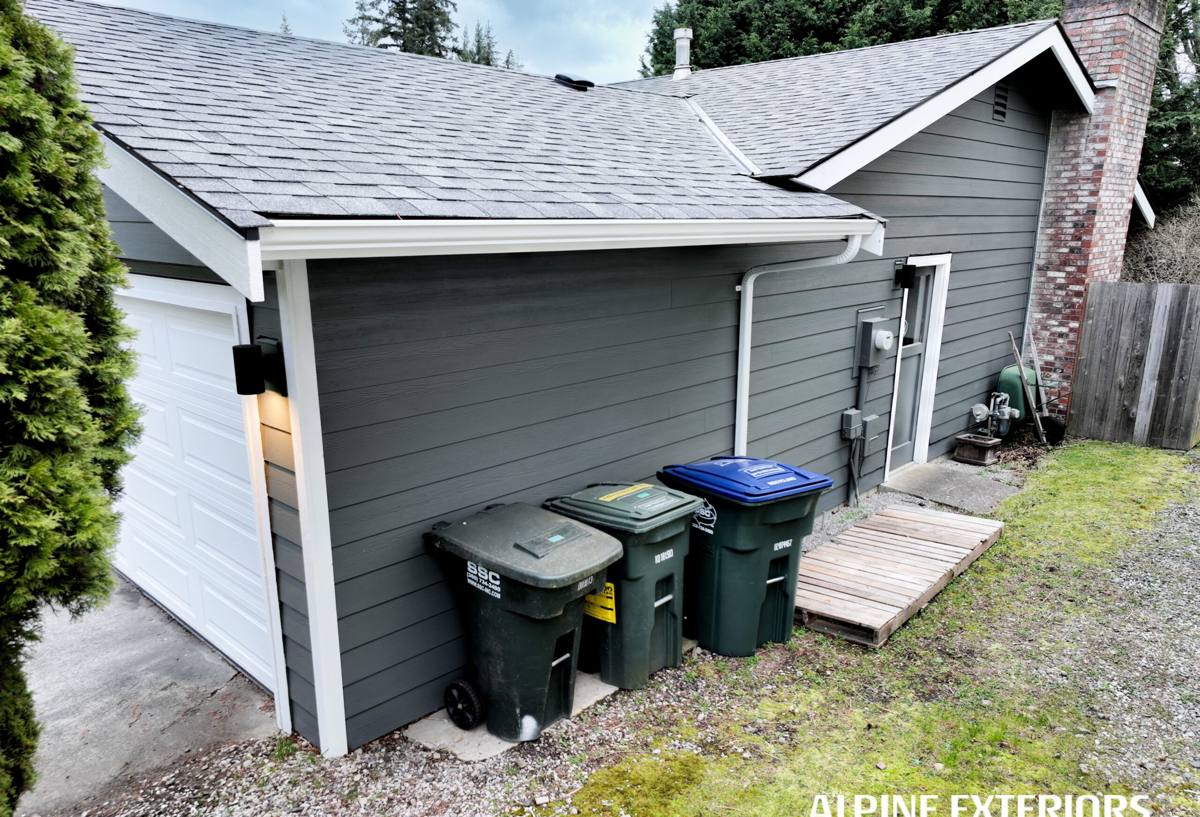
What Salt Air, Driving Rain, and a Long Moss Season Do to Edgemoor Siding
Salt Air and Fastener Corrosion
Homes close to Bellingham Bay are exposed to airborne salt that standard-grade fasteners, flashing, and trim hardware weren't built to sit in year after year. Corrosion here doesn't always show up as visible rust on the siding face first — it often starts at fastener heads and hidden flashing, working loose or failing well before the siding material itself would otherwise need attention. A replacement that doesn't upgrade fastener and flashing hardware for a marine environment is solving half the problem.
Wind-Driven Rain Off the Bay
Rain that comes in at an angle finds every gap a straight-down rain never would. Window and door flashing, siding laps, and butt joints all take more direct water pressure on an exposed Edgemoor elevation than they would on a sheltered inland wall. Over time, siding and flashing details that were installed to a minimum standard rather than a correct one let water track behind the wall, and that damage is invisible until it's significant.
A Long Moss and Mildew Season
Whatcom County's wet, mild climate keeps moss and mildew active for most of the year, and shaded, tree-covered sections of Edgemoor properties hold moisture even longer between storms. Porous or moisture-absorbing siding materials pick up growth and staining faster in that environment, and it tends to come back quickly after a simple cleaning if the underlying material and drainage detailing haven't changed.
Repair, Recoat, or Full Replacement? Knowing Which One Your Home Needs
Not every aging or damaged siding job needs a full tear-off. Isolated damage — a cracked board, a small area of impact damage, failed caulk at one or two joints — can sometimes be repaired without replacing the whole wall. But when the underlying material or the original installation is the problem, patching just delays a bigger cost and lets hidden water damage keep spreading behind the wall. Signs that point toward full replacement rather than a repair:
- Siding that's soft, spongy, or crumbles when pressed, especially near the bottom courses or below windows
- Visible cupping, warping, or buckling across multiple boards, not just one isolated spot
- Paint or finish that keeps failing within a year or two of repainting, no matter how well the prep work was done
- Moss or mildew staining that returns within months of cleaning, particularly on shaded or bay-facing walls
- Bubbling, peeling, or dark staining on interior walls or trim near exterior corners after heavy rain
- Rust streaking from fastener heads or corroded trim and flashing visible at joints and corners
- A home with the original siding still on it after 20-plus years, especially if it's never had a full tear-off inspection
If more than one or two of these show up, or if they're spread across multiple elevations, a full replacement is almost always the more honest recommendation than another round of patching.
How Different Siding Materials Hold Up to Edgemoor's Exposure
Material choice matters more here than it would on a sheltered, inland lot, because salt air and driving rain expose every weakness in a product faster than a milder environment would.
| Material | Behavior in Salt Air and Driving Rain | Typical Long-Term Outcome on a Bay-Facing Lot |
|---|---|---|
| Vinyl siding | Can warp or distort with temperature swings; seams and laps offer limited resistance to wind-driven rain | Shorter effective lifespan on exposed elevations; fading and brittleness accelerate near salt air |
| Cedar / primed wood | Attractive but the wood fiber absorbs moisture readily; finish needs frequent renewal in this climate | Ongoing repainting and caulking cycle; rot risk rises if maintenance lapses even briefly |
| LP SmartSide / engineered wood | Wood-fiber core is sensitive to moisture at cut edges, joints, and fastener penetrations | Edge and joint swelling can develop over time if water reaches the core, especially on exposed walls |
| James Hardie fiber cement | Non-combustible, dimensionally stable core; factory-applied finish resists the fading and chalking marine air accelerates in field-applied paint | Low ongoing maintenance and consistent performance across shaded and exposed elevations alike |
This is the comparison that led us to standardize on one product rather than offer several. A material that performs well in a mild, sheltered climate can still fall short on a bay-facing Edgemoor wall, and we'd rather install one system we trust completely than offer a cheaper option that shifts long-term maintenance risk back onto the homeowner.
Why We Replace Failing Siding with James Hardie — Not a Cheaper Alternative
We install James Hardie fiber cement exclusively. We don't install LP SmartSide, vinyl, Cemplank, Allura, primed spruce, or cedar. Each of those products has a legitimate place in the market and plenty of satisfied owners elsewhere, but on a property exposed to salt air and driving rain, we've made a professional call to stand behind one system rather than sell a lower-cost option we don't fully trust in this environment.
HZ5 and the ColorPlus Finish
Hardie's HZ5 formulation is engineered for regions with heavy moisture exposure and freeze-thaw cycling, which fits Whatcom County's coastal, wet-winter climate well. The ColorPlus finish is baked on at the factory under controlled conditions rather than applied on site, which matters directly for a marine environment — field-applied paint tends to fail faster when it's fighting salt air and constant dampness, while a factory finish holds its color and seal far longer under the same conditions.
What Correct Installation Requires
Fiber cement only performs to spec when it's installed to Hardie's published requirements — correct fastener type and spacing, proper clearance from grade and roof lines, a drainage or rain-screen gap behind the panels, and properly sequenced, sealed flashing at every window, door, and penetration. On an exposed Edgemoor wall, a well-made material installed loosely will still develop moisture problems. The material and the installation have to both be right; neither one covers for the other.
What a Full Siding Replacement Involves, Start to Finish
A correct replacement isn't just pulling off old boards and nailing up new ones. On a coastal, moisture-exposed property, each of these steps is where quality actually gets decided:
- Full tear-off to the sheathing — removing old siding and trim entirely rather than covering over it, so the wall underneath can actually be seen and evaluated.
- Sheathing and framing inspection — checking for rot, delamination, or water-damaged framing that's been developing behind the old siding, sometimes for years, and repairing anything compromised before new material goes on.
- New water-resistive barrier and drainage plane — installing a correct WRB and rain-screen gap so any moisture that does get past the siding face has a clear path to drain and dry rather than sitting against the wall.
- Flashing at every penetration — windows, doors, roof-to-wall transitions, and any other penetration get flashed and sequenced correctly, which matters more on a wind-driven-rain elevation than almost anything else in the job.
- Corrosion-resistant fastening — hardware rated for the salt exposure this location actually sees, not standard-grade fasteners chosen to save a small amount on materials.
- Siding installation to manufacturer spec — correct spacing, fastener placement, and joint treatment so the warranty is actually valid and the assembly performs as engineered.
- Trim, caulking, and finish detail — the corner boards, window trim, and color-matched sealant work that makes a job look finished and keeps water out of the small gaps that get overlooked on a rushed job.
Our Process for an Edgemoor Siding Replacement
We start with an in-person walkthrough of the home, not a phone estimate — a bay-facing wall, a shaded north side, and a sheltered elevation on the same house can all need different treatment, and that's not something you can price accurately from a photo. We look at the current siding condition, check for visible signs of moisture damage, and talk through what we expect to find once the old material comes off.
Once a project starts, we do a full tear-off, inspect and repair the sheathing and framing as needed, and build the wall assembly back up correctly — WRB, drainage gap, flashing, then siding. We build a contingency conversation into the estimate up front rather than surprising you with a change order mid-project, because on an older Edgemoor home, finding some degree of hidden moisture damage behind failing siding is common, not rare. Weather matters too — siding needs reasonably dry conditions to install correctly, and we plan around Whatcom County's wetter stretches rather than rushing a job into a rain window.
Why Hiring a Crew That Already Works Edgemoor Matters
A contractor who mostly works drier, inland, sheltered properties can still do competent work, but they haven't necessarily built the habit of treating fastener corrosion, wind-driven rain flashing, and drainage detailing as standard practice rather than optional upgrades. Working this stretch of the Whatcom County coastline regularly means those details aren't an afterthought added because a homeowner asked — they're built into how the job gets bid and built from the start. That's the difference between a crew that's replaced siding on a handful of bay-facing homes and one for whom it's routine.
Keeping New Siding Performing Through Edgemoor's Moss Season
Even the right material installed correctly benefits from basic upkeep in this climate. A soft wash to clear moss and mildew buildup on shaded walls once a year or so, keeping gutters and downspouts clear so water isn't sheeting down the siding face, and trimming back vegetation that keeps a wall section shaded and damp all help new siding hold its finish and stay maintenance-light for the long run. Hardie's factory finish and non-porous core make that upkeep far lighter than it would be with a wood-based or wood-fiber product, but "low maintenance" isn't "no maintenance," especially a short walk from the water.
If your Edgemoor home is showing signs of failing siding, or you just want an honest read on whether you're looking at repair or full replacement, we're happy to walk the property with you and explain exactly what we see — no pressure, no obligation. Reach out below for a free estimate.