 Sudden Valley
 Roofing in Silver Beach: What the Local Climate Actually Demands
Silver Beach and the surrounding Sudden Valley area sit under heavy tree canopy, close to water, and squarely inside Whatcom County's wet, marine-influenced weather pattern. That combination is hard on a roof in ways that don't show up on a spec sheet. Shaded lots stay damp longer after a rain than open ones. Moisture-laden air moving in off Bellingham Bay pushes driving rain and wind up against roof slopes for months at a stretch. And the long, mild moss season here means a roof can be growing organic material for most of the year, not just a few weeks in late fall.
None of that means asphalt shingles are the wrong choice for this neighborhood — they're still one of the most practical, cost-effective roofing systems available, and they perform well here when they're installed and maintained with this specific climate in mind. The problem is when a roof gets installed the same way it would be in a dry, sunny part of the state. That's when you see premature granule loss, moss working its way under shingle tabs, and soft spots developing at valleys and eaves years before they should.
Moss, Shade, and Standing Moisture
A shaded roof dries slower. Slower drying means algae and moss have more time to establish, and once moss takes hold it lifts shingle edges, traps water underneath, and accelerates wear on the mat below the granules. On a Silver Beach lot with mature trees close to the house, this isn't an occasional maintenance item — it's a recurring condition the roof has to be built to handle.
Driving Rain and Wind-Driven Water
Rain here doesn't always fall straight down. Wind off the water can drive it sideways under shingle tabs, into valleys, and around flashing details that would be fine in calmer weather. That's why the underlayment and flashing work matter as much as the shingle brand itself — water intrusion almost always starts at a transition point, not in the middle of an open shingle field.
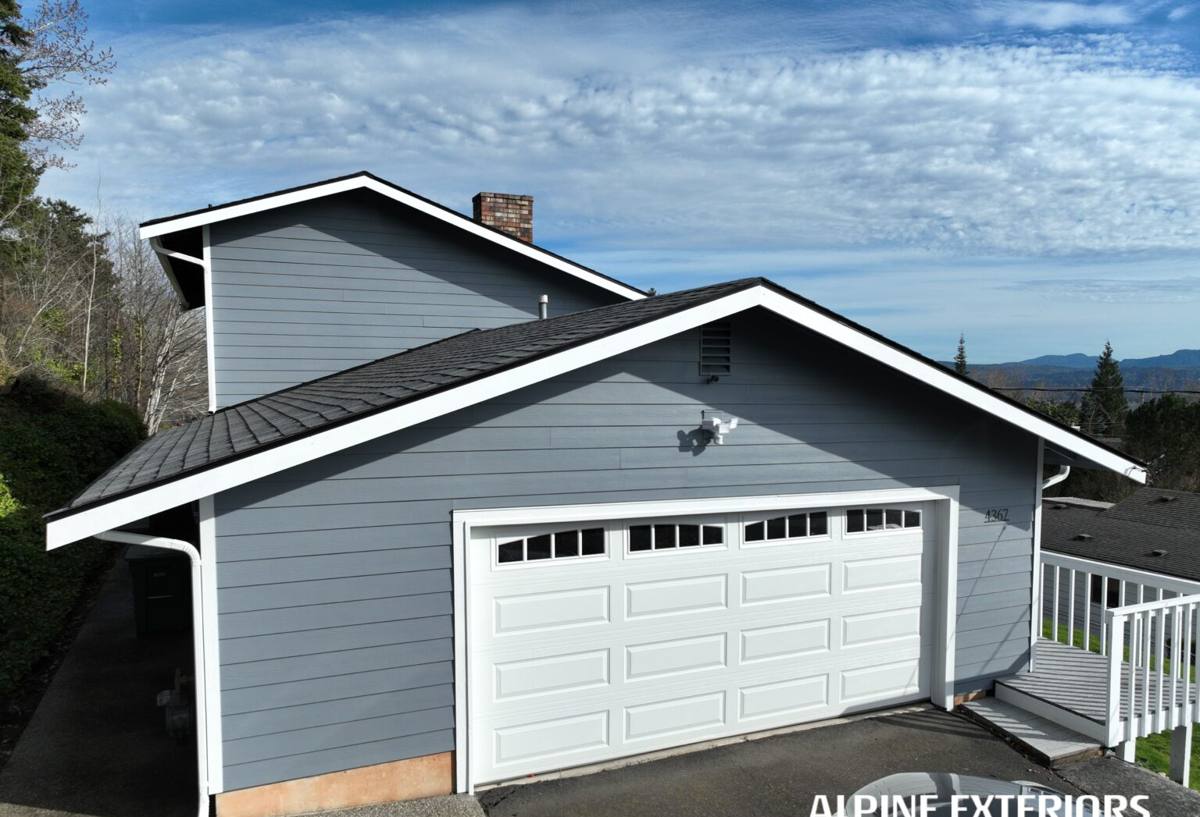
What a Correctly Installed Asphalt Shingle Roof Includes
A roof that's going to hold up to a Whatcom County winter needs more than shingles nailed to plywood. The parts underneath and around the shingles do most of the actual work of keeping water out.
- Ice-and-water shield at eaves and valleys — a self-adhering membrane in the spots most likely to see standing water or wind-driven rain, not just a code minimum strip.
- Synthetic underlayment across the full deck — a secondary water barrier that stays intact and doesn't degrade the way older felt paper can under prolonged damp conditions.
- Proper valley construction — either woven, closed-cut, or open metal valleys installed to shed water fast, since valleys concentrate more runoff than any other part of the roof.
- Correctly lapped step and counter-flashing at chimneys, walls, and roof-to-siding transitions — most leaks in this area trace back to flashing, not the shingles themselves.
- Balanced attic ventilation — intake at the eaves and exhaust at the ridge, sized to the attic volume, so moisture and heat don't build up under the deck and shorten the shingles' life from underneath.
- Correct nailing pattern and fastener count — matched to the shingle manufacturer's wind rating, which matters more on exposed or elevated lots.
Skip any one of these and the roof can still look fine for a couple of years. The failures just show up later, usually as a leak that's harder to trace than it should be.
Choosing the Right Shingle for a Shaded, Damp Lot
Not every asphalt shingle product is built the same way, and the differences matter more on a shaded, moisture-prone lot than they do on an open, sun-exposed one.
| Shingle Type | How It Performs Here | Trade-Offs |
|---|---|---|
| 3-tab shingles | Lower upfront cost, adequate on simple, well-ventilated roofs | Lighter weight, lower wind rating, shows wear faster under heavy moss and moisture cycling |
| Architectural (dimensional) shingles | Heavier mat, better wind resistance, sheds water more effectively on complex rooflines | Higher material cost, still needs algae-resistant granules to fully address moss |
| Algae-resistant (copper-granule) shingles | Granules formulated to resist the growth that drives most premature staining and lifting in shaded areas | Modest cost premium; resistance fades gradually over the shingle's life, doesn't eliminate need for maintenance |
For most homes in this neighborhood, an architectural shingle with algae-resistant granules is the practical middle ground — it costs more than a basic 3-tab up front, but it's the combination best matched to shaded, damp conditions and tends to hold its appearance and performance longer, which is where the real value shows up.
Our Process for a Silver Beach Roofing Project
- On-site inspection. We look at the existing roof, decking condition, attic ventilation, and specific exposure of your lot — how much shade, how much wind, where water tends to collect.
- Written estimate. A clear scope covering tear-off, decking repair allowances, underlayment, flashing, shingle selection, and ventilation — no vague line items.
- Tear-off and deck inspection. Old roofing comes off down to the deck so we can check for soft spots or rot before anything new goes down, not after.
- Underlayment, flashing, and ventilation installed first. These get done correctly before a single shingle goes on, since they're the layer that actually controls water once the roof is finished.
- Shingle installation to manufacturer spec. Correct nailing pattern, exposure, and starter course — the details that determine whether the warranty is actually valid if something goes wrong later.
- Cleanup and walkthrough. Site cleared of debris and nails, and we walk the finished roof and ventilation with you before calling the job done.
Cost Factors for an Asphalt Shingle Roof in This Area
Every roof is priced on its own specifics, but a handful of factors consistently move the number for homes in this area.
| Factor | Why It Affects Cost |
|---|---|
| Roof pitch and access | Steeper roofs and lots with limited equipment access take longer and require more safety setup |
| Number of valleys and penetrations | More flashing detail work at valleys, chimneys, and vents means more labor and material |
| Existing deck condition | Rot or soft spots found during tear-off require plywood replacement before shingles go down |
| Shingle tier selected | 3-tab vs. architectural vs. algae-resistant lines carry different material costs |
| Ventilation upgrades needed | Adding ridge or soffit venting where none exists is additional work but pays off in shingle lifespan |
| Tree cover and debris on site | Heavy overhanging trees mean more cleanup time and sometimes limb clearance before work starts |
Roof Maintenance Checklist for Homes Near Sudden Valley
A well-installed roof still needs upkeep in this climate. Homeowners who stay ahead of these items consistently get more usable life out of the same shingle product than those who don't.
- Clear gutters and downspouts at least twice a year — clogged gutters back water up under the eave line
- Have moss treated or gently removed before it spreads across a full slope, not after
- Trim back tree limbs that overhang the roof to cut down on shade, debris, and abrasion
- Check attic ventilation is unobstructed by insulation or debris at the soffits
- Walk the roofline visually after major windstorms for lifted or missing shingles
- Have the roof professionally inspected every few years, even with no visible problems
Signs Your Silver Beach Roof Needs Attention Now
Some warning signs are easy to miss from the ground, especially on a shaded roof where moss can mask other problems. Watch for granules collecting in gutters, dark streaking or green growth spreading across a slope, shingle edges that look curled or lifted, and any staining on interior ceilings near exterior walls or chimneys. Any one of these is worth a look before it turns into a deck repair instead of a shingle repair.
Why Hire a Crew That Already Works in Silver Beach
A roofer who works this neighborhood regularly already knows how the shade patterns, wind exposure, and moss cycle behave on lots like yours — that's not something you can fully substitute with a general checklist. We know which details tend to fail first on shaded, tree-covered roofs in this part of Whatcom County, and we build around those failure points instead of finding them the hard way. We're also familiar with the permitting and inspection process for this area, so there are no surprises mid-project.
If you're weighing a repair against a full replacement, or just want an honest read on how much roof you have left, we're glad to come take a look. The estimate is free, there's no pressure attached to it, and you'll get a straight answer about what your roof actually needs — use the form below to get started.