 Sudden Valley
 Composite Decking Built for Yew Street's Climate
Yew Street sits inside the Sudden Valley community, tucked into the wooded, lake-adjacent terrain that defines this part of Whatcom County. It's a beautiful place to have a deck — and a hard place to keep one looking good. Between the driving winter rain, the marine-influenced air that moves through the county off Puget Sound, and the tree cover that shades a lot of Sudden Valley lots for much of the year, wood decks here rarely age gracefully. Moss takes hold early, stain fails faster than the can promises, and boards start cupping and splintering within a handful of seasons.
Composite decking was built to shrug off exactly this kind of weather. It doesn't absorb water the way wood fibers do, it doesn't need to be sanded and re-stained every year or two, and a properly capped board resists the moss and algae staining that's almost unavoidable on a shaded, damp lot. That doesn't mean every composite deck installed on Yew Street performs the same — the install details matter as much as the product — but for this climate, composite is the material we recommend most often when homeowners ask us for something that will actually hold up.
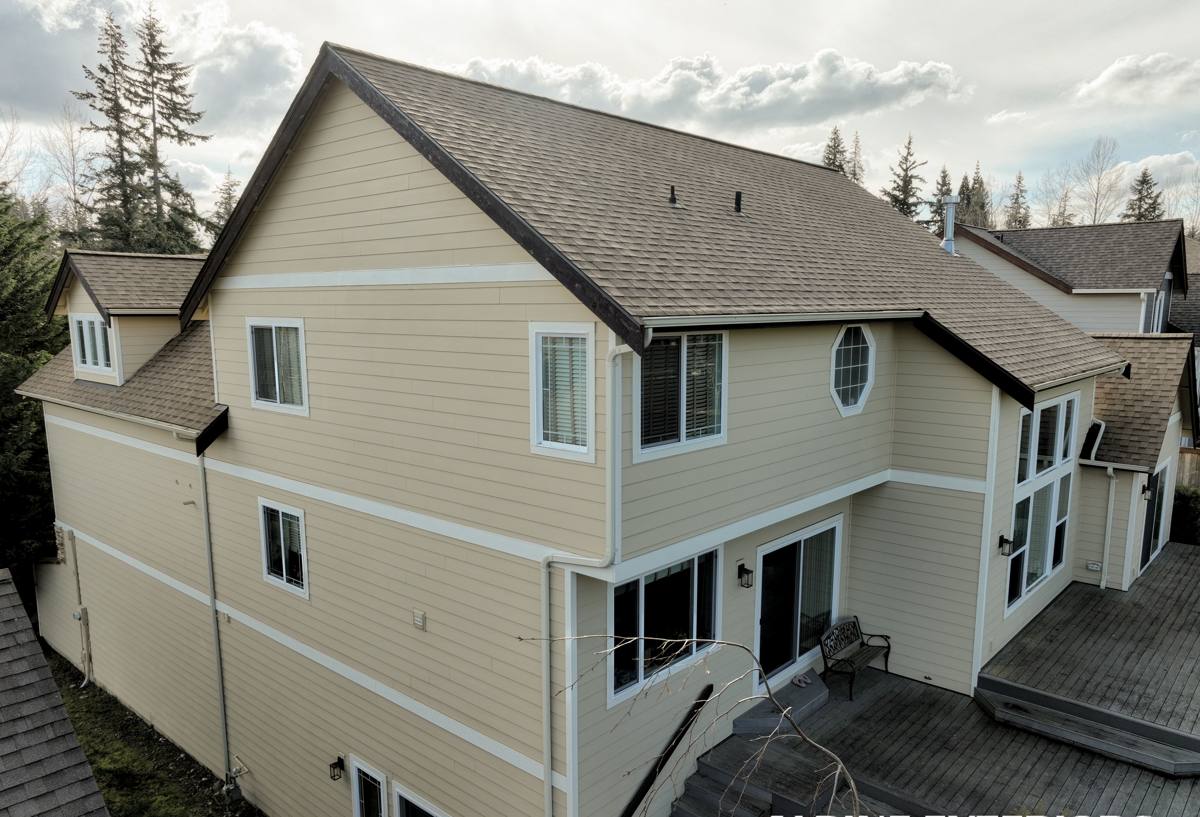
What Sudden Valley Weather Does to a Deck Over Time
Moss, Algae, and Shade
Tree cover and proximity to the lake keep a lot of Sudden Valley decks damp long after a storm has passed elsewhere in the county. On shaded lots, that dampness can linger for days, and moss doesn't need much more than that to establish itself in wood grain, fastener heads, and the gaps between boards. Once moss takes hold, it holds moisture against the deck surface, which accelerates rot in wood and can make even composite surfaces slippery if they're not cleaned periodically.
Moisture Cycling
Whatcom County's pattern of driving rain followed by drier stretches puts wood decking through constant wet-dry cycling. Boards swell, dry, shrink, and swell again — and over years that cycle works fasteners loose, opens up checking and splinters, and pulls stain and sealant off the surface faster than the manufacturer's schedule assumes. Composite boards handle this cycling far better because the material doesn't move nearly as much with moisture the way solid wood does.
UV and Temperature Swings
Sudden Valley doesn't get the punishing summer sun that some parts of Washington see, but south- and west-facing decks still take real UV exposure, and the swing between summer highs and winter cold matters for how boards, fasteners, and finishes hold up over a 15- to 25-year deck life. A deck built with the wrong hardware or fastening approach for that swing will show it in loosened rails and popped fasteners well before the decking itself wears out.
Composite vs. Wood vs. PVC: What We Recommend and Why
There isn't a single right answer for every home, but here's how the common options stack up for a shaded, wet, Whatcom County lot like the ones along Yew Street:
| Material | Moisture & Moss Resistance | Maintenance | Typical Lifespan |
|---|---|---|---|
| Pressure-treated wood | Fair — absorbs water, prone to moss in shade | Annual cleaning, periodic re-staining/sealing | 10–15 years before major repairs |
| Cedar | Better natural rot resistance, still absorbs moisture | Regular oiling/staining to prevent graying and moss | 15–20 years with upkeep |
| Capped composite | Strong — polymer shell resists moisture intrusion and staining | Occasional soap-and-water cleaning, no staining/sealing | 25–30 year warranty ranges common |
| PVC / cellular decking | Excellent — no wood fiber to absorb moisture | Lowest maintenance; more sensitive to installation temperature | Similar to or longer than capped composite |
For most Yew Street homes, we land on capped composite as the practical middle ground: it handles this climate well, doesn't demand a maintenance routine most people won't keep up with, and the installed cost is more predictable than premium PVC systems. We'll walk through the honest trade-offs for your specific project rather than push one product line — the right call depends on your budget, how much sun the deck gets, and how the structure underneath is holding up.
What a Correct Composite Deck Installation Actually Involves
Substructure and Framing
Composite decking is heavier and behaves differently under load than wood, so it typically needs tighter joist spacing than a traditional wood deck — often 16 inches on center, sometimes tighter for diagonal board patterns or picture-frame borders. We also run joist tape over the framing before boards go down, which protects the wood structure underneath from the moisture that inevitably gets trapped between the composite decking and the joists over time.
Drainage and Ventilation
This is the detail that gets skipped most often, and it's the one that matters most in a climate like this. Where a deck attaches to the house, the ledger board needs proper flashing so driving rain doesn't work its way behind the siding — a mistake there can cause hidden rot long before anyone notices a problem on the deck surface. Underneath, the structure needs enough clearance and airflow to let the ground and framing dry out between storms, especially on shaded lots where things simply don't dry as fast.
Fastening and Board Spacing
Composite boards expand and contract with temperature more than people expect, and correct gapping between boards accounts for that movement so the deck doesn't buckle or leave gaps that catch debris and moss. We use hidden fastener systems on most composite jobs, which also means no exposed screw heads to trap water and grime.
Rail, Fascia, and Stair Details
Fascia boards that hide the joist ends, code-compliant railing height and baluster spacing, and properly finished stair stringers all matter for both looks and safety — and on sloped or lakeside lots, which are common around Sudden Valley, stair and railing details often need more attention than on a flat city lot.
Our Process for Yew Street Deck Projects
On-Site Assessment
We start by looking at the existing structure (if there is one), the ledger connection to the house, sun and shade exposure, and how water currently moves across the lot. On a lot with heavy tree cover, that assessment also shapes how we plan for airflow underneath the new deck.
Permitting
Deck projects attached to a dwelling generally require a permit through Whatcom County, and if your property falls under the Sudden Valley Community Association, exterior projects may also need to follow the association's design review process. We handle the county permitting piece as part of the job and will flag anything that needs association sign-off before we start.
Installation Timeline
Most composite deck replacements or new builds on a typical residential lot take anywhere from a few days to a couple of weeks, depending on size, whether the old structure is being reused, and access to the site. We plan around the wetter stretches of the calendar where we can, since fastening and finish work go better in a dry window.
Cleanup and Walkthrough
Every job ends with a full site cleanup and a walkthrough where we go over board care, what to expect from the material in this climate, and anything specific to your deck's exposure or layout.
Keeping a Composite Deck Looking Good in Whatcom County
Composite decking is low-maintenance, not no-maintenance. A little seasonal attention goes a long way in a climate that grows moss on almost anything that sits still:
- Sweep leaves and debris off the deck regularly, especially through fall and winter
- Wash with mild soap and water once or twice a year rather than relying on rain to rinse it clean
- Avoid aggressive pressure-washing at close range, which can wear the surface texture on some capped boards
- Keep gutters and downspouts clear so runoff doesn't pool near the ledger or foundation
- Trim back overhanging branches to cut down on shade, debris, and moss buildup
- Check railing connections and any visible fasteners once a year
- Keep the space underneath the deck clear of stored materials so air can still circulate
What Affects the Cost of Your Deck
Composite decking generally costs more upfront than pressure-treated wood — often somewhere in the range of one-and-a-half to two times the material cost — but that gap narrows over the life of the deck once you factor out the staining, sealing, and board replacement that wood eventually needs. Beyond material choice, a few things drive the final number on most projects:
- Size and shape of the deck, including any curves, angles, or picture-framing
- Condition of the existing substructure, if you're replacing decking rather than building new
- Height off the ground and whether stairs, multiple levels, or a landing are involved
- Railing material — composite or aluminum rail systems cost more than basic wood rail
- Board tier — composite lines span a wide range in price and warranty length
- Site access — a lot with difficult access or steep grade takes more labor to build on
We'll walk your specific lot and give you a real number based on what's actually there, not a generic square-footage estimate that ignores your site's quirks.
Why a Crew That Already Works in Sudden Valley Matters
A lot of what makes a deck last here isn't exotic — it's getting the ordinary details right for this specific climate and terrain. A crew that regularly works Yew Street and the rest of Sudden Valley already knows how shaded, lake-adjacent lots dry out differently than an open lot across town, what Whatcom County's permitting process expects for an attached deck, and how sloped sites in this community typically need to be handled for stairs and footings. That familiarity shows up in fewer surprises mid-project and in a deck that's actually built for how water and shade behave on your specific lot, not a generic set of assumptions.
It also means faster response when you need a quote, a repair, or someone to look at an older deck that's showing its age — we're not driving in from across the county to get to you.
Ready for a Free Estimate
If you're weighing a new composite deck, a replacement for an aging wood deck, or just want an honest read on whether your current deck is worth repairing, we're happy to come take a look. There's no pressure and no obligation — just a straight assessment of your lot, your options, and a real number to work from. Use the form below to request your free estimate.