 Sudden Valley
 Why Cordata Siding Wears Out Faster Than Homeowners Expect
Cordata sits in a stretch of Whatcom County where the weather never really lets up on a house. Moist marine air moves through most months of the year, driving rain comes in sideways during fall and winter storms, and the shaded, damp stretches between rain events give moss and algae plenty of time to take hold on north-facing walls and anything under tree cover. None of that is dramatic on any single day. It's the accumulation, year after year, that separates siding that lasts three decades from siding that starts failing in ten.
Most siding doesn't fail from one big event. It fails because water finds a way behind it, or moisture sits against it long enough to feed rot, mold, and moss growth that keeps coming back no matter how many times it gets pressure washed. A siding replacement done for this specific climate has to address that moisture cycle directly, not just put a new, better-looking surface over the same problems.
Salt-tinged marine air moving through this part of Whatcom County doesn't just affect wood and paint — it's hard on fasteners, flashing, and any exposed metal trim over time. Corroding fasteners and degrading flashing are a quieter failure mode than a cracked panel, but they lead to the same result: water finding its way behind the wall.
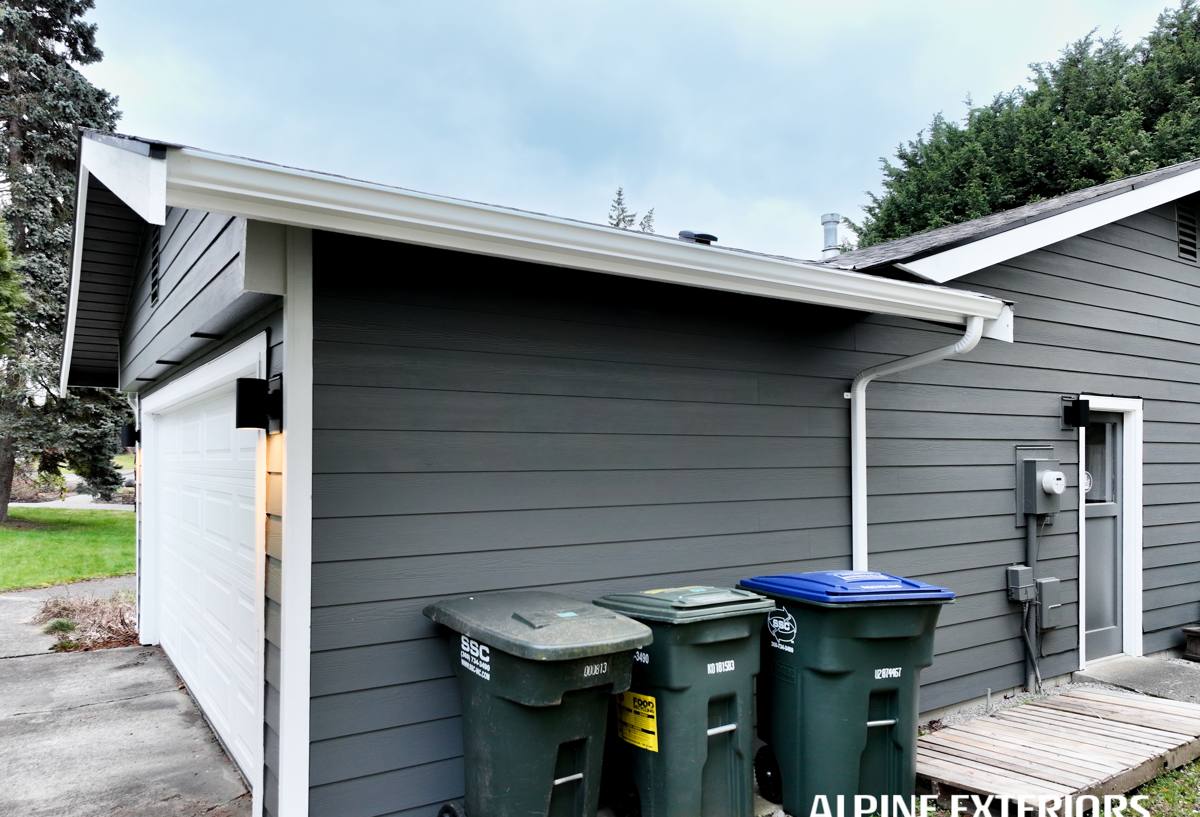
What a Correct Siding Replacement Actually Involves
Replacing siding is not just stripping old panels and nailing up new ones. Done right, it's a sequence where each step protects the next, and skipping any of them is exactly how a ten-year-old siding job starts showing rot at the corners.
Tear-Off and Sheathing Inspection
Once the old siding is off, the sheathing underneath gets a real inspection, not a glance. This is where a lot of hidden damage from years of trapped moisture shows up: soft plywood, delaminating OSB, or framing that's been slowly wicking water at window and door openings. Any of that needs to be repaired before a single new panel goes up. Covering damaged sheathing with attractive new siding just hides a problem that gets more expensive the longer it sits.
Weather-Resistive Barrier and Flashing
A weather-resistive barrier goes over the sheathing, and it has to be lapped correctly, sealed at penetrations, and integrated with new flashing at every window, door, and roofline intersection. In a climate that gets driving, wind-pushed rain, flashing details matter more than the siding material itself. Water that gets past bad flashing will find framing no matter how good the siding looks from the street.
Fastening, Clearances, and Joints
Fiber cement siding has specific fastening patterns, minimum clearances from grade, decks, and roof lines, and joint treatment requirements. Nailing it like a generic exterior panel, closing up clearances to save a few inches, or caulking joints incorrectly are the most common ways a technically "new" siding job ends up with the same moisture problems as the one it replaced.
Finish and Final Details
The last step is trim, caulking at transitions, and making sure every cut edge and seam is treated so water can't wick into the material. This is finish-level work, but it's also where long-term performance is won or lost.
Why We Only Install James Hardie Fiber Cement
We install one siding system: James Hardie fiber cement. That's a deliberate standard, not a limitation on what we're capable of installing. Fiber cement is non-combustible, dimensionally stable in wet climates, and holds a factory-applied ColorPlus finish that resists the fading and peeling that repainted wood and some engineered products struggle with here.
Hardie also engineers its products by climate zone, and the HZ5 line is built for regions that see the kind of moisture cycling and temperature swings Whatcom County gets. That's not a marketing detail — it affects how the product is formulated to resist moisture absorption and hold its shape over decades of wet-dry cycles, which is exactly the stress this area puts on exterior materials.
The ColorPlus factory finish also matters for maintenance. A factory-baked finish resists the moss, mildew staining, and coating failure that painted wood and some other sidings deal with in shaded, damp conditions. That doesn't mean a Hardie wall never needs cleaning — anything exposed to this climate collects moss and grime eventually — but it holds its finish and substrate integrity through that cleaning far better than the alternatives.
A James Hardie warranty is also transferable to a new owner within its terms, which matters in a market where homes change hands. A well-documented, correctly installed siding job is something a seller can point to, not just a receipt in a drawer.
How Siding Materials Compare in This Climate
| Material | Moisture / Moss Behavior | Maintenance | Why We Do or Don't Install It |
|---|---|---|---|
| James Hardie fiber cement | Dimensionally stable, resists moisture absorption; factory finish resists staining | Occasional washing; no repainting cycle with ColorPlus | What we install — engineered for this kind of climate, strong transferable warranty |
| Vinyl | Doesn't absorb water, but seams and panels can trap moisture behind them; can warp with heat and cold | Low, but limited repair options if damaged | We don't install it — appearance and repairability trade-offs don't match our standard |
| LP SmartSide (engineered wood) | Treated to resist moisture, but any breach at cuts, fasteners, or joints exposes wood-based core to rot | Moderate; finish and joint sealing need monitoring over time | We don't install it — installation sensitivity is a poor fit for our wet climate |
| Cedar / primed wood | Attractive but absorbs moisture readily; moss and mildew take hold quickly in shade | High — regular refinishing, caulking, and moss treatment | We don't install it — maintenance burden is too high for the payoff here |
None of this means the other materials are junk. Vinyl is inexpensive and low-maintenance in the right setting, and engineered wood products have real strengths. It means that, for the specific combination of driving rain, salt-influenced marine air, and long moss seasons this part of Whatcom County deals with, we've standardized on the product that holds up best over the long run and stand behind that with every job we do.
Signs Your Cordata Home May Need Siding Replacement
- Panels that are cracking, buckling, or visibly separating at the seams
- Soft or spongy spots when you press on the siding, especially near the bottom courses or corners
- Moss or dark staining that returns within a season or two of being cleaned
- Paint that's peeling or blistering repeatedly on the same wall sections
- Visible rot or discoloration around trim, window edges, or where siding meets the foundation
- A noticeable rise in heating costs without another explanation
- Gaps, warping, or daylight visible at seams and corners
One or two of these on their own might just need a repair. Several at once, especially combined with soft sheathing underneath, usually means the wall assembly has been taking on water for a while and a full replacement is the more honest fix.
Our Process, Start to Finish
- Walkthrough and assessment — we look at the existing siding, sheathing condition where accessible, trim, and any problem areas you've noticed.
- Written estimate — a clear scope covering removal, sheathing repair allowances, product line and color, and flashing details, so there are no surprises mid-project.
- Tear-off and inspection — old siding comes off and the sheathing gets a real look before anything new goes up.
- Weather barrier and flashing — new house wrap and flashing integrated at every opening and transition.
- Hardie installation — installed to manufacturer fastening, clearance, and joint specifications, not shortcuts.
- Final walkthrough — trim, caulking, and finish details checked before we call it done.
Cost Factors for Siding Replacement in Cordata
| Factor | Why It Affects Your Price |
|---|---|
| Home size and number of stories | More surface area and taller walls mean more material and labor, plus equipment for access |
| Condition of existing sheathing | Rot or water damage found during tear-off adds repair scope you can't fully know until the old siding is off |
| Trim and architectural detail | Homes with more corners, dormers, and trim transitions take longer to flash and finish correctly |
| Product line and color | ColorPlus factory finishes and certain profiles cost more than base product but eliminate a repainting cycle |
| Site access | Tight lot lines, slopes, or landscaping close to the house can add setup and protection time |
We don't quote a job without seeing the house, because the sheathing condition alone can move a number significantly once tear-off starts. What we can promise is a written estimate with no vague allowances hiding in the fine print.
Why Hiring a Crew That Already Works in This Area Matters
A crew that regularly works Cordata and the surrounding Whatcom County communities has already seen how the local moisture cycle plays out on real houses — which wall orientations collect moss fastest, where driving rain tends to find its way behind poorly flashed trim, and how a marine climate stresses a wall assembly differently than it would somewhere drier. That local pattern recognition shows up in the details: where extra flashing attention goes, how clearances are handled near grade and decking, and which trim transitions get the most scrutiny before the crew calls a job finished.
Many neighborhoods in this part of Whatcom County have their own exterior guidelines, whether that's a homeowners' association or general permitting requirements through the county or city. A crew that's already pulled permits and worked within those guidelines nearby isn't guessing at what's expected, which keeps a project from stalling on paperwork instead of progress.
It also means straightforward accountability. A local crew is available for a warranty question or a follow-up look years down the road, not a one-time name on an invoice.
If your Cordata home's siding is showing its age, or you just want an honest look at what shape it's really in, we're happy to come out and give you a straightforward, no-pressure estimate using the form below.