 Sudden Valley
 Why Sehome Decks Take More of a Beating Than People Expect
Sehome homeowners often assume a deck is a deck — build it once, enjoy it for twenty years, done. In this part of Whatcom County, that's not quite how it works. Homes here sit close enough to the water that salt-laden air reaches fasteners, flashing, and railing hardware long before it reaches drier inland areas. Add in driving, wind-blown rain that gets up under fascia boards and behind ledger connections, and a moss season that can stretch from October well into spring, and you've got a structure that's under attack from three directions at once: corrosion, moisture intrusion, and organic growth.
None of that means a deck can't last. It means the build has to plan for those three things from the first footing to the last cap rail, instead of treating them as maintenance problems to solve later.
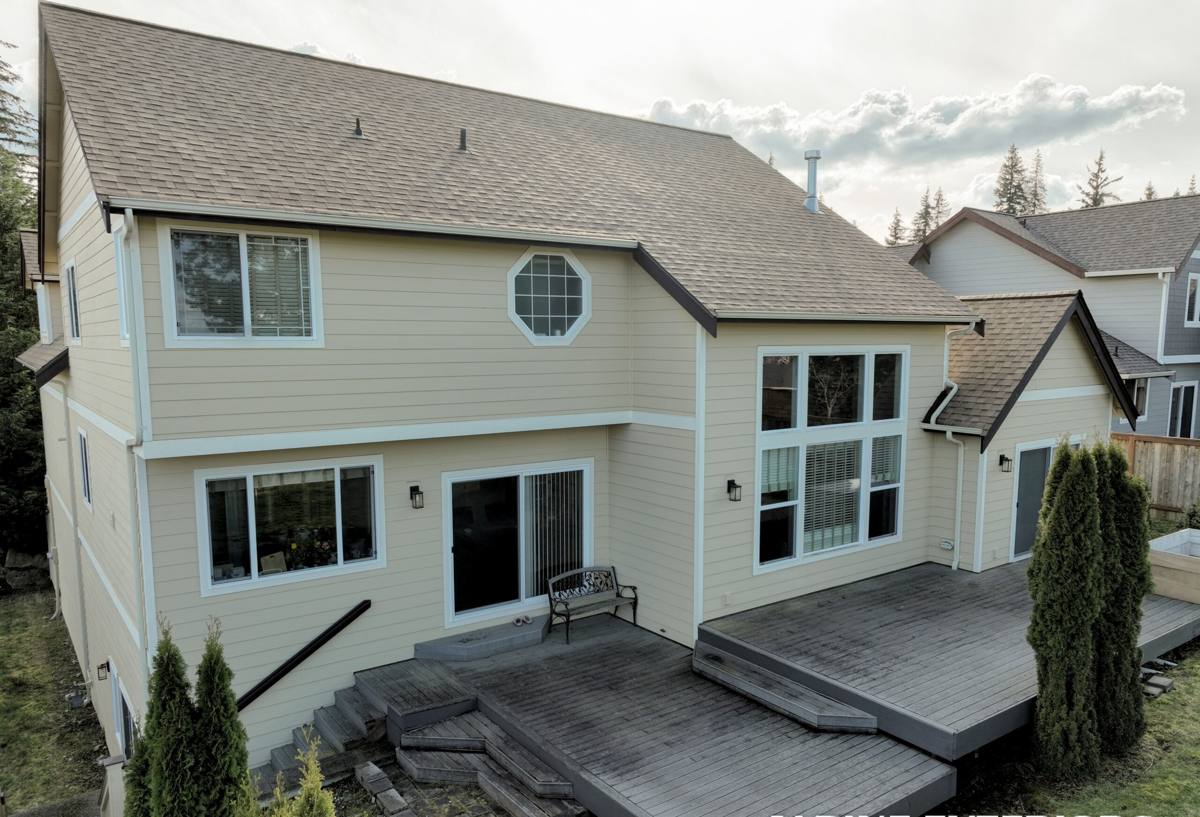
What Salt Air Actually Does to a Deck
Salt air doesn't rot wood the way standing water does — it corrodes metal. Every deck has dozens of metal connection points: joist hangers, structural screws, post bases, railing brackets, and ledger bolts. If any of those are rated for general exterior use but not for coastal exposure, they'll start pitting and weakening years before the wood around them shows any sign of trouble. The failure is invisible until it isn't — a hanger that looks fine on the outside can be significantly weaker underneath the surface corrosion.
What we do differently
We spec stainless steel or heavy-duty coated hardware rated for coastal and high-moisture exposure on every connection point, not just the ones that are easy to inspect later. It costs more up front than standard galvanized hardware. It's also the single biggest factor in whether a deck's structure is still sound in fifteen years or needs to be torn apart to fix a hidden hanger failure.
Driving Rain and Where Decks Actually Fail
Most deck failures don't happen because a board rotted in the open — they happen because water got somewhere it wasn't supposed to be and had no way to leave. The two most common entry points are the ledger board connection (where the deck attaches to the house) and the space directly under the decking surface, where debris collects and moisture sits against the joists.
- Ledger flashing: A properly flashed ledger sheds water away from the house wall instead of letting it wick into the rim joist. This is the single most important flashing detail on the entire structure.
- Joist protection: Uncovered joist tops absorb water every time it rains, then dry slowly under the decking. Covering joist tops with a moisture-shedding barrier keeps that cycle from ever starting.
- Deck board spacing: Gaps that are too tight trap needles, seed pods, and moss spores; gaps that are too wide let debris fall through but don't drain properly either. Spacing is set based on the specific decking material, not guessed at.
- Ground clearance and airflow: Low decks with poor under-deck ventilation stay damp for days after a storm. Airflow underneath matters as much as drainage on top.
Moss: The Slow Problem Homeowners Notice Last
Whatcom County's moss season is long, and a deck surface is one of the easiest places for it to take hold — shaded areas, north-facing sides of the house, and anywhere water sits even briefly after rain. Moss itself isn't just cosmetic. It holds moisture against the decking surface, and on wood decking specifically, that constant damp contact accelerates surface decay and makes boards slicker and more dangerous underfoot.
The fix isn't a one-time treatment — it's a combination of material choice, board spacing that lets the surface actually dry between rains, and a deck design that doesn't create shaded, poorly-drained pockets in the first place. We factor sun exposure and drainage into the layout before a single board goes down, not as an afterthought.
Choosing the Right Decking Material for This Climate
There's no single "best" decking material — there's a best material for a given budget, maintenance appetite, and how much sun or shade the deck actually gets. Here's how the common options hold up specifically under Whatcom County conditions:
| Material | Moss/Moisture Resistance | Maintenance | Typical Lifespan |
|---|---|---|---|
| Pressure-treated wood | Moderate — needs sealing to perform well | Annual cleaning and re-sealing | 10–15 years with upkeep |
| Cedar | Good natural resistance, but surface still needs care in shade | Periodic cleaning and oil/stain | 15–20 years with upkeep |
| Capped composite | Strong — resists moisture absorption | Occasional washing, no sealing | 25–30 years |
| PVC decking | Excellent — doesn't absorb moisture at all | Occasional washing | 25–30+ years |
We're straightforward with homeowners about trade-offs: wood costs less up front and looks great when it's maintained, but it demands real annual attention in this climate or it shows it fast. Composite and PVC cost more initially but largely remove the maintenance burden that moss season creates. Neither is wrong — it depends on how much upkeep you actually want to do.
A Note on Railings and Fascia
Railing systems and fascia boards see the same coastal exposure as the deck surface, often with less airflow around them. Powder-coated aluminum or capped composite railings hold up better here than raw wood balusters, which tend to need refinishing more often than the deck surface itself.
Footings, Framing, and What's Underneath
The parts of a deck nobody sees are the parts that determine whether it's still standing and level in twenty years. In this region, that means footings set below frost depth and sized for the soil conditions on the specific lot, not a generic footing spec pulled from a catalog. Framing lumber should be rated for ground contact where it's within a few inches of soil or sits in a consistently damp zone, even if code minimums would allow lighter-rated lumber elsewhere on the structure.
We also pay attention to post-to-beam and beam-to-joist connections — these carry the full structural load of the deck, and undersized or improperly fastened connections are one of the more common issues we find when repairing or replacing an older deck in this area.
Our Process, Start to Finish
- On-site assessment: We walk the space, check sun exposure and drainage patterns, and talk through how you'll actually use the deck — that shapes size, layout, and material recommendations.
- Design and material selection: We lay out options with honest cost and maintenance trade-offs, not a single "recommended" package.
- Permitting: Deck permits in Whatcom County depend on size, height, and attachment to the structure. We handle the permit process so you're not the one tracking down requirements.
- Footings and framing: Footings are dug to proper depth, framing goes up with coastal-rated hardware throughout, and ledger flashing is installed before anything else touches the house wall.
- Decking, railings, and finish work: Boards are spaced and fastened according to the manufacturer's spec for that specific material, railings are set, and all cut ends are sealed.
- Final walkthrough: We go over basic care for whatever material you chose, so you know what upkeep — if any — to expect.
Maintaining a Deck Through Moss Season
Whatever material you choose, a little seasonal attention goes a long way toward avoiding bigger problems:
- Sweep debris out of gaps between boards before fall rains set in — trapped leaves and needles hold moisture against the wood or composite surface.
- Rinse or gently scrub shaded, moss-prone areas at least once in late fall and again in early spring.
- Check railing hardware and post bases annually for any sign of surface corrosion or loosening.
- Keep nearby vegetation trimmed back so sunlight and airflow can reach shaded sections of the deck.
- Re-seal wood decking on the manufacturer's recommended schedule — don't wait until it's visibly gray or cracking.
- Address standing water or slow drainage under the deck promptly; it's easier to fix a drainage issue early than to repair joists later.
Why It Matters That We Already Work in This Area
A deck built to a generic national spec sheet isn't wrong, exactly — it's just not built for what actually happens to a structure sitting in Whatcom County's combination of salt air, sustained rain, and long moss seasons. Crews who work Sehome and the surrounding area regularly make different calls by habit: coastal-rated hardware as the default instead of the upgrade, ledger flashing that's never treated as optional, and material recommendations based on how a specific spot on your property actually drains and gets sun, not on a showroom sample.
That local pattern recognition is the difference between a deck that needs hardware replaced or joists repaired in year eight, and one that's still solid decades in.
Get a Straightforward Estimate
If you're planning a new deck in Sehome or looking at repairing or replacing one that's showing its age, we're glad to come take a look. There's no pressure and no obligation — just an honest assessment of what your specific site needs and what it would take to build it right. Use the form below to request a free estimate.