 Sudden Valley
 Why Barkley Roofs Wear Differently
Barkley sits close enough to Lake Whatcom and the marine air moving in off the Puget Sound corridor that roofs here take on a different kind of abuse than roofs thirty miles inland. It's not one big storm that does the damage — it's the accumulation. Salt-laden air corrodes exposed metal fasteners and flashing faster than it does in a dry climate. Driving rain, pushed sideways by wind off the water, finds its way under shingles that would hold up fine in a straight-down rain. And the long, wet moss season that runs from fall through spring keeps organic growth working on the roof surface for months at a time, not just a few weeks.
None of this means Barkley roofs fail faster than average. It means they need to be built and maintained with those specific stresses in mind. A roof replacement done to a generic spec — the kind that works fine in a drier part of the state — will underperform here. One built for Whatcom County conditions will hold up the way it's supposed to.
Signs a Barkley Roof Needs Replacement, Not Another Repair
Most homeowners call us after a repair, not before. That's normal — a leak gets your attention, a slightly worn roof doesn't. But there's a point where patching stops being the economical choice. Here's how we tell the difference on a typical evaluation.
Repair Is Still the Right Call When:
- The damage is isolated to one area — a single flashing point, a section around a vent, storm damage to a small patch of shingles.
- The roof is under roughly two-thirds of its expected lifespan and the rest of the field is sound.
- Moss and algae staining is surface-level and hasn't lifted or curled the shingles underneath.
Replacement Is the Honest Recommendation When:
- Granule loss is widespread rather than localized — you'll see bare, shiny patches on multiple slopes.
- Moss has been established long enough to hold moisture against the shingle mat, which speeds up decay from underneath where you can't see it.
- There's soft decking, staining on the interior ceiling, or daylight visible through the attic sheathing.
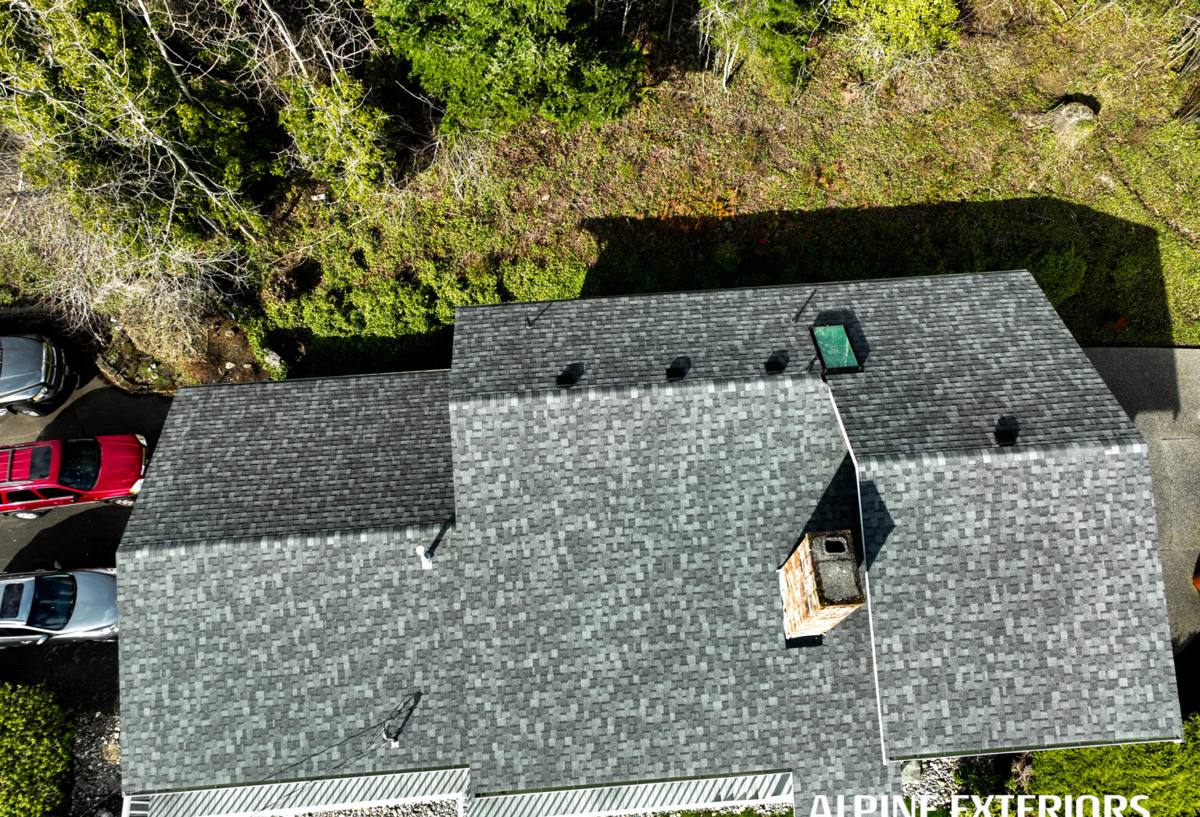
- Flashing around chimneys, skylights, or valleys is corroded or was never installed correctly to begin with — this is one of the most common failure points we find in this area.
We'll tell you honestly which category your roof falls into. If a repair will genuinely buy you several more years, that's what we'll recommend. Replacement only makes sense when the underlying structure and materials are past the point of a repair holding.
What a Correct Roof Replacement Involves Here
A roof replacement is more than swapping old shingles for new ones. In a climate like this, the layers you don't see matter as much as the ones you do.
Tear-Off and Deck Inspection
We remove the existing roofing down to the deck rather than layering over it. That's the only way to actually see what's underneath — soft spots, rot, or damage from long-term moisture that's been hidden under the old material. Any compromised decking gets replaced before anything new goes down. Skipping this step is the single most common shortcut that leads to problems five years later.
Underlayment Built for Wind-Driven Rain
Standard felt underlayment is adequate in a lot of the country. Given how often rain here arrives at an angle instead of straight down, we use synthetic underlayment and self-adhered membrane at the vulnerable points — eaves, valleys, and around every penetration — where wind-driven water is most likely to get pushed backward under the shingle line.
Flashing That's Actually Sealed, Not Just Installed
Flashing failures are behind a large share of the leaks we get called out to inspect. Every chimney, skylight, vent pipe, and roof-to-wall transition gets new flashing, correctly stepped and sealed, not just reused or caulked over the old metal. Corroded flashing in a salt-air environment is a matter of when it fails, not if.
Ventilation Sized to the Attic
A roof that's replaced without addressing attic ventilation is only half fixed. Poor airflow traps moisture, which shortens shingle life and feeds the exact moss and mildew growth this climate already encourages. We size intake and exhaust ventilation to the attic, not just to whatever vents happened to be there before.
Comparing Roofing Materials for Whatcom County Weather
There's no single "best" roofing material — it depends on your home, your budget, and how much long-term maintenance you're willing to take on. Here's how the common options actually perform under salt air, heavy rain, and sustained moss pressure.
| Material | Moisture & Rain Performance | Moss Resistance | Typical Lifespan Here |
|---|---|---|---|
| Architectural asphalt shingle | Good, especially with proper underlayment and flashing | Moderate — algae-resistant granules help but don't eliminate growth | 20–30 years |
| Metal roofing (standing seam) | Excellent — sheds water fast, minimal seams | High — moss struggles to establish on a smooth, sloped metal surface | 40–60 years |
| Cedar shake | Requires diligent maintenance in this climate | Low without regular treatment — cedar holds moisture and feeds moss growth | Varies widely with upkeep |
| Synthetic/composite shingle | Good, engineered for moisture resistance | Moderate to high depending on product | 30–50 years |
We don't push one product on every homeowner. Cedar shake has real appeal and we'll install it if that's what you want, but we'll be upfront that it demands more maintenance in a wet, moss-prone climate than asphalt or metal — that's a maintenance trade-off, not a defect, and it's worth knowing before you commit to the upkeep. Metal costs more up front but asks the least of you afterward. Architectural asphalt remains the most common choice because it balances cost, appearance, and performance well when it's installed correctly.
Our Roof Replacement Process in Barkley
- On-site evaluation. We walk the roof, check the attic, and look at flashing, decking condition, and ventilation — not just the shingle surface.
- Written estimate. You get a clear scope of work and price, with material options explained in plain terms, no pressure to decide on the spot.
- Scheduling around the weather. We plan replacement dates with Whatcom County's rain patterns in mind and stage materials so your home isn't left exposed longer than necessary.
- Tear-off and deck repair. Old roofing comes off, the deck is inspected, and any damaged sheathing is replaced before anything new is installed.
- Underlayment, flashing, and ventilation installation. The layers that determine how the roof performs over the next twenty-plus years go in first.
- Final roofing material installation. Shingles, metal panels, or shakes are installed to manufacturer spec, including nailing pattern and exposure — details that affect both warranty coverage and wind resistance.
- Cleanup and walkthrough. We clear debris and nails from the property and walk the finished roof with you before calling the job done.
What Roof Replacement Costs in Barkley
Every roof is priced on its own specifics, but the main cost drivers are consistent from job to job. This isn't a quote — it's a guide to what actually moves the number.
| Factor | Why It Matters |
|---|---|
| Roof size and number of slopes/valleys | More cuts, seams, and flashing points mean more labor and material |
| Material choice | Asphalt, metal, and shake carry different material and labor costs, as shown above |
| Deck condition | Rotted or soft sheathing found during tear-off adds repair cost that can't be known until the old roof is off |
| Roof pitch and accessibility | Steep or hard-to-access roofs take longer and require more safety setup |
| Ventilation upgrades | Adding proper intake/exhaust venting where the original system was inadequate |
| Tear-off layers | Removing multiple existing layers of roofing costs more than a single-layer tear-off |
We'll flag likely cost variables during the evaluation so the estimate isn't a surprise, and we'll tell you upfront if we think deck repair is likely before we ever get up there.
Ventilation and Moss Prevention After the New Roof
A new roof isn't maintenance-free, especially here. A few habits extend the life of the investment considerably:
- Keep gutters clear so water isn't backing up under the eaves during heavy rain events.
- Trim back overhanging branches — shade and falling debris are two of the biggest contributors to moss taking hold.
- Have moss growth treated before it establishes rather than after, especially on north-facing slopes that stay damp longest.
- Check attic ventilation isn't blocked by insulation or storage, since that's the difference between a roof that sheds moisture and one that traps it.
We're happy to walk you through simple upkeep at the end of a job — it's a five-minute conversation that saves homeowners real money over the life of the roof.
Why Hiring a Crew That Already Works Barkley Matters
Roofing crews that mostly work drier, inland regions tend to underbuild for this climate — not out of carelessness, but because it's simply not what they're used to specifying. A crew that regularly works Whatcom County knows which flashing details actually hold up against wind-driven rain off the lake, which materials handle a long moss season without excessive upkeep, and how local permitting and inspection work in this area. That local familiarity shows up in fewer callbacks, not in a fancier sales pitch.
It also matters for scheduling. A crew based in the area can respond to weather windows realistically instead of promising a start date that a rain system is going to blow through.
Pre-Replacement Checklist for Barkley Homeowners
- Note any interior signs of leaks — ceiling stains, musty odors in the attic, or damp insulation — and mention them during the evaluation.
- Check your attic for daylight, active drips, or condensation on the underside of the roof deck.
- Look at your roof from the ground for visible moss, sagging, or missing shingles.
- Pull any paperwork from your last roof installation or repair, if you have it — it helps us understand the roof's history.
- Think through timing: is there a season you'd prefer to avoid having the roof open, even briefly, during tear-off?
- Ask about warranty terms for both materials and labor before work begins, not after.
If your roof is showing its age or you just want an honest read on where it stands, we're glad to come take a look. The estimate is free, there's no pressure, and you'll get a straight answer about whether you need a repair or a full replacement.