 Sudden Valley
 Siding Repair for Columbia-Area Homes in Sudden Valley
Homes in the Columbia area, tucked into the Sudden Valley side of Whatcom County, deal with a specific combination of weather that most siding was never designed to fight off indefinitely: driving rain that comes in sideways off the water and through the tree cover, a moss and mildew season that stretches for most of the year, and salt-laden marine air that finds its way into every fastener, seam, and joint. Siding repair here isn't a cosmetic errand. Done correctly, it stops water that's already found a way in, restores the panel's ability to shed rain, and buys you years before you're looking at a full re-side. Done poorly — a bead of caulk over a stained board, a patch that doesn't match the original coursing — it hides the problem instead of solving it, and the rot underneath keeps working.
This page is about that one job, in this one area: what local homes actually need from a siding repair, what a correct repair looks like piece by piece, how our process works from first look to final walk-through, and why it's worth hiring a crew that already knows this stretch of Whatcom County rather than someone driving in cold.
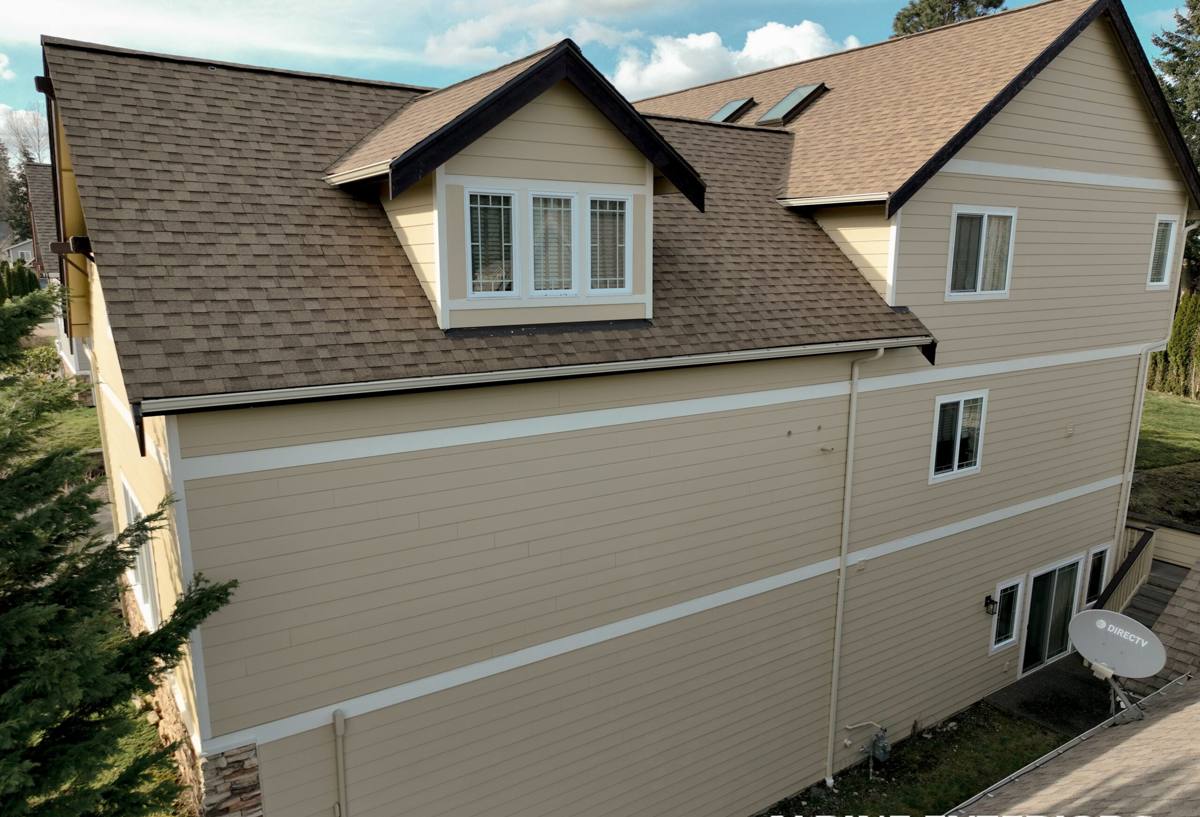
What the Local Climate Does to Siding Here
Every siding failure we get called out for in this area traces back to one of three things, usually working together rather than alone.
Wind-Driven Rain
Storms coming across the water don't just fall straight down — they push rain sideways into the field of the wall, not just the exposed top edges. Siding is built to shed water moving downward across a lapped surface; it's far less forgiving of water being forced sideways or upward into a seam. Over enough seasons, that pressure finds every gap in caulking, every loose piece of trim, and every spot where flashing was skipped or installed short.
A Long Moss and Mildew Season
Shaded, tree-covered lots — common throughout this part of Sudden Valley — stay damp longer after every rain than an open, sun-exposed wall would. That extended dampness is exactly what moss and mildew need to take hold on siding, trim, and the ground-level courses closest to landscaping. Moss itself doesn't just sit on the surface; its root structure holds moisture against the material underneath, which is what turns a cosmetic nuisance into a moisture problem if it's left alone for a few seasons.
Salt Air and Fastener Corrosion
Marine air carries salt further inland than most homeowners expect, and it's hard on anything metal — nail heads, staples, flashing, trim fasteners. Corroding fasteners lose their grip over time, which shows up as siding that's started to work loose, nail pops pushing through the face of a board, or streaking that runs down from a fastener location. It's a slow process, which is exactly why it tends to go unnoticed until the siding itself is visibly failing.
The Repair Issues We See Most Often in Columbia
Not every siding problem in this area looks the same, and the right fix depends entirely on what's actually causing it. Here's how we sort through the most common calls:
| What You See | Likely Cause | What the Repair Actually Requires |
|---|---|---|
| Dark staining or soft spots near the bottom courses | Splashback and prolonged ground moisture | Remove affected boards, check sheathing underneath, replace with proper ground clearance and drainage |
| Moss or mildew buildup on shaded walls | Extended dampness under tree cover | Careful cleaning without damaging the finish, then addressing airflow and drainage so it doesn't return as fast |
| Nail pops or boards that have worked loose | Corroding fasteners, often salt-air related | Re-fasten or replace with corrosion-resistant fasteners set to the correct pattern and depth |
| Buckled or warped panels | Trapped moisture behind the siding, or panels installed without expansion gaps | Remove and inspect the water-resistive barrier, correct the gap, reinstall to spec |
| Cracking at corners or around openings | Missing or failed flashing, impact damage, or material fatigue | Replace flashing details first, then the siding — patching over bad flashing just resets the clock |
What a Correct Repair Actually Involves
A repair that only replaces what's visibly damaged, without asking why it failed there, tends to fail again in the same spot within a few years. Doing it right means a few things happen every time, regardless of how small the job looks.
Finding the Real Water Path
Damaged siding is a symptom, not the whole story. Before anything gets cut out, we trace where water is actually getting in — that might be a failed piece of flashing several courses above the visible stain, a gap at a window or corner trim, or a seam that was never properly lapped. Replacing the board without fixing the entry point means the new material starts failing the same day it goes up.
Matching Material, Profile, and Finish
A patch that doesn't match the surrounding siding's exposure, profile, or color stands out immediately and can also create a new water path at the seam between old and new material. Getting this right means matching the plank width and reveal, and — since we only install James Hardie fiber cement — using the same ColorPlus finish system so the repaired section weathers the same way the rest of the wall does instead of aging at a different rate.
Flashing, Trim, and the Details That Get Skipped
Most siding repairs that come back within a year or two failed not because of the siding itself but because flashing, trim, or caulk joints around the repair were reused or reinstalled incorrectly. Correct repair work replaces compromised flashing, re-seals penetrations properly, and re-establishes the drainage path behind the cladding — not just the visible face.
Our Repair Process
- On-site inspection. We look at the damaged area and the surrounding wall, not just the spot you called about, since siding failures rarely stay isolated.
- Diagnosis. We identify the actual cause — moisture path, fastener failure, impact damage, or material fatigue — before recommending a fix.
- Written scope and estimate. You get a clear explanation of what's being replaced, why, and what it costs, with no surprise add-ons once work starts.
- Removal. Damaged siding and any compromised flashing or trim come off carefully, and we check the sheathing and water-resistive barrier underneath before closing anything back up.
- Correction. Any underlying issue — bad flashing, a missing expansion gap, rot in the sheathing — gets fixed before new siding goes on.
- Reinstallation. New James Hardie material goes in matched to the existing coursing, fastened correctly, and finished to blend with the surrounding wall.
- Final walk-through. We show you the completed work and explain what was found and fixed, so you're not left guessing.
Repair or Replace? How We Help You Decide
Not every damaged wall needs a full re-side, and not every problem area should just get patched. We're honest about which situation you're in, because a patch on a wall that's failing broadly just delays a bigger job and costs more in total. A few signs point toward full replacement rather than a spot repair:
- Damage or staining is showing up in multiple, unrelated areas of the same wall or across several walls
- The siding is an older material — old wood, older vinyl, or aging fiber cement — that's simply reached the end of its service life
- Moisture has gotten behind the siding broadly, not just at one penetration or seam
- Previous patches or repairs are already failing or don't match the surrounding material
- You're planning other exterior work soon and it makes more sense to combine it into one project
If your situation is a genuinely isolated issue — one section damaged by impact, one area with a flashing failure — a targeted repair is the right call, and we'll tell you that plainly instead of upselling a full re-side you don't need.
Cost Factors in a Siding Repair
Every repair is different, but the price is driven by a consistent set of factors. Knowing them ahead of time helps you understand the estimate instead of just seeing a number.
| Factor | Why It Matters |
|---|---|
| Extent of hidden damage | What's behind the visible siding — rotted sheathing, a compromised barrier — often costs more to correct than the siding itself |
| Height and access | Second-story sections, steep lots, and areas near trees or landscaping take longer to access safely |
| Color and profile matching | Matching an existing ColorPlus finish and plank profile takes more care than installing on a blank wall |
| Flashing and trim scope | Repairs that require replacing flashing, corner trim, or window trim involve more than just the siding panels |
| Number and location of repair areas | Several small, scattered repairs can sometimes cost more in total labor than one larger, contiguous section |
Why We Repair Exclusively With James Hardie Fiber Cement
When we replace damaged siding, we replace it with James Hardie fiber cement — never vinyl, LP SmartSide, primed wood, or other fiber cement brands. That's a deliberate standard, not a sales preference. Fiber cement doesn't feed moss and mildew growth the way wood-based products can, it's non-combustible, and its ColorPlus factory finish holds color and resists cracking and peeling far better than field-applied paint over the long stretch of wet seasons this area sees. Hardie's HZ5 product line is engineered specifically for climates with heavy moisture exposure, which describes this part of Whatcom County well. When we patch a Hardie wall, the new material is built to weather at the same rate as the original siding — which isn't something we could promise if we were mixing materials or brands on the same wall.
Why It Matters That We Already Work in This Area
A crew that already does repair work around Sudden Valley and the Columbia area has already seen how the local wind, rain angle, tree cover, and salt air actually behave on real houses here — not in a manual, but on walls like yours. That matters when you're diagnosing a repair, because the same-looking stain can have a completely different cause depending on the wall's orientation to prevailing wind and rain, how shaded it is, and how close it sits to the water. It also means we're not learning the quirks of this climate on your house; we're applying what we've already confirmed works here, repair after repair.
If you're dealing with damaged, stained, or failing siding on a home in the Columbia area, we're happy to take a look and give you a straight answer — repair or replace, with a written estimate and no pressure either way. Use the form below to request a free estimate.