 Sudden Valley
 Storm Damage Is Different in South Hill
South Hill sits up in the terrain that catches the full brunt of what rolls in off Bellingham Bay and the Strait of Georgia. Homes here take wind from angles that flatter, more sheltered lots in the valley never see, and that wind almost always arrives with rain behind it. When a storm passes through, the damage isn't always the dramatic kind — a tree limb through the ridge, shingles peeled back like a page turning. More often it's the quiet kind: a few tabs lifted just enough to let wind-driven rain track sideways under the course above, flashing nails backed out a quarter inch, a soft spot near a valley that won't show itself until the next heavy rain finds it again.
We've been doing exterior work in and around Whatcom County long enough to know that a roof here isn't just fighting wind and rain in isolation. It's fighting salt air that slowly works on exposed metal fasteners and flashing, a moss season that runs most of the year in our climate, and freeze-thaw cycles that widen any crack a storm already started. Repairing storm damage on a South Hill roof means accounting for all of that, not just patching the obvious hole.
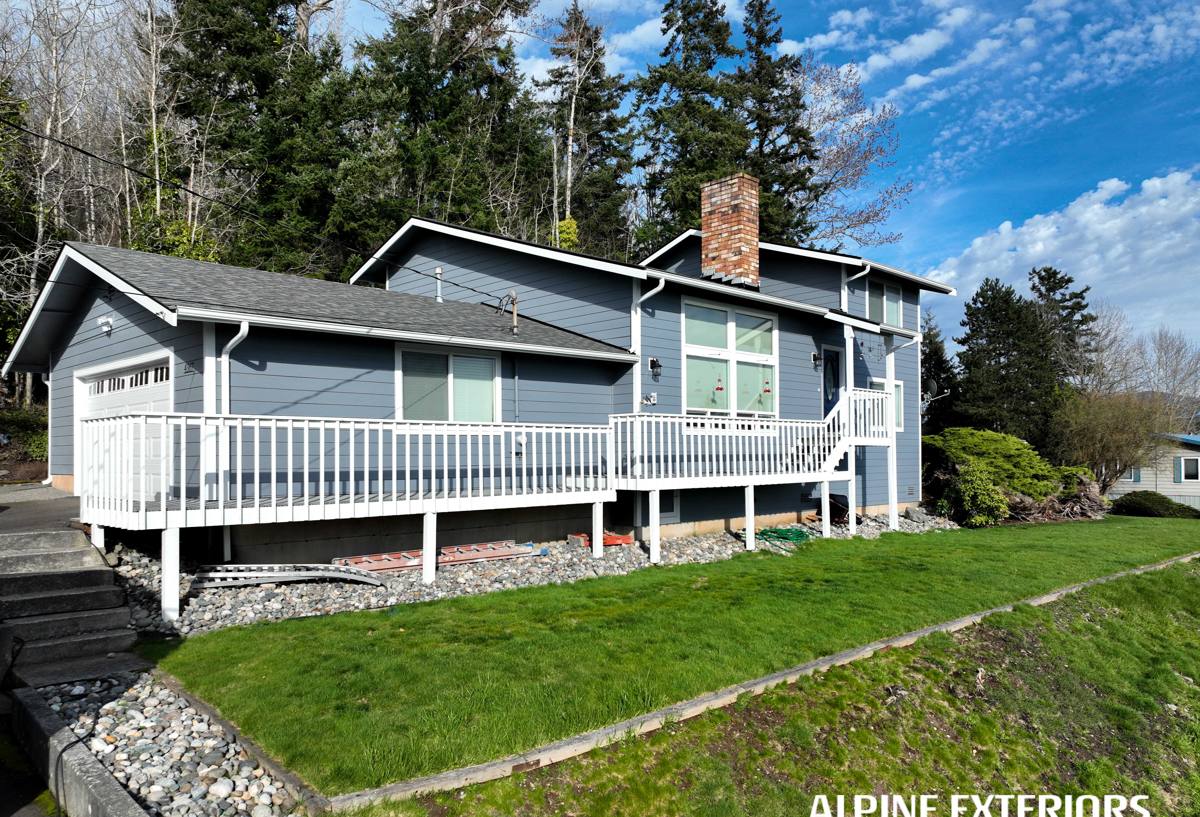
What Our Storms Actually Do to a Roof
Wind Damage
Sustained wind and gusts during a Pacific storm system don't need hurricane speeds to do real damage. Shingles rated for standard wind exposure can still lift at the tab edge when a gust catches a corner that's already lost a little adhesive strength from age or heat cycling. Once a tab lifts and drops back down, the seal is broken even if the shingle looks intact from the ground. That's the damage that gets missed in a quick visual check and shows up as a leak weeks later.
Wind-Driven Rain
Because our storms come in sideways off the water, rain doesn't just fall on a roof — it's pushed up under laps, around vents, and along ridge caps. Flashing that's held up fine for years under normal rainfall can suddenly be the weak point once wind starts driving water uphill against it. This is a big part of why storm damage repair here has to include flashing and penetration details, not just the shingle field.
Debris Impact
South Hill has enough tree cover that limb strikes are a real and recurring cause of storm damage — everything from small branches that puncture a shingle to larger limbs that crack sheathing. Impact damage needs to be checked not just at the visible strike point but around it, since the force can loosen fasteners and shift shingles well beyond where the limb actually landed.
Moss and Trapped Moisture
Our long moss season means most roofs here are carrying at least some moss growth by the time a storm hits, especially on north-facing slopes and shaded sections. Moss holds moisture against the roofing material and lifts shingle edges, which means storm-driven rain has an easier path underneath in areas where moss has already been working. Post-storm repair on a moss-affected roof often means addressing both problems together, because fixing the leak without addressing the moss just invites a repeat.
What a Correct Storm Repair Actually Involves
A lot of storm damage repair in this region gets done as a surface patch — a dab of sealant over a visible tear, a shingle swapped out, done. That approach can look fine for a season and still leave the underlying entry point for water untouched. A repair that actually holds up through our wet season looks different.
- Full-slope inspection, not spot-checking — wind damage rarely stays confined to one shingle, so we walk the affected slope and the ones adjacent to it.
- Underlayment check at the damage site — if water has been getting under the shingle layer, the underlayment and sheathing need to be evaluated, not just covered back up.
- Flashing and penetration review — valleys, vent boots, and any flashing near the damaged area get checked for the wind-driven-rain issues described above.
- Fastener condition — salt air and repeated wet-dry cycles corrode and loosen roofing nails over time; storm stress often finishes the job on fasteners that were already marginal.
- Matching materials correctly — replacement shingles need to match the existing product closely enough that the repair doesn't become the next weak point through mismatched expansion or a poor seal against older, weathered shingles.
Our Process for South Hill Storm Repairs
1. Assessment
We start with a ground and roof-level inspection, looking at the storm-obvious damage as well as the secondary signs — lifted tabs, granule loss in gutters, soft decking underfoot, staining in the attic if accessible. We're honest about what's cosmetic and what's structural; not every storm mark needs a repair, and we'll tell you when it doesn't.
2. Documentation
If you're filing an insurance claim, we document the damage with enough detail to support that process. We work for the homeowner, not the insurer, and we'll give you a straight assessment of what the storm caused versus what was pre-existing wear — insurers look closely at that distinction, and an honest report serves you better than an inflated one in the long run.
3. Repair Plan
We lay out what needs to happen: shingle and flashing replacement, decking repair if water reached that far, and any moss or debris cleanup that's part of preventing a repeat. You get a clear scope before work starts, not a surprise add-on list halfway through.
4. The Work
Repairs are done to match the existing roof system as closely as possible — same or compatible shingle profile, correct nailing pattern for our wind exposure, and flashing detail work that accounts for the wind-driven rain pattern common to this area, not just a standard install.
5. Follow-Up
We check our own work after the next significant rain when that's practical, because a repair that looks watertight on a dry day sometimes reveals a missed spot once wind-driven rain tests it properly.
Storm Repair vs. Full Replacement: Making the Right Call
Not every storm-damaged roof needs to be replaced, and not every roof that looks rough after a storm was actually in good shape beforehand. The honest answer usually depends on how much of the roof's remaining service life the storm used up.
| Factor | Leans Toward Repair | Leans Toward Replacement |
|---|---|---|
| Roof age | Under 10-12 years, healthy elsewhere | Nearing or past typical shingle lifespan |
| Damage extent | Isolated to one slope or a small area | Spread across multiple slopes |
| Pre-storm condition | Minimal moss, granules intact | Heavy moss, widespread granule loss |
| Decking condition | Sound, dry to the touch | Soft, stained, or delaminating |
| Prior repairs | None or few | Multiple past patches in different areas |
We'll always give you the repair option when it's genuinely the right call for the roof's condition and remaining life — we're not going to push a replacement a roof doesn't need.
Why It Matters That We Work South Hill Regularly
A roofing crew that mostly works other parts of Whatcom County or comes up from out of the area doesn't always have a feel for how South Hill's exposure differs from a sheltered lot a few miles down the hill. We know which slopes in this area tend to hold moss longer, which orientations take the worst of the wind-driven rain, and what a normal storm season here does to fasteners and flashing over a few years. That local pattern recognition matters when you're trying to tell the difference between damage from last week's storm and wear that's been building for a while — it affects both the repair plan and, if you're filing one, the insurance claim.
It also means we're not learning the neighborhood on your roof. We've seen enough South Hill homes go through enough Sudden Valley storm seasons to know what actually holds up here and what tends to fail early, and we build that knowledge into every repair.
What to Check After a Storm
- Look for shingle granules collecting in gutters or at downspout outlets — a sign of wind abrasion or impact damage.
- Check the attic (if accessible) for new staining, damp insulation, or daylight showing through the decking.
- Scan the roofline from the ground for shingles that look lifted, curled, or out of alignment with their course.
- Note any branches or debris that landed on the roof, even if they've since rolled or blown off.
- Watch for water stains on interior ceilings in the days following a storm — some leaks take time to show.
- Check flashing around chimneys, skylights, and vent pipes for gaps or visible movement.
If you spot any of these, it's worth getting a professional look before the next storm system finds the same weak spot.
Let's Take a Look
If a recent storm has you wondering whether your South Hill roof took real damage or just cosmetic wear, we're glad to come take an honest look. There's no pressure and no obligation — just a straight assessment from a crew that knows this area's weather and what it does to a roof over time. Use the form below to request a free estimate.