 Sudden Valley
 Why Bellingham Siding Takes More Punishment Than People Expect
Homes around Bellingham and the broader Sudden Valley area sit right at the edge of Puget Sound weather patterns: damp air pulled in off the water, driving rain that comes in sideways during fall and winter storms, and long stretches of the year where surfaces barely get a chance to fully dry out. Add in the tree cover common to Whatcom County neighborhoods and you get a siding environment that's tougher on a wall than most manufacturers' marketing photos ever show.
Salt-tinged marine air accelerates corrosion on fasteners and trim hardware that isn't rated for it. Driving rain finds every gap in flashing, caulking, and butt joints, then works its way behind the cladding instead of running off the face of it. And moss season here isn't a few weeks — on north-facing walls and shaded elevations, moss and algae can be an active problem for most of the year, holding moisture against the siding surface long after a storm has passed.
None of that is exotic. It's just what siding on this part of the map has to deal with, year after year. The material and the installation both have to be chosen with that reality in mind, not with a generic "siding is siding" assumption.
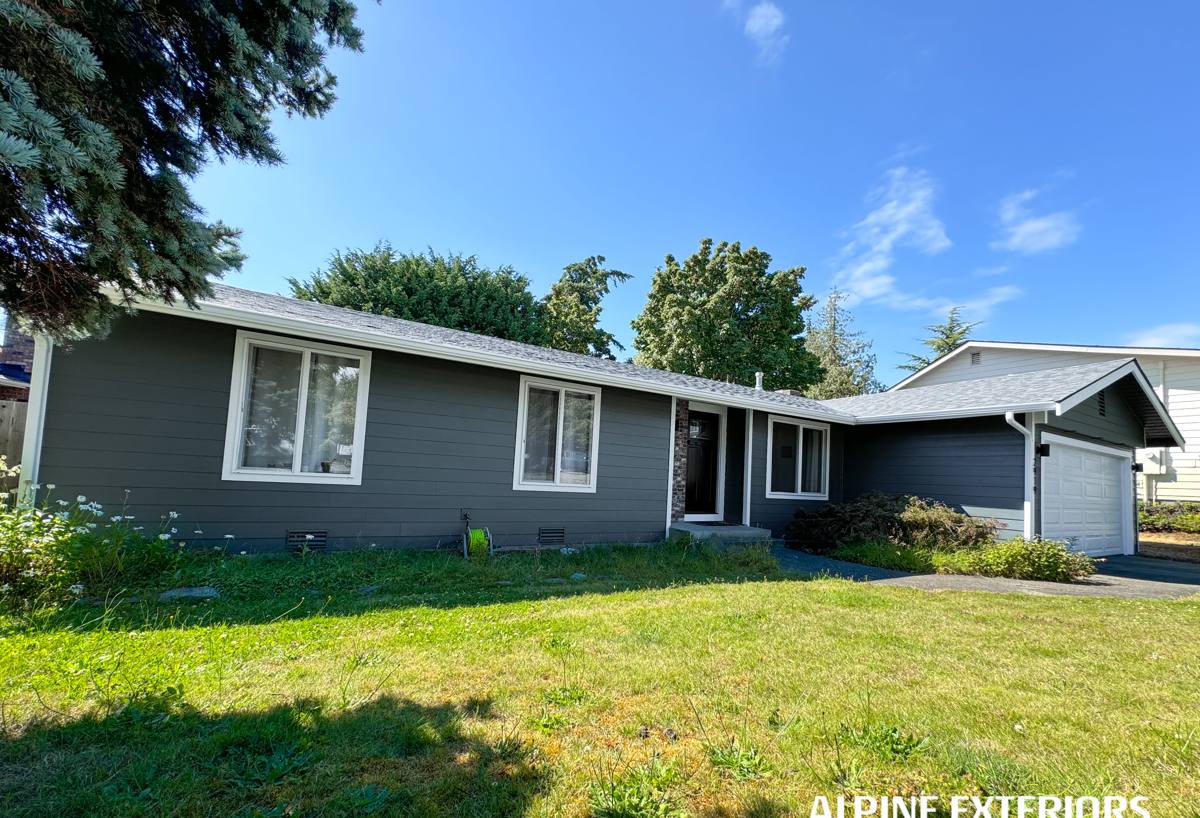
What This Climate Actually Requires From a Siding System
Three things matter more here than in a drier, calmer climate:
- Dimensional stability — the material shouldn't swell, cup, or warp as it cycles between saturated and dry.
- Moisture resistance at the material level — not just a good paint job, but a substrate that doesn't rot, delaminate, or absorb water into its core.
- A factory finish that resists moss and algae staining — because on a shaded Bellingham-area lot, biological growth is a matter of when, not if.
This is the specific reason we install James Hardie fiber cement exclusively and don't offer LP SmartSide, vinyl, Cemplank, Allura, or wood siding as alternatives. Wood-based products, even engineered ones, are more vulnerable to moisture intrusion at cut edges and panel joints — exactly the failure points that driving rain and prolonged dampness exploit. Vinyl expands and contracts with temperature swings and can warp or crack over time, and it doesn't hold paint if a homeowner ever wants to change the color. Fiber cement doesn't have those weaknesses, and James Hardie in particular engineers its HardieZone system specifically for regions like ours.
James Hardie's HZ5 Engineering for the Pacific Northwest
James Hardie makes climate-specific versions of its siding — the HZ10 line for hot, humid Southern climates and the HZ5 line for colder, wetter regions like Western Washington. HZ5 products are formulated and tested for freeze-thaw cycling and sustained moisture exposure, which lines up directly with what a Bellingham-area home actually experiences through a typical winter.
The ColorPlus factory finish is the other piece that matters locally. It's a baked-on, multi-coat finish applied under controlled conditions rather than field-painted on site, and it's formulated to resist fading and hold up against the kind of grime and biological growth that shaded, damp walls attract. A factory finish also means fewer touch-up cycles over the life of the siding compared to field-applied paint, which matters when a house is tucked under trees and hard to access with a ladder every few years.
What a Correct Installation Involves Here
James Hardie siding performs the way it's engineered to only when it's installed to spec. In a climate with this much moisture pressure, the installation details are not optional extras — they're the difference between siding that lasts decades and siding that fails early despite being a premium product.
The details that matter most locally
- Correct clearance between the bottom of the siding and grade, decks, patios, and roof lines, so water has somewhere to go instead of wicking up into the panel.
- Proper weather-resistive barrier and flashing at every window, door, and penetration — this is where driving rain finds its way behind the cladding if it's rushed.
- Fastener spacing and type matched to Hardie's engineering specs, using corrosion-resistant fasteners appropriate for a marine-influenced environment.
- Field-cut edges sealed or back-primed before installation, since an unsealed cut edge is a moisture entry point regardless of how good the factory finish is elsewhere on the panel.
- Butt joints and trim details caulked with a product rated for the movement and moisture cycling the assembly will see.
Skip any of these and you can end up with a home wearing an excellent product that still develops moisture problems behind the wall — the kind of failure that has nothing to do with the siding itself and everything to do with how it went up.
Our Process for Bellingham-Area Homes
We walk every project the same way, adjusted for what the specific house and lot need:
- On-site inspection — we look at existing siding condition, moisture staining, trim and flashing points, and how sun/shade exposure varies around the house, since that affects moss risk and finish choices.
- Scope and product plan — panel or plank profile, ColorPlus color, and trim details laid out before any material is ordered.
- Prep and weather barrier — removal of old siding, inspection of sheathing for hidden moisture damage, and installation of the weather-resistive barrier and flashing system.
- Installation to Hardie spec — correct fastening, clearances, and sealed joints throughout.
- Final walkthrough — checking trim lines, caulking, and touch-up needs before we consider the job done.
If we find sheathing damage or rot during tear-off — which isn't unusual on older homes in wetter parts of Whatcom County — we stop and talk it through with the homeowner before covering anything up. Siding installed over compromised sheathing doesn't hold up, no matter how good the siding is.
Why a Crew That Already Works This Area Matters
Siding installation quality varies more by crew than by brand. A contractor who works Bellingham and the surrounding Sudden Valley communities regularly has already seen how local wind-driven rain patterns, shade cover, and lot drainage tend to play out on real houses — not just in a training manual. That translates into practical judgment calls: where to add extra flashing attention, which elevations need the most moss-resistant color and finish planning, and how to sequence a tear-off around our wetter months so sheathing isn't left exposed longer than it should be.
There's also a simpler advantage: familiarity with local permitting expectations and a working relationship with regional material suppliers, which keeps a project moving instead of stalling on paperwork or backordered trim pieces.
Cost Factors for a Bellingham-Area Hardie Project
| Factor | Why It Moves the Price |
|---|---|
| Home size and wall complexity | More corners, dormers, and trim details mean more cutting, flashing, and labor time. |
| Tear-off and sheathing condition | Hidden moisture damage found during removal adds repair work before new siding goes up. |
| Siding profile and plank width | Lap siding, panel siding, and shingle-style products differ in material and labor cost. |
| Trim and accessory scope | Corner boards, window trim, and fascia work add to both material and install time. |
| Site access | Steep lots, mature landscaping, or limited staging space near the house affect labor efficiency. |
| Color and finish selection | Standard ColorPlus colors versus custom orders can affect lead time and cost. |
Living With Hardie Siding in a Moss-Heavy Climate
Even with a moss-resistant factory finish, no siding is entirely maintenance-free in a climate this damp. What changes with James Hardie is how much maintenance is actually required and how forgiving the material is when upkeep slips for a season.
- Rinse siding periodically, especially on shaded, north-facing walls where moss and algae take hold fastest.
- Keep gutters clear so overflow doesn't run down the siding face repeatedly in one spot.
- Trim back vegetation that keeps a wall section shaded and damp longer than the rest of the house.
- Inspect caulking at trim and joints every couple of years, since caulk is the first thing to wear out, well before the siding itself.
Because the color is baked into the factory finish rather than field-painted, a rinse-down restores appearance without the risk of stripping a coat of paint the way field-applied finishes can wear thin over time.
What to Check Before Hiring Anyone for a Hardie Installation
- Are they James Hardie-focused, or is Hardie one of several competing products they'll sell you based on margin?
- Can they explain their flashing and moisture-barrier approach in plain terms, not just "we follow code"?
- Do they talk through clearance requirements at grade, decks, and rooflines specific to your home?
- Will they show you ColorPlus color options and explain warranty coverage before you commit?
- Do they have a plan for what happens if they find sheathing damage during tear-off?
If a contractor can't answer those clearly, that's worth knowing before the tear-off starts, not after.
If you're weighing a siding replacement on a Bellingham-area home, we're happy to take a look and walk through what your house specifically needs. The estimate is free, there's no pressure, and you'll get a straight answer about scope and cost before anything is decided — just fill out the form below.