 Sudden Valley
 Putting windows into a house that's still under frame is a different job than swapping out an old window in a finished wall, and it comes with a different set of stakes. Get it right during new construction in Cordata and the window openings stay dry for decades. Get it wrong — skip a step in the flashing sequence, use the wrong sealant, ignore how the siding will terminate against the frame — and you won't see the problem until the drywall is already up and water has been finding its way behind the wall for a year or two. We install new-construction windows for builders and homeowners in the Cordata area who want the job done once, correctly, before the walls close in.
Why New-Construction Window Installation Is Its Own Trade
"New-construction" windows aren't just a product category — they're a nail-fin window paired with an installation sequence that only works before the exterior wall is finished. The window has a flange around the perimeter that gets integrated into the wall's water-resistive barrier (housewrap or building paper) in a specific shingle-lapped order: sill flashing first, then the window itself, then jamb flashing, then head flashing, each piece overlapping the one below it so water is always directed outward and down, never trapped behind the next layer. Miss that order, or use the wrong tape or flashing product for the sheathing underneath it, and the window can look perfect from day one while quietly failing at the flashing.
This matters more here than in a lot of places. Whatcom County sees long stretches of driving, wind-pushed rain rather than gentle vertical rain, which means water gets forced sideways into wall assemblies at window openings far more than in drier climates. Add the salt-laden air that moves in off the water and a moss season that can run most of the year on shaded elevations, and you've got conditions that punish any shortcut in the flashing detail. New construction is the one point in a home's life when correcting that is easy — before the siding goes on, every flashing lap is visible and fixable. After that, it's a repair, not an installation.
What a Correct Installation Sequence Looks Like
- Rough opening checked for square, level, and correct size before the window ever gets set
- Sill pan flashing installed to shed any water that gets past the window back out to the exterior, not down into the framing
- Window set, shimmed plumb and square, and fastened per the manufacturer's schedule — not just "nailed until it feels solid"
- Jamb flashing lapped over the sill flashing and under the housewrap on the sides
- Head flashing installed last, lapped over the housewrap above so water sheds over the top of the window, never behind it
- Housewrap integration checked around the full perimeter before siding installation begins
- Interior air-sealing at the rough opening addressed separately from the exterior weatherproofing — the two jobs solve different problems and both matter
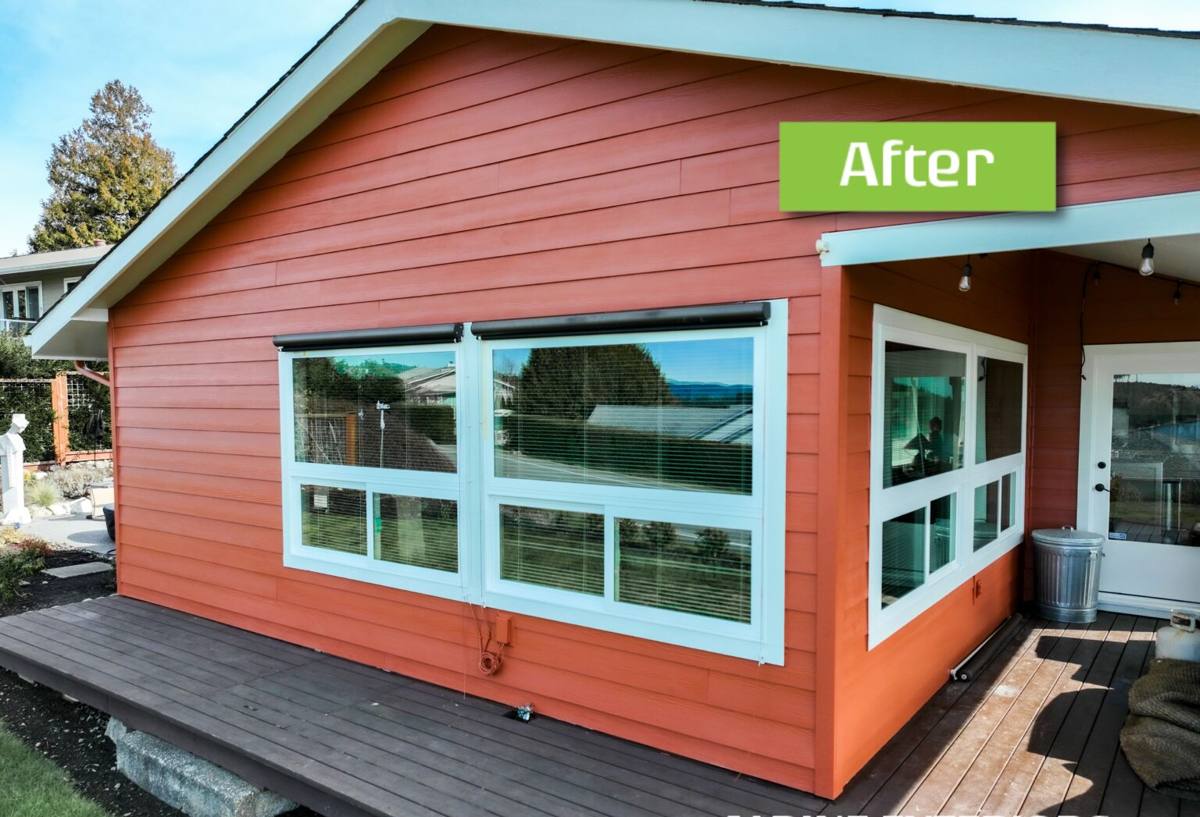
What Cordata Homes Need From New-Construction Windows
Cordata sits in the same weather pattern as the rest of Whatcom County — wet falls and winters, wind off the water, and enough cloud cover on north and west-facing walls that moss and algae get a long head start if a wall assembly holds moisture at all. New builds and additions here need window openings that assume rain will hit the wall sideways, not just fall straight down, and flashing details built for that reality rather than a generic installation.
We also pay attention to how the window's flashing will interact with whatever siding is going over it. Fiber cement, vinyl, and wood siding all terminate against a window trim differently, and the flashing sequence has to leave the right reveal and the right lap for whichever product is specified for the job. Coordinating that now — while the wall is still open — is a lot cheaper than adjusting trim details after the siding crew has already started.
Product Considerations for New Construction
New-construction windows come in a range of frame materials and glazing packages, and the right choice depends on the wall assembly, the orientation of the house, and the builder's or owner's budget. We install to the specifications given for a project, and where we're asked for a recommendation, we favor products with a proven nail-fin flashing flange, a documented installation instruction set from the manufacturer, and glazing suited to this region's driving rain and long gray stretches — low-E coatings that help with both winter heat loss and summer glare off the water.
Frame Material Comparison
| Frame Type | Typical Strengths | Trade-offs in This Climate |
|---|---|---|
| Vinyl | Lower cost, low maintenance, good energy performance | Frame can expand/contract with temperature swings; quality varies widely by manufacturer |
| Fiberglass | Very stable dimensionally, strong, paintable | Higher upfront cost than vinyl |
| Wood/clad-wood | Traditional appearance, good insulator | Exterior cladding and flashing detail must be flawless — any lapse invites moisture into the wood core over time |
| Aluminum | Slim sightlines, durable frame | Poor insulator unless thermally broken; can be prone to condensation in cold, damp stretches |
Our Process on a New-Construction Job
1. Plan Review and Rough Opening Verification
Before any window arrives on site, we review the window schedule and check rough openings against actual window dimensions. Catching a framing error at this stage costs nothing; catching it after the windows are ordered and cut costs time and money.
2. Sill Flashing and Water-Resistive Barrier Prep
We install sill pan flashing and integrate it with the wall's housewrap before the window goes in. This is the step most often rushed on a tight schedule, and it's the one that determines whether a leak, if it ever happens, drains harmlessly to the outside or ends up in the wall cavity.
3. Setting and Fastening the Window
Each window is set plumb, level, and square, then fastened according to the manufacturer's schedule — the pattern and spacing of fasteners that keeps the frame from racking or bowing and keeps the manufacturer's warranty intact.
4. Jamb and Head Flashing
Flashing goes on in the correct shingle-lap order, integrated with the housewrap so every layer directs water outward and down. We check this visually before it gets covered by siding, because it's the last point anyone will ever see it.
5. Final Walkthrough Before Siding
We walk the full perimeter of every window opening before siding crews start, confirming flashing laps, fastening, and housewrap integration are correct. On projects where we're also doing the siding, this is an internal handoff; on projects where another crew is siding the house, we make sure our work is documented and ready for their install.
Coordinating With Builders and Other Trades
New-construction window installation happens at a specific point in a build schedule — after the wall is framed and wrapped, before siding starts. That means we're usually coordinating with a general contractor or builder's timeline rather than working in isolation. We show up when the wall is ready, install correctly, and communicate clearly with whoever's scheduling the trades that follow, so the project keeps moving instead of stalling waiting on a window crew.
Signs a New-Construction Window Job Was Rushed
- Flashing tape or building paper installed in the wrong lap order (should always shed water downward and outward)
- Gaps or voids in the flashing where two pieces should overlap
- Windows fastened without shims, leaving the frame able to rack under wind load
- No sill pan flashing at all — water landing directly on bare sheathing
- Housewrap taped to the window flange with generic tape not rated for long-term exterior exposure
- Trim or siding details planned without accounting for the window's actual flashing dimensions
Why Hire a Crew That Already Works in Cordata
New-construction window installation is unforgiving of shortcuts, and the consequences of a bad flashing job don't show up for months or years — long after the crew that did it has moved on. A crew that regularly works new-construction projects in and around Cordata and the rest of Whatcom County has already seen how this region's driving rain and moss-prone shade patterns expose weak flashing details, and builds every installation assuming those conditions, not average-climate conditions from a generic install guide. That's the difference between a window that's dry for the life of the house and one that becomes a hidden problem behind the siding.
If you're building or adding on in the Cordata area and need new-construction windows installed correctly the first time, we're happy to walk the site, review your window schedule, and give you a straightforward, no-pressure estimate using the form below.