 Sudden Valley
 Deck Building in Edgemoor: Built for the Water, Not Just the View
Edgemoor sits close to the water, and that proximity is exactly why decks here take more abuse than decks a few miles inland. Salt-laden air off the bay, driving rain that comes in sideways during winter storms, and long stretches of gray, damp weather that keep wood surfaces wet for days at a time all combine to shorten the life of a deck that wasn't built with this specific climate in mind. Sudden Valley Siding builds and repairs decks throughout Whatcom County, and Edgemoor projects get the same attention to moisture management and material selection that we'd give any waterfront-adjacent property — because that's what actually determines whether a deck lasts fifteen years or thirty.
This page is specifically about deck building for Edgemoor homes. We're not going to give you a generic rundown of deck styles you could find anywhere. Instead, we're covering what this particular stretch of coastline does to a deck over time, what a properly built deck needs to resist it, and how we approach the job so you're not calling us back in five years for repairs that should never have been necessary.
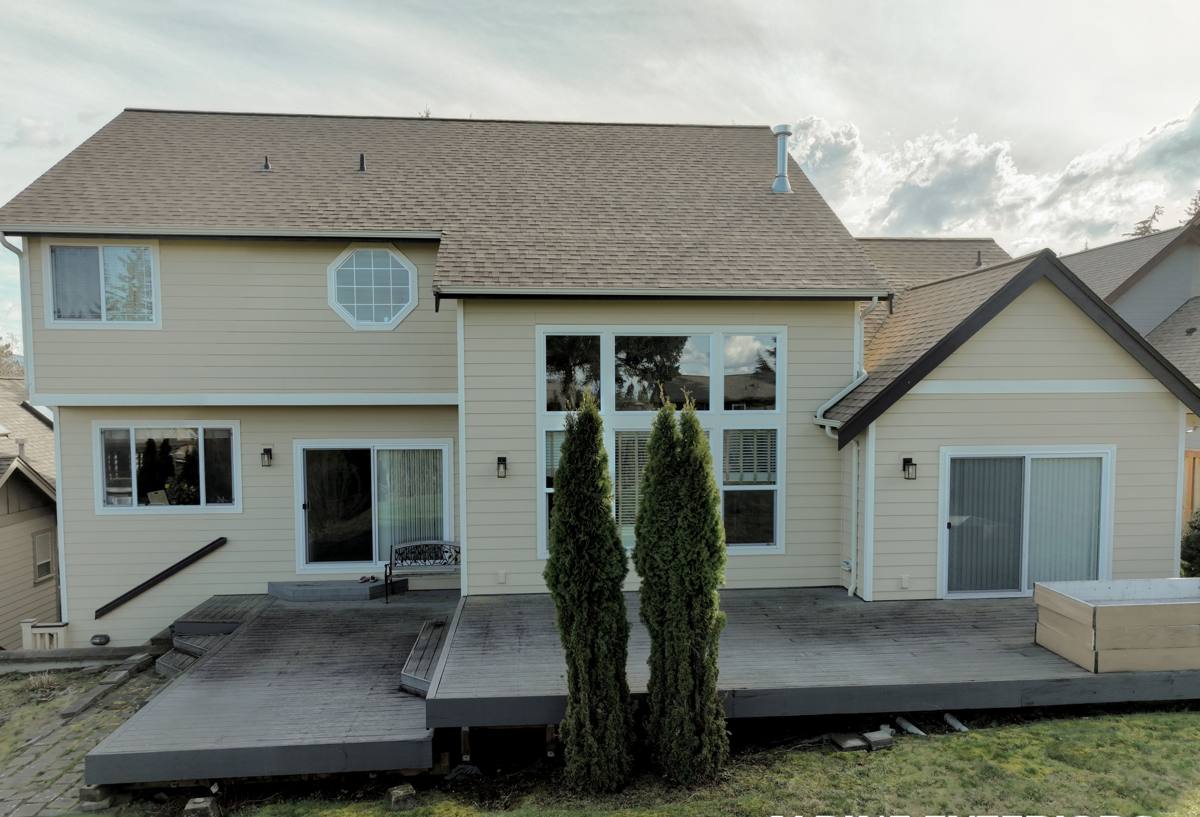
What Salt Air and Coastal Moisture Do to a Deck
Homes in Edgemoor deal with a combination of conditions that's tougher on exterior wood and metal than most of the county sees. It's worth understanding the mechanics before you decide what to build.
Salt Air and Fastener Corrosion
Airborne salt accelerates corrosion on any fastener, bracket, or connector that isn't rated for it. Standard galvanized screws and joist hangers can start showing rust streaks within a couple of seasons in a salt-air environment, and once a fastener corrodes it loses holding strength — which is a structural problem, not just a cosmetic one. This is one of the first things we check when we're asked to look at an older deck near the water: the framing lumber is often fine, but the hardware holding it together is failing.
Driving Rain and Water Intrusion
Storms coming off the water don't just fall straight down — they drive in at an angle, which means rain gets pushed into joints, under ledger boards, and behind fascia in ways that vertical rain wouldn't reach. Any gap in flashing or any spot where two boards meet without proper sealing becomes a place where water collects and sits. Wood that stays wet for extended periods is what leads to rot, and rot doesn't announce itself — by the time you can see it, it's usually spread further than it looks.
Moss, Algae, and the Long Wet Season
Whatcom County's moss season runs long, and a deck surface that doesn't drain and dry quickly becomes a growing surface for moss and algae. Beyond being slippery and unattractive, moss holds moisture directly against the decking material, which speeds up exactly the kind of wood breakdown or coating failure you're trying to avoid. Deck orientation, gap spacing between boards, and surrounding tree cover all affect how much of a moss problem a given deck will have.
What a Correctly Built Edgemoor Deck Requires
Given those conditions, a deck built for this area needs a few things that a deck built somewhere drier and inland might not prioritize as heavily.
- Corrosion-resistant fasteners and connectors — stainless steel or coated hardware rated for coastal/high-moisture exposure, not standard-grade galvanized
- Proper ledger board flashing — the connection where a deck meets the house is the single most common source of hidden rot; it needs correctly lapped flashing, not just caulk
- Adequate board spacing and slope — decking needs consistent gaps and a slight pitch away from the house so water actually sheds instead of pooling
- Ventilated substructure — airflow underneath the deck matters as much as what's on top; blocked or low-clearance framing traps moisture against joists
- Material matched to maintenance expectations — some materials need yearly attention to perform well here, others need almost none; that tradeoff should be a decision you make knowingly, not one you discover later
- Footings sized and set for local soil and frost conditions — undersized or shallow footings are a recurring issue we find on older decks in the area
Decking Material Options: Honest Tradeoffs for This Climate
There's no single "best" decking material — there's a best material for your budget, your maintenance appetite, and how much salt exposure your specific lot gets. Here's how the common options actually compare when you factor in Edgemoor's conditions.
| Material | How It Handles Salt Air & Moisture | Maintenance | General Cost Range |
|---|---|---|---|
| Pressure-treated wood | Good if properly sealed and re-coated on schedule; the treatment resists rot but the surface still needs upkeep | Annual cleaning and re-sealing/staining | Lowest upfront cost |
| Cedar | Naturally rot- and insect-resistant, but salt air and moss will gray and weather it faster without regular care | Periodic cleaning, oiling, or staining to maintain appearance and protection | Mid-range |
| Composite decking | Doesn't rot or absorb moisture the way wood does; performs well in salt air and wet conditions with minimal issue | Occasional washing; no sealing or staining required | Higher upfront, lower long-term labor |
| PVC/capped polymer | Fully resistant to moisture absorption and salt corrosion; among the most stable options for this environment | Occasional washing only | Highest upfront cost |
We'll walk through these options with you honestly, including what each one actually costs to own over time, not just to install. A cheaper material that needs yearly maintenance you won't keep up with often ends up costing more than a higher-upfront material that just holds up on its own.
Framing and Structure: Where Most Deck Failures Actually Start
Homeowners tend to focus on the decking surface — the boards you walk on — because that's what you see. But the framing underneath is what determines whether the deck is safe and how long it lasts, and it's also where most of the coastal-climate damage happens first because it's hidden from view.
When we build a new deck in Edgemoor, or when we're asked to evaluate an existing one, the framing gets the same scrutiny as the surface material:
- Ledger board attachment and flashing at the house connection
- Joist hanger condition and fastener corrosion
- Post and footing depth relative to frost line and soil conditions
- Beam sizing for the actual span and load, not just what's minimally code-compliant
- Clearance and airflow underneath the structure
A deck can have brand-new, attractive decking boards on top of framing that's quietly failing underneath. If you're getting a deck rebuilt or resurfaced, it's worth asking your contractor whether they're actually inspecting the substructure or just replacing what's visible.
Railings, Stairs, and Code Considerations
Railing and stair details matter more than they get credit for, both for safety and for long-term durability. Railing posts need secure structural attachment — not just surface-mounted brackets — because they take lateral loads every time someone leans on them. In a salt-air environment, railing hardware is subject to the same corrosion concerns as the deck framing, so it needs the same material considerations.
Whatcom County building code sets requirements for railing height, baluster spacing, and stair geometry, and depending on the size and height of your deck, a permit may be required. We handle the permitting conversation as part of the process rather than leaving you to figure out what applies to your specific project.
Our Deck Building Process
We keep the process straightforward and transparent from the first visit to the final walkthrough.
- On-site assessment. We look at your lot, existing structure (if there is one), sun and wind exposure, and proximity to the water to understand what conditions the deck will actually face.
- Material and design discussion. We go over decking material options, framing needs, and layout based on how you plan to use the space and how much maintenance you want to take on.
- Written estimate. You get a clear, itemized estimate before any work starts — no surprise add-ons.
- Permitting. If your project requires a permit, we handle that process rather than leaving it to you.
- Construction. Framing first, with full attention to flashing, fasteners, and structural connections, followed by decking, railing, and stairs.
- Final walkthrough. We go over the finished deck with you, including any maintenance recommendations specific to the material you chose.
New Builds vs. Repairs and Replacements
Not every project starting point is the same, and the right approach depends on what you're working with.
New Deck Construction
If you're building from scratch, this is the easiest scenario to get right, because every material and structural decision can be made up front with Edgemoor's conditions in mind rather than working around what's already there.
Deck Repair
Not every problem means a full rebuild. Localized rot at a ledger board, failing fasteners, or a section of decking that's degraded faster than the rest can often be repaired if the core structure is sound. The key is catching it before the damage spreads into the framing.
Full Replacement
If the substructure has widespread rot, undersized footings, or corrosion throughout the hardware, patch repairs won't hold and a full rebuild is the more honest recommendation. We'll tell you plainly which category your deck falls into rather than upselling a rebuild you don't need or patching one that's genuinely done.
Signs Your Existing Deck Needs Attention
A few checks you can do yourself before calling anyone:
- Soft or spongy spots when you walk across the decking
- Visible rust streaking around fasteners or connectors
- Gaps or separation where the deck meets the house (ledger board area)
- Wobble or movement in railing posts
- Persistent moss or algae buildup that doesn't clear up between cleanings
- Visible cracking, splintering, or graying that goes beyond normal weathering
Any one of these is worth a professional look. Structural issues in decks don't improve on their own, and moisture damage in this climate tends to progress faster than homeowners expect.
Why Hire a Crew That Already Works in Edgemoor
Deck building isn't identical everywhere in Whatcom County. A crew that mostly works dry, inland sites doesn't necessarily think about salt-rated hardware or driving-rain flashing details as a default — they might not need to, where they usually work. We work throughout Sudden Valley and the surrounding Whatcom County area, including waterfront-adjacent neighborhoods like Edgemoor, so those considerations are built into how we approach every project here, not treated as an upgrade or an afterthought.
That local familiarity also means we're not guessing about how a given material or fastener choice will actually hold up a few years in — we've seen what does and doesn't work on decks facing this exact combination of salt air, rain, and moss exposure.
If you're planning a new deck or need an honest evaluation of one you already have, we're happy to take a look and talk through your options. Reach out for a free, no-pressure estimate using the form below.