 Sudden Valley
 Why Barkley Homes Need Siding Built for This Climate
Barkley sits close enough to the water and tree cover that its homes take a different kind of beating than siding manufacturers often assume. You've got salt-tinged air drifting in off the bay, long stretches of driving rain that comes sideways as often as it comes straight down, and a moss season that can run eight or nine months out of the year in the shaded, north-facing sides of a lot. None of that is dramatic on any given day. It's the accumulation that does the damage — moisture that never fully dries between storms, salt residue that slowly breaks down cheaper coatings, and moss and algae that hold water against a wall long after the rain has stopped.
Siding in Whatcom County isn't just a cosmetic choice. It's the one layer of the house doing daily battle with a genuinely wet, coastal-influenced climate. A product that performs fine in a drier inland market can fall apart here faster than its warranty period would suggest. That's the backdrop for every recommendation on this page.
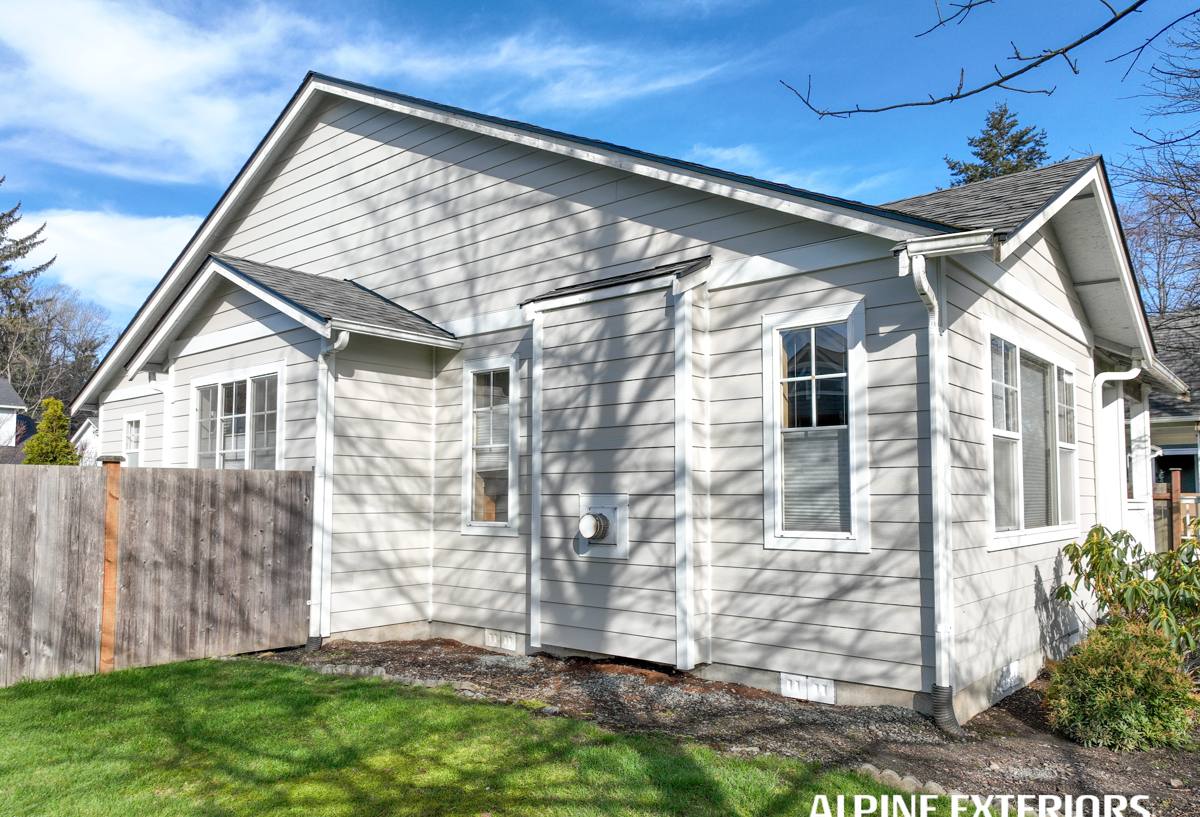
What "Correct" Fiber Cement Siding Looks Like Here
Fiber cement is not a one-size-fits-all product, and it's not automatically climate-proof just because it's cement-based. What makes it perform well in Barkley comes down to three things: the right product engineering for a wet marine climate, a factory finish that doesn't rely on field-applied paint to keep water out, and installation details that account for how water actually moves across a wall in this area.
Product engineering matters more here than almost anywhere
James Hardie is the only fiber cement manufacturer that engineers its boards differently by climate zone rather than selling one formulation nationwide. For a market like ours — high humidity, heavy annual rainfall, salt exposure — that means a board formulated to resist moisture-related swelling, cracking, and moss/mildew growth, rather than a generic product that happens to work here well enough.
Factory-applied finish, not field paint
ColorPlus finish is baked on at the factory under controlled conditions, which gives far more even, durable coverage than field-painted siding — primed boards that get their color coat on-site, exposed to whatever weather shows up that week. In a climate where you might get three dry days in a row if you're lucky, that difference in finish quality shows up years sooner as fading, chalking, or peeling on lesser products.
Installation details that respect local water behavior
Correct fiber cement installation in a wet coastal climate means proper rain-screen or drainage-plane detailing behind the siding, correctly flashed and caulked butt joints, starter strips set to the right clearance off grade and hardscape, and fastener patterns that match the manufacturer's spec for wind and moisture exposure. Skipping any one of these doesn't usually cause a visible problem in year one. It shows up in year five or six as trapped moisture, staining, or siding that never quite dries out behind the surface.
The Moss and Algae Problem, Specifically
Moss doesn't just look bad — it holds moisture directly against the siding surface for extended periods, which is exactly the condition that breaks down lesser materials and finishes over time. Homes in Barkley with mature tree cover, north- or west-facing walls, or lots that stay shaded through the wet months see this more than most. A few things make a real difference:
- Adequate roof overhangs and gutter function so water isn't sheeting directly down the wall face
- Landscaping kept back from siding so foliage isn't holding damp air against the wall
- A factory finish dense enough to resist organic growth taking hold in the surface texture
- Proper clearance between the bottom siding course and grade, decking, or soil
- Periodic gentle washing — moss and algae are a maintenance item, not a defect, but they're worth staying ahead of
None of this eliminates moss entirely — nothing does, in this climate — but it's the difference between an occasional wash-down and a wall that's fighting a losing battle against trapped moisture.
Why We Only Install James Hardie
We get asked fairly often about other fiber cement brands, and occasionally about vinyl or engineered wood products. Our answer is the same every time: we standardized on James Hardie because it's the product we're confident holding up in this specific climate, backed by a manufacturer warranty structure we're comfortable standing behind. That's not a knock on every alternative on the market — it's a professional line we've drawn based on what we've seen perform, and what we're willing to put our name on when we hand a homeowner the keys to a finished job.
Practically, that means every Barkley project we take on uses Hardie's HZ5 product line — the version of their fiber cement engineered specifically for climates like ours, with wetter weather and moss/mildew exposure factored into the formulation rather than treated as an afterthought.
Our Process for a Barkley Fiber Cement Project
1. On-site assessment
We walk the property and look at more than just the siding that's failing. Exposure direction, overhang depth, drainage patterns, existing moisture damage, and how the current wall assembly is put together all factor into the plan.
2. Removal and sheathing check
Old siding comes off and we inspect the sheathing and framing underneath before anything new goes up. This is the point where hidden moisture damage — if any exists — gets found and dealt with, rather than sealed behind new siding.
3. Weather-resistive barrier and drainage plane
We install or verify a proper weather-resistive barrier with a drainage gap behind the siding, which is the detail that lets any moisture that does get past the surface actually drain and dry instead of sitting against the wall.
4. Installation to manufacturer spec
Fastener spacing, joint treatment, clearances, and flashing details follow James Hardie's published installation requirements for our climate zone — not a generalized approach borrowed from drier-market projects.
5. Final walkthrough
We go over the finished work with the homeowner, including basic maintenance expectations for this climate — what to watch for, what's normal, and what isn't.
Cost Factors for a Barkley Fiber Cement Project
Every home is different, but the same handful of factors move the price up or down on most projects in this area. Rather than quote a number that won't mean much without seeing the house, here's what actually drives cost:
| Factor | Why It Matters Here |
|---|---|
| Extent of hidden moisture damage found at removal | Coastal homes with prior moisture intrusion sometimes need sheathing or framing repair before new siding goes on |
| Home size and wall complexity | Dormers, multiple gables, and cut-up wall lines take longer to flash and fit correctly |
| Trim and accessory scope | Fascia, soffit, and trim work bundled with siding affects both material and labor cost |
| Access and site conditions | Slopes, tree cover, and tight lot lines common in this area affect scaffolding and staging time |
| Product line and color selection | ColorPlus color choice and board profile affect material pricing within the Hardie lineup |
Why Hiring a Crew That Already Works Barkley Matters
A siding crew that's worked this specific area knows which walls take the worst of the weather, how the moss cycle behaves on shaded lots, and what drainage and flashing details actually hold up here versus what looks fine on paper. That's different from general fiber cement experience. A crew that's only installed in drier, inland markets can do technically correct work by a generic spec and still miss the details that matter specifically for Whatcom County's rainfall and salt exposure. Local experience also means faster, more accurate assessments — we've seen the failure patterns before, so we know what to check for at the start rather than discovering it mid-project.
Signs Your Current Siding Is Losing the Fight
- Persistent dark streaking or green/black growth that returns quickly after washing
- Soft spots, bubbling, or visible warping, especially on north- or west-facing walls
- Paint that's peeling or chalking heavily rather than just fading evenly
- Visible gaps or separation at butt joints and corners
- A musty smell near exterior walls, which can indicate moisture getting behind the siding
Any one of these on its own isn't necessarily an emergency, but they're worth a professional look before the next wet season adds to the problem.
If you're weighing a siding project in Barkley or elsewhere in Sudden Valley, we're happy to take a look and give you a straightforward, no-pressure estimate — no obligation, just an honest read on what your home needs.