 Sudden Valley
 Fairhaven's Climate Is Harder on Siding Than Most Homeowners Realize
Fairhaven sits close enough to Bellingham Bay that salt-laden air is a daily fact of life for anything on the exterior of a house — trim, fasteners, paint, and especially siding. Add Whatcom County's long wet season, with driving rain that comes in sideways off the water, and you've got a combination that punishes materials not built to handle it. Then there's moss. Northwest Washington's mild, damp winters give moss and algae months to establish themselves on any siding surface that holds moisture, and once established, they hold even more moisture against the wall behind them.
None of this is exotic weather. It's just persistent. A siding product that performs fine in a dry climate, or even in a milder coastal one, can start showing problems here within a few years — not because it's a bad product everywhere, but because it's the wrong product for this specific combination of salt, rain, and shade-driven moss growth. That's the lens we use on every Fairhaven job: not "what's popular" or "what's cheapest," but "what actually holds up here."
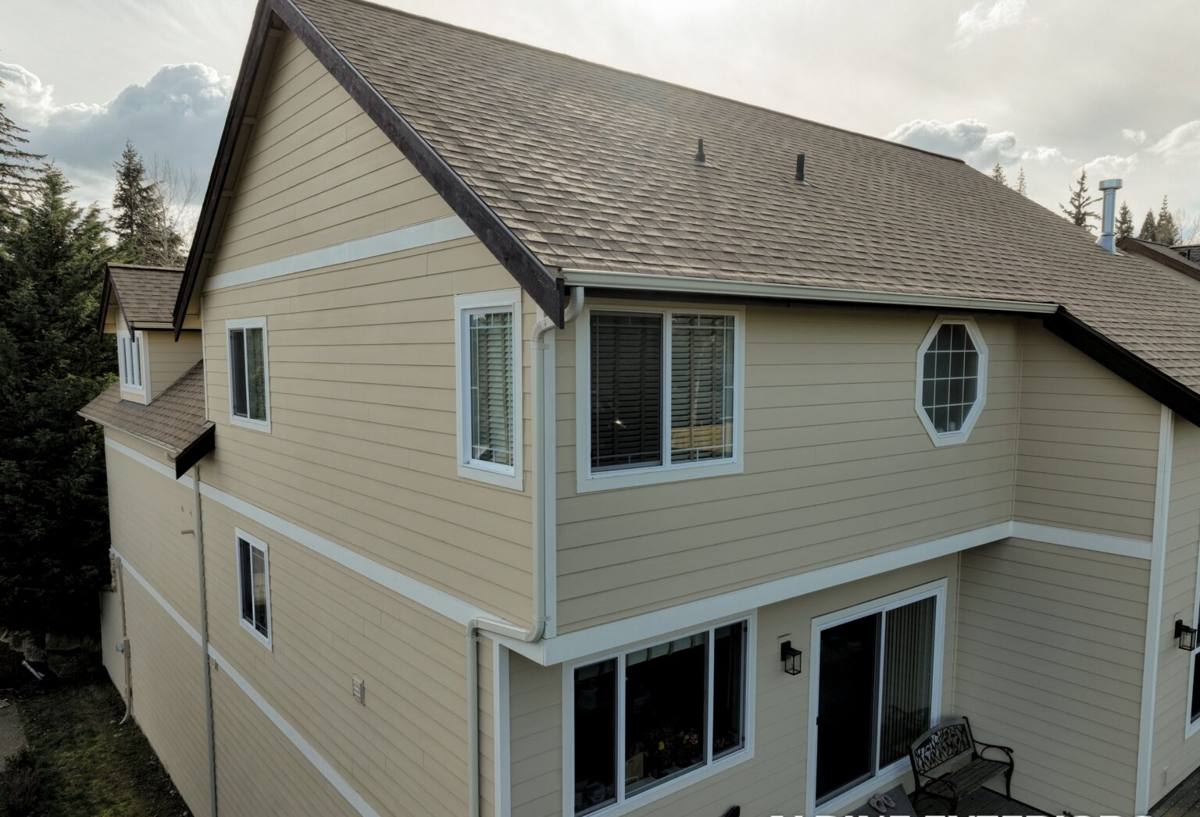
What James Hardie Siding Is Built to Handle
James Hardie fiber cement siding is made from cement, sand, and cellulose fiber, cured into a dense, stable board. That composition matters for a coastal Whatcom County home in a few concrete ways:
- It doesn't rot. Unlike wood-based products, fiber cement has no organic fiber content for moisture to break down over time.
- It's dimensionally stable. It doesn't swell and shrink with humidity swings the way wood and some engineered wood products do, which means joints and caulk lines stay tighter longer.
- It's non-combustible. Not a climate factor specific to Fairhaven, but a real durability and insurance advantage worth mentioning.
- The factory finish (ColorPlus) is baked on, not field-applied. That finish is formulated to resist fading and holds up better against salt exposure than a standard field-applied paint job, and it comes with its own finish warranty separate from the substrate warranty.
James Hardie also makes climate-engineered product lines — HZ5 for harsher, wetter climates and HZ10 for milder ones — engineered specifically for regional moisture and freeze-thaw conditions. For a home exposed to bay winds and sustained wet weather, using the correct HZ designation for our zone isn't a minor spec detail; it's part of what makes the installation actually match the climate it's going into.
Why We Only Install James Hardie
We don't install LP SmartSide, vinyl, Cemplank, Allura, primed spruce, or cedar. That's not because those products have no legitimate use anywhere — it's because after years of doing this work in salt air and heavy rain, we've settled on one system we trust to perform consistently in this specific climate and stand behind our labor on. Vinyl can warp and fade faster under UV and thermal cycling, and its seams give moisture a path in. Engineered wood siding is only as good as its factory coating and is more sensitive to installation error around moisture. Untreated wood siding like cedar or primed spruce needs an ongoing paint and maintenance commitment most homeowners underestimate, especially in a climate that keeps surfaces damp for months at a time. Fiber cement, done correctly, removes most of that maintenance burden and rot risk. Standardizing on one product also means our crews install it constantly — they're not relearning a new material's quirks on every job.
What a Correct James Hardie Installation Actually Involves
James Hardie siding is only as good as the installation behind it. The board itself resists moisture and rot, but the assembly around it — water-resistive barrier, flashing, fastening, gaps — is what determines whether water gets managed or trapped. A correct install includes:
- A continuous water-resistive barrier (housewrap) installed shingle-style so every seam sheds water downward, with all penetrations properly flashed and taped.
- Flashing at every window, door, and roofline intersection, integrated with the barrier rather than just caulked over the top.
- Correct fastener type, spacing, and depth — Hardie specifies this precisely, and over- or under-driven nails are one of the most common installation defects we find on inspection.
- Proper clearance at the bottom edge of the siding from grade, decks, patios, and roof lines, so splash-back and standing water don't sit against the board.
- Caulking only where Hardie's install guide calls for it — not as a substitute for correct flashing.
- Painted or factory-finished cut edges, since a raw cut edge left exposed is a moisture entry point regardless of how good the board itself is.
Skip or rush any one of these steps and you can end up with moisture problems behind siding that's technically rated to resist moisture. This is the part of the job that separates a correct James Hardie installation from one that just looks right from the curb.
Comparing Siding Options for Coastal Whatcom County Conditions
| Factor | James Hardie Fiber Cement | Vinyl | Untreated Wood / Primed Spruce |
|---|---|---|---|
| Salt air resistance | Strong — inorganic material, factory-baked finish | Moderate — can chalk and fade faster near the bay | Weak without diligent repainting |
| Moisture / rot risk | Very low when correctly installed and flashed | Low material rot risk, but seams can trap moisture | High — organic material is vulnerable over time |
| Moss/algae resistance | Good; smooth factory finish sheds growth more easily | Fair; textured surfaces can hold moisture | Poor; porous surface promotes growth |
| Maintenance | Occasional wash; repaint only if ever needed decades out | Low, but panels can't be spot-repainted to match | Regular repainting and sealing required |
| Fire resistance | Non-combustible | Combustible, can melt/deform | Combustible |
This isn't a knock on every alternative in every climate — it's why, specifically in a bay-adjacent, high-moisture, moss-prone area like Fairhaven, fiber cement is the product we're willing to warranty our installation work on.
Our Process on a Fairhaven Job
1. Site Assessment
We walk the home and look specifically for what our climate causes: moisture staining, soft spots near grade or roof transitions, existing moss buildup, and areas shaded enough to stay damp longer than the rest of the house. This tells us where extra flashing attention and drainage detailing matter most.
2. Tear-Off and Substrate Check
Once old siding is off, we check the sheathing underneath for hidden rot or moisture damage before anything new goes on. Covering a compromised substrate with new siding just delays a much bigger repair.
3. Water Management Layer
Housewrap, flashing, and integrated window/door detailing go in before a single piece of Hardie board is installed. This layer does more long-term work than the siding itself.
4. Installation to Hardie Spec
Correct fastener spacing, clearances, and factory or job-site-finished cut edges, using the HZ product line specified for our climate zone.
5. Final Inspection
We check caulking, seams, and clearances before calling the job done — the details that determine whether the siding performs the way it's rated to over the next several decades.
Living With James Hardie Siding Through a Long Moss Season
Correctly installed Hardie siding is low-maintenance, not zero-maintenance. A few habits keep it performing well through Whatcom County's wet stretch:
- Rinse siding annually, especially on shaded or north-facing walls where moss and algae get the most time to establish.
- Keep gutters clear so overflow doesn't run down the siding face repeatedly through the rainy months.
- Trim back vegetation and tree cover that keeps a wall shaded and damp longer than the rest of the house.
- Check caulking at trim and penetrations every year or two and touch up as needed — caulk is a maintenance item even on a low-maintenance siding.
- Watch for any soft spots, staining, or gaps near the bottom edge, which are the first sign of a flashing or clearance issue, not a siding failure.
Why Local Installation Experience Matters in Fairhaven
A crew that regularly works this stretch of Whatcom County already knows how bay-adjacent exposure, prevailing wind-driven rain, and shaded lots behave differently than they would ten miles inland. That's not something you get from a spec sheet — it comes from having flashed and finished siding on homes dealing with the same salt air and moss pressure, season after season. It shows up in small decisions: where to add extra flashing attention, which walls need closer clearance checks, how much drying time to plan around a wet forecast. Those are the details that separate siding that looks good on install day from siding that's still performing correctly ten years later.
Get a Straight Answer for Your Fairhaven Home
If you're weighing a siding replacement and want to know what James Hardie would actually involve for your specific home — product line, install approach, and a realistic cost range — we're glad to walk the property and give you a straight, no-pressure estimate.