 Sudden Valley
 Why Lake Whatcom Homes Ask More of Their Siding
Homes around Lake Whatcom sit in a microclimate that's tougher on exterior materials than most people realize until they're dealing with the damage. The lake holds humidity close to the ground long after a storm has passed. Tree cover on many Sudden Valley lots blocks the sun and wind that would otherwise dry a wall down after rain. And Whatcom County's marine-influenced weather — driven by Pacific systems that push through Bellingham Bay and the Salish Sea — means long stretches of the year where siding simply doesn't get a chance to fully dry out between soakings.
That combination shows up as a longer moss and algae season than you'll find twenty minutes inland, more sustained moisture contact at the lower courses of a wall, and faster breakdown of any siding product that wasn't built to shed water aggressively. We've replaced siding on enough Lake Whatcom homes to know this isn't a hypothetical — it's the specific set of conditions a correct installation has to be designed around, not a generic Pacific Northwest talking point.
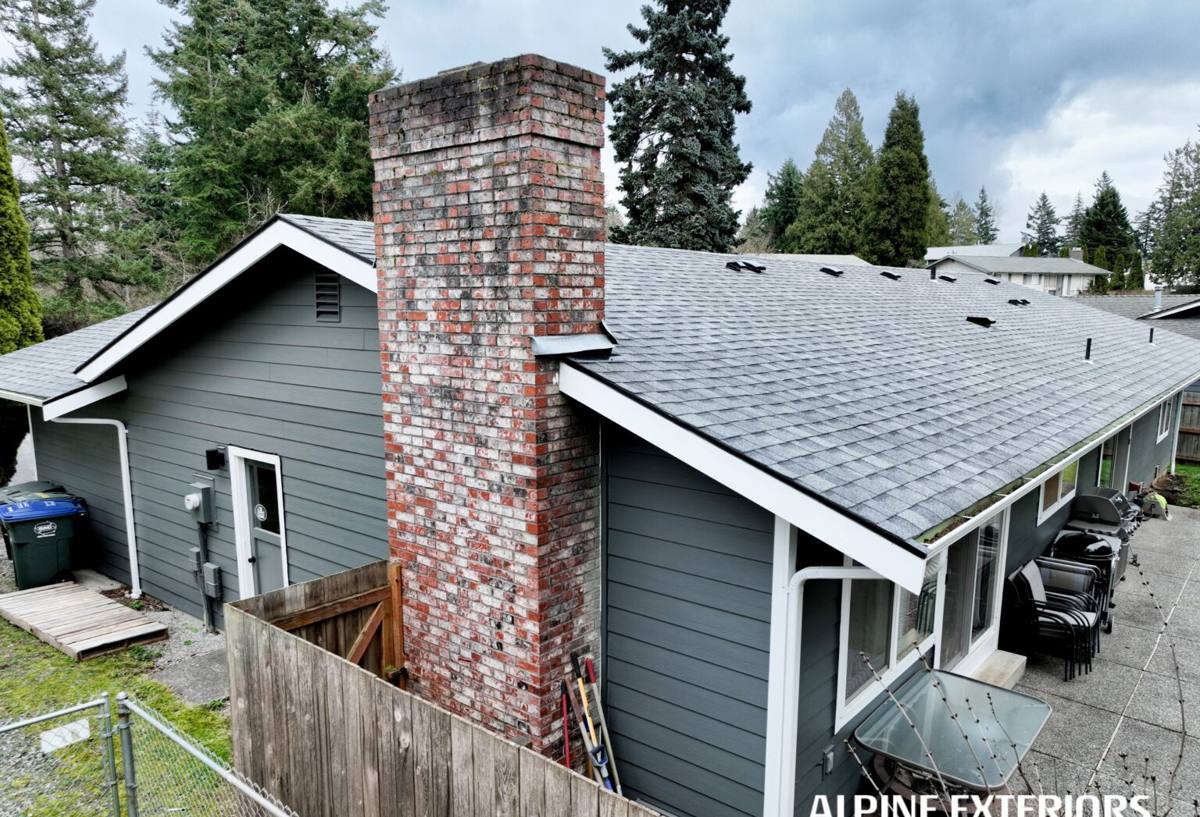
What Actually Fails First on Lake Whatcom Siding
When we walk a property near the lake, the failure pattern is usually consistent and it rarely starts where homeowners expect.
North and lake-facing walls
Walls facing the water or facing north get the least direct sun and the most sustained dampness. On these elevations we typically see moss establishing in seams and lap joints months before it shows up anywhere else on the house, along with soft or swelling material at butt joints where water has been sitting rather than draining.
Lower courses and grade-level trim
Splashback off decks, gravel paths, and sloped yards keeps the bottom two or three courses of siding wetter than the rest of the wall. This is where wood-based products show rot first, and where any siding system needs a real drainage gap and correct clearance from grade — not just caulk — to hold up over time.
Under decks, eaves, and tree canopy
Shaded, low-airflow zones under decks and mature trees are where mildew and moss growth outpaces everywhere else on a Sudden Valley lot. If your siding already looks noticeably greener or grimier under a deck or a stand of trees than it does on the open, sunny side of the house, that's the moisture pattern talking, not a cleaning problem.
What a Correct Siding Replacement Actually Involves
Replacing siding well is not just pulling off old boards and nailing up new ones. On a lake-adjacent home, the details underneath the visible surface matter as much as the siding itself.
- Full removal of the old siding down to the sheathing so we can actually see what's underneath — not a re-side over existing material that hides rot
- Inspection and repair of any sheathing or framing damage found once the old siding is off, before anything new goes up
- Installation of a code-compliant weather-resistive barrier, correctly lapped so water sheds down and out, not into the wall
- A drainage gap or rainscreen detail so moisture that gets behind the siding can actually drain and the wall can dry
- Correct flashing at every window, door, deck ledger, and roof-to-wall intersection — the majority of siding failures we find trace back to a flashing detail, not the siding material itself
- Proper fastening pattern and clearances at butt joints, corners, and trim per the manufacturer's installation instructions
- Minimum clearance from grade, decks, and roof lines maintained so splashback and standing moisture don't sit against the bottom edge
Skip any one of these steps and the new siding can look great for a season or two while the real problem — water management — never got fixed. That's how homeowners end up replacing siding twice in ten years instead of once in thirty.
Why We Install Only James Hardie Fiber Cement Here
We stopped installing vinyl, LP SmartSide, and other wood-based composite siding products years ago, and Lake Whatcom's climate is a big part of why. Vinyl can warp and gap at the seams under repeated wet-dry cycling and doesn't hold up well against the kind of driving, wind-pushed rain this area gets off the water. Wood-based composite products depend heavily on maintaining an intact factory coating; any breach at a cut edge, fastener hole, or joint lets moisture into the wood fiber core, and in a climate that stays damp this long, that moisture doesn't get a fair chance to dry out before it does damage.
James Hardie fiber cement is built differently at the material level. It's cement, sand, and cellulose fiber — non-combustible, dimensionally stable, and not vulnerable to rot the way wood-based products are. It doesn't warp in the heat/cold swings we get through the year, and it stands up to sustained dampness without the core degrading. For a house that's going to spend a good chunk of its year genuinely wet, that's the difference that matters most.
We're not saying every other product is worthless everywhere — we're saying that on the homes we build for, in this climate, Hardie is what we're willing to put our name behind and warranty.
HZ5 engineering for this region
Hardie manufactures its siding in different HZ (Hardie Zone) formulations engineered for different regional moisture and freeze profiles. Western Washington falls into the HZ5 zone, and Hardie's HZ5 product line is specifically formulated for high-moisture, humid climates like ours — it's not a one-size-fits-all product shipped in from a dry-climate plant.
ColorPlus factory finish
Hardie's ColorPlus finish is baked on at the factory under controlled conditions, rather than field-painted on site. That gives a more consistent, better-adhered finish than site-applied paint, and it comes with its own finish warranty separate from the product warranty — both of which matter more in a climate that's hard on exterior finishes than it would in a drier one.
Our Process From Estimate to Final Walkthrough
The steps are the same on every Lake Whatcom job because skipping one is how corners get cut.
- Walk-through and assessment — we look at every elevation, note moisture patterns, moss and algae growth, existing flashing conditions, and any soft spots, and we're honest about what we find, good or bad
- Written estimate — a clear scope covering removal, sheathing repair allowance, water-resistive barrier and drainage detail, Hardie product line and profile, color, and trim
- Full tear-off — old siding comes off completely so the sheathing and framing underneath are fully visible and repairable
- Water management install — barrier, flashing, and drainage gap go in before a single piece of new siding is hung
- Hardie installation — installed to Hardie's published specifications for fastening, clearances, and joint treatment
- Final walkthrough — we go over the finished job with you, including care and maintenance basics specific to a lake-adjacent property
Choosing the Right Hardie Product and Color for a Lake Lot
Most Lake Whatcom homes we work on fall into one of two settings: open lakefront with more direct sun and wind exposure, or wooded interior Sudden Valley lots with heavy tree cover and shade. Both benefit from Hardie's lap siding or panel systems, but the practical decisions differ.
On shaded, tree-covered lots, lighter ColorPlus finishes tend to show less visual contrast when a little surface pollen, moss spore, or organic buildup settles between cleanings — a maintenance consideration, not a durability one, since the fiber cement itself isn't at risk from that buildup the way a wood-based product's coating can be. On more open, wind-exposed lakefront elevations, we pay closer attention to fastening schedules and trim detailing since those walls take more direct wind-driven rain.
Trim and corner details matter more here than in a drier climate too — Hardie trim boards paired with correctly flashed corners give you a consistent look while keeping the water-management performance consistent all the way around the house, not just on the primary siding field.
What Siding Replacement Costs Around Lake Whatcom
Every home is different, but these are the main factors that move the number up or down on a Lake Whatcom project specifically.
| Cost Factor | Why It Matters Here |
|---|---|
| Sheathing/framing repair needed | Homes with long-term moisture exposure near the lake more often need some sheathing replaced once old siding comes off |
| Wall height and access | Multi-story lakefront homes and steep Sudden Valley lots can add scaffolding or lift time |
| Hardie product line and profile | Lap siding, panel systems, and trim packages price differently by product and coverage |
| Trim and detail complexity | Homes with more corners, dormers, and roof-to-wall intersections need more flashing and trim labor |
| Site access and tree removal/trimming | Wooded lots sometimes need limbs cleared for safe scaffolding and material staging |
| Existing siding removal difficulty | Multiple layers of old siding or extensive rot add demo time before install can start |
We won't quote a firm number without seeing the house — anyone who does before an in-person walk-through is guessing. What we can tell you upfront is that a correct job on a lake-adjacent home usually costs more than the same square footage inland, mostly because of the extra water-management detailing that a damp climate like this demands.
What to Check Before Hiring Anyone for This Job
- Do they remove old siding fully, or offer to install over it?
- Will they show you the sheathing condition before closing the wall back up?
- Do they install a drainage gap or rainscreen detail, or just siding directly over the barrier?
- Can they explain their flashing approach at windows, decks, and roof lines specifically?
- Are they licensed and insured to do exterior work in Washington?
- Do they have experience with homes in this specific microclimate — lake-adjacent, tree-covered, high-moisture — or mostly drier inland jobs?
- Is the manufacturer's installation instruction followed, or is it "close enough"?
Why Local Lake Whatcom Experience Matters
A siding crew that mostly works drier, sunnier neighborhoods can do fine work there and still get caught off guard by what a Lake Whatcom property throws at a wall. The moss timing is different. The drying window after a storm is shorter. Shaded, tree-heavy lots need airflow and drainage details that a wide-open lot in a drier part of the county simply doesn't require. Crews that already know this lake's conditions build those details in as standard practice, not as an afterthought once a callback comes in.
We work in Sudden Valley and around Lake Whatcom regularly enough to know which elevations of a house need the most attention before we ever pull the first piece of old siding, and we build every job around James Hardie fiber cement because it's the product we trust to hold up to what this specific climate does to a house year after year.
If your siding is showing moss, soft spots, or you're just planning ahead for a lake-area home, we're happy to walk the property and give you a straight, no-pressure assessment and estimate — just fill out the form below to get started.