 Sudden Valley
 Why Edgemoor Siding Wears Differently Than Siding Inland
Edgemoor sits close enough to Bellingham Bay that homes here deal with a combination most inland Whatcom County properties don't: salt-laden air moving off the water, wind-driven rain that hits siding at an angle instead of falling straight down, and a wet season that stretches long enough for moss and algae to get a real foothold on north-facing walls and anything shaded by mature trees. None of these things alone is unusual for Western Washington. Together, over years, they change what "normal wear" looks like on a house.
Salt air accelerates corrosion on fasteners, flashing, and any exposed metal trim faster than it would a few miles inland. Driving rain finds every gap in caulking, every hairline crack, and every spot where old siding has started to separate from its substrate, pushing moisture in where it doesn't belong. And the region's long moss season means organic growth isn't just cosmetic — moss and algae hold moisture against the siding surface for extended periods, which matters a lot depending on what the siding is actually made of.
A repair crew that hasn't worked this specific stretch of coastline can misdiagnose what they're looking at. They might treat a moisture problem as a coating problem, or patch a symptom without addressing the flashing detail that's actually letting water in. That's the gap a crew with real Edgemoor experience closes.
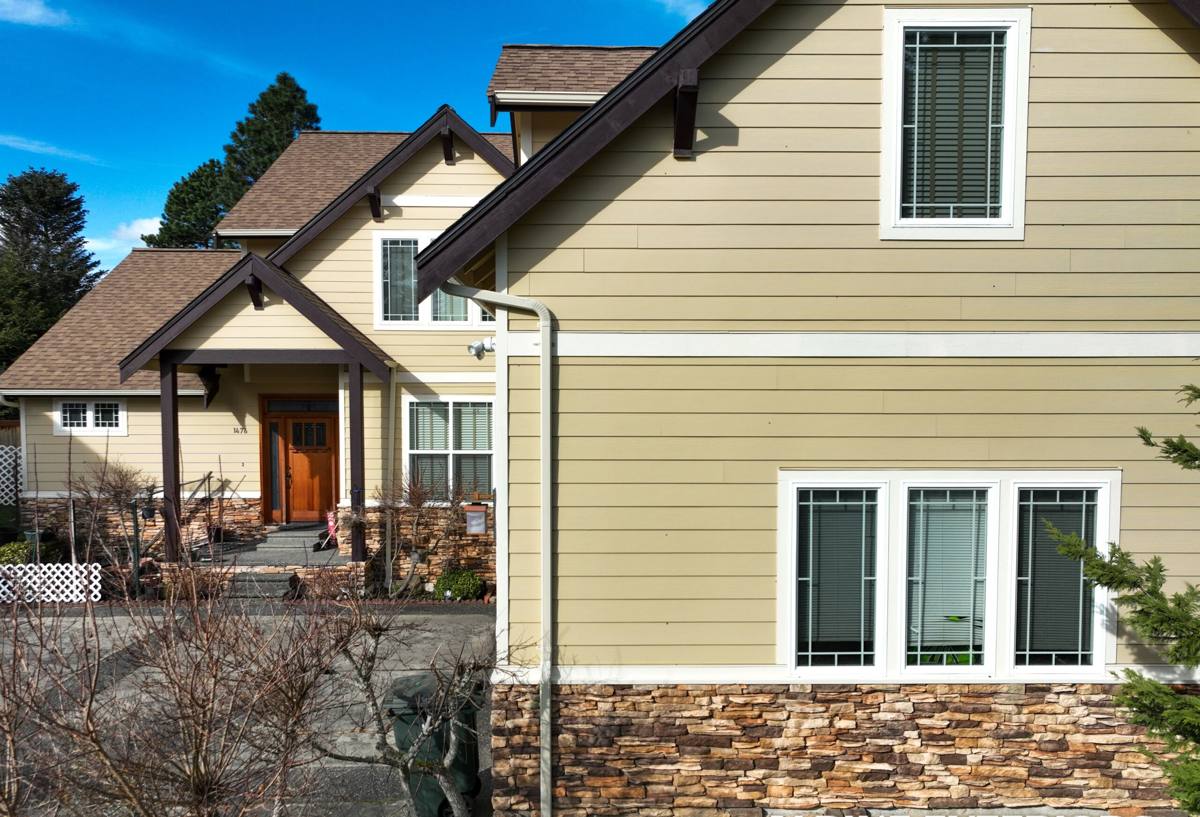
Signs Your Siding Needs Repair — Not Just a Wash
Homeowners often call about moss or discoloration, and that's a fair starting point, but it's rarely the whole story. Before any repair estimate, we're looking for evidence of what's happening underneath the surface, not just what's visible on top.
- Soft or spongy spots when you press on the siding, especially near the bottom courses or below windows
- Visible cracking, especially where panels meet trim, corners, or penetrations like hose bibs and vents
- Paint or finish that's bubbling, peeling, or failing in a way that looks different from simple sun fade
- Dark staining streaks below seams or nail heads, which usually points to water tracking behind the surface
- Persistent moss or algae growth that comes back quickly after cleaning
- Gaps opening up at seams, corner boards, or where siding meets window and door trim
- Any section that feels noticeably cooler or damper to the touch than the surrounding wall
Any one of these can be minor. Several together, especially on the sides of the house that take the brunt of driving rain, usually mean water has been getting behind the siding for a while, not just sitting on top of it.
What a Correct Siding Repair Actually Involves
Diagnosing Before Cutting
A repair that just replaces the damaged-looking board and stops there is a repair that's likely to fail again. The correct approach starts by opening up the affected area enough to see the house wrap, flashing, and framing behind it. If water has been getting in, we need to know how and for how long before we close anything back up.
Matching Material and Finish
Fiber cement siding installed years apart doesn't always match in profile, reveal, or finish, even from the same manufacturer. Getting a repair to blend in means matching plank width, texture, and color as closely as the product line allows — and being honest with the homeowner up front if an exact match isn't realistic on an older section of wall.
Flashing and Water Management
Most siding failures we open up trace back to a flashing or sealant detail, not the siding material itself. Windows, doors, and any wall penetration need proper flashing that sheds water outward and down, not a bead of caulk asked to do a flashing's job. This is the part of a repair that doesn't show once the job is finished, but it's the part that determines whether the repair lasts.
Fastening and Clearances
Correct nailing pattern, proper gaps at butt joints for expansion, and keeping the bottom edge of siding clear of grade, decks, and hardscape all matter more in a climate that delivers this much sustained moisture. A repair that ignores clearance rules just relocates the next failure a few years down the road.
Why We Only Install and Repair James Hardie Fiber Cement
We made a decision as a company to work with James Hardie fiber cement exclusively — not vinyl, not LP SmartSide, not Cemplank or Allura, not primed spruce or cedar. That's a deliberate standard, not a lack of options, and it matters directly for repair work in a climate like this one.
| Material | How It Handles This Climate | Why It's Not What We Install |
|---|---|---|
| Vinyl siding | Sheds rain reasonably well but relies on loose-fit panels; can warp or crack in temperature swings and doesn't stop moss from taking hold in shaded, damp corners | Limited repairability, panels fade and become brittle with age, thinner profile shows waviness on older walls |
| LP SmartSide (engineered wood) | Performs well when perfectly sealed, but any cut edge, fastener hole, or coating failure exposes wood strand material to moisture | Long-term moisture exposure in a wet coastal climate raises the stakes on any installation or maintenance lapse |
| Primed spruce / cedar | Natural wood grain look, but untreated or lightly primed wood absorbs moisture readily and needs frequent recoating | Highest ongoing maintenance burden; moss and algae growth accelerates wood decay if not kept clean and sealed |
| James Hardie fiber cement | Non-combustible, dimensionally stable, factory-applied ColorPlus finish resists moisture and doesn't rely on field-applied paint for its primary protection | This is what we install and repair — it's built for exactly this kind of coastal, wet-season exposure |
Hardie's HZ5 product line is engineered specifically for climates with prolonged moisture exposure and freeze-thaw cycling, which describes Whatcom County's wet season well. The factory-baked ColorPlus finish also matters for repair work specifically: it holds color and resists the moss and mildew staining that plagues field-painted surfaces, and Hardie backs it with a real transferable warranty structure rather than a manufacturer disclaiming responsibility once a house changes hands.
Our Repair Process
- On-site inspection. We walk the exterior, focusing first on the sides of the house exposed to prevailing wind and rain, and any area with visible moss, staining, or soft spots.
- Opening up problem areas. Where we suspect moisture intrusion, we remove enough material to actually see the condition of the wrap, flashing, and framing — not guess at it.
- Honest repair-vs-replace recommendation. If the damage is contained and the surrounding siding is sound, we repair. If moisture has spread further than the visible symptoms suggested, we'll tell you that plainly, with the reasoning, before any work starts.
- Correcting the root cause. Flashing, sealant, and clearance issues get fixed as part of the repair, not left in place to cause the same failure again.
- Matching and finishing. New material is matched as closely as possible to the existing siding, with attention to how it will weather alongside the older sections.
- Cleanup and walkthrough. We show you what we found and what we did about it before we consider the job finished.
Repair Cost Factors
| Factor | Why It Affects Cost |
|---|---|
| Extent of hidden water damage | Repairs that require replacing house wrap, sheathing, or framing cost more than surface-level board replacement |
| Height and access | Second-story or steeply pitched sections take longer and require more equipment |
| Color and texture matching | Older Hardie installations may need a closer color match search, or a larger section replaced for a seamless look |
| Number of affected areas | Isolated repairs are more economical per square foot than damage scattered across multiple walls |
| Flashing and trim work involved | Fixing the underlying water management detail adds labor but prevents repeat failures |
Why a Crew That Already Works Edgemoor Matters
Siding repair isn't just carpentry — it's diagnosis specific to how a particular house, in a particular microclimate, has been taking on weather for years. A crew that regularly works Edgemoor and the surrounding Bellingham Bay-facing neighborhoods has already seen which wall orientations fail first, which older Hardie color runs are hardest to match, and which flashing shortcuts from past decades tend to cause trouble later. That pattern recognition shortens the diagnostic phase and reduces the odds of a repair that only addresses what's visible.
It also means straightforward logistics — material matching, scheduling around the wetter months, and being available if a repair needs a follow-up visit — without the overhead of a crew commuting in from well outside the area.
Maintaining Siding After a Repair
- Rinse siding gently once or twice a year to keep moss and algae from establishing, especially on shaded or north-facing walls
- Keep gutters clear so overflow doesn't run down the siding face repeatedly
- Trim back vegetation and tree cover that keeps siding damp and shaded longer than necessary
- Walk the exterior after major storms and check caulking at trim, windows, and penetrations
- Address small cracks or gaps early — they're inexpensive to fix now and expensive to ignore
- Keep an eye on ground clearance as landscaping, mulch, or hardscape changes over time
None of this is complicated, but it's the kind of light, regular attention that keeps a correctly executed repair from needing a repeat visit.
Get a Straight Answer About Your Siding
If you're seeing moss that keeps coming back, soft spots, cracking, or staining on your Edgemoor home, it's worth having someone look before it spreads further. We'll give you a free, no-pressure estimate and tell you honestly whether you're looking at a repair or something more — no upsell, just what the siding actually needs. Fill out the form below to get started.