 Sudden Valley
 Why Columbia-Area Homes Wear Out Siding Faster Than You'd Expect
Homes in the Columbia neighborhood near Sudden Valley sit close enough to Lake Whatcom and the surrounding tree canopy that siding takes a harder beating than it would in a drier inland town. Three things do most of the damage over time: salt-tinged marine air moving in off the Puget Sound region, wind-driven rain that gets pushed sideways into wall assemblies instead of just falling straight down, and a moss and algae season that can run eight or nine months out of the year under the tree cover common to this part of Whatcom County. None of these are dramatic events. They're slow, cumulative, and they punish whatever siding material and installation detail is weakest first.
If your siding was installed correctly with the right materials, this climate is manageable. If it wasn't — wrong fasteners, missing flashing, caulk used where a drainage gap should be — the wear shows up early, often behind the surface where you can't see it until paint starts failing or boards start softening.
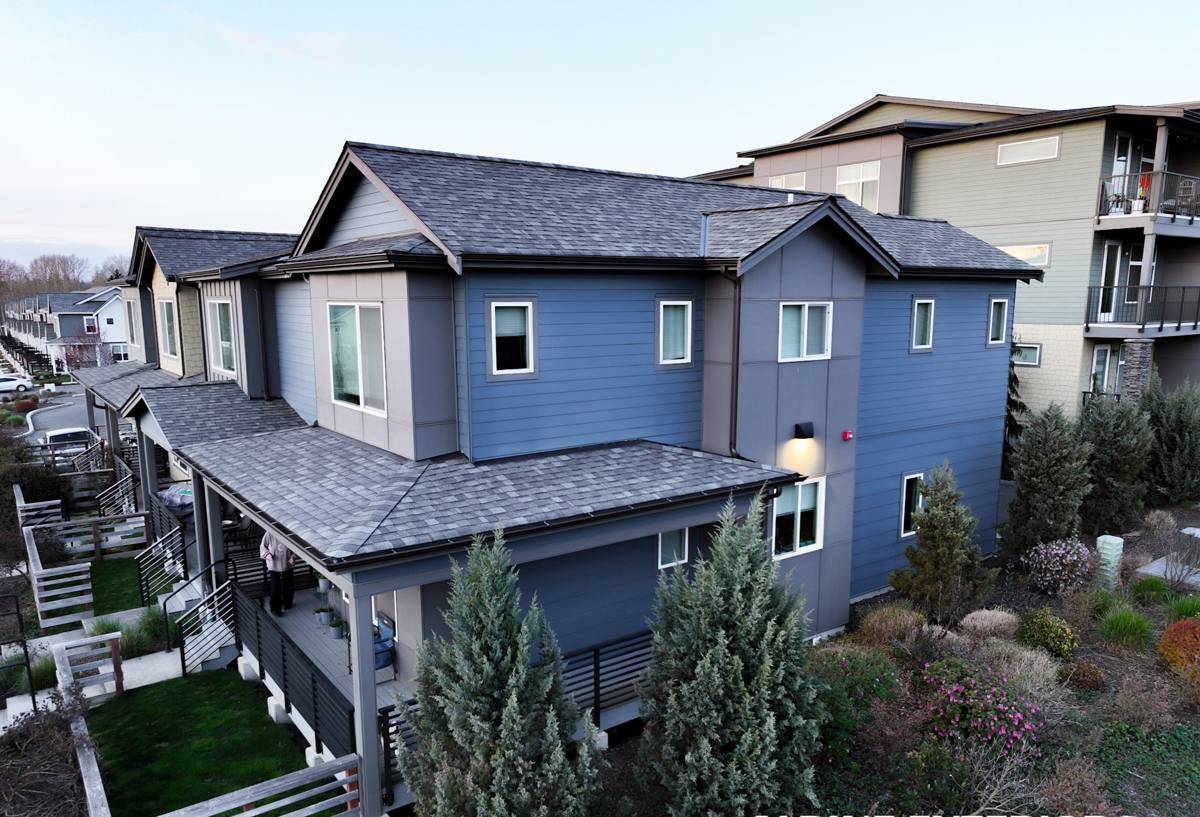
Signs a Columbia Home Actually Needs Siding Replacement
Not every issue means a full tear-off. But in this climate, a few signs consistently mean the siding system underneath is compromised, not just cosmetically tired:
- Paint that's peeling or bubbling in sheets rather than fading evenly — usually a sign of moisture trapped behind the siding
- Soft or spongy spots when you press on siding near the bottom courses, corners, or below windows
- Persistent moss or black streaking that returns within weeks of cleaning, even on the shaded north and west walls
- Visible gaps, warping, or cupping in wood-based siding, especially where boards meet trim
- A musty smell in an adjacent interior wall or a noticeable rise in heating bills without another explanation
Any one of these can be isolated. Several together, especially on a home that's had wood-based or older composite siding for more than 15-20 years, usually means it's time to look at the whole wall system rather than patching board by board.
What a Correct Siding Replacement Actually Involves
Siding replacement done right is not just swapping old boards for new ones. In a climate that pushes rain sideways and grows moss on anything shaded, the assembly behind the visible siding matters as much as the siding itself. A correct job includes:
Tear-off and substrate inspection
Removing the old siding down to the sheathing so we can actually see what's underneath — rot, mold, compromised framing, or house wrap that's failed. Skipping this step is the single most common shortcut that causes premature failure.
Weather-resistive barrier and drainage plane
A properly lapped water-resistive barrier, with a drainage gap behind the new siding, gives any moisture that does get past the surface a path to drain and dry instead of sitting against the wall. In a wall assembly with no drainage gap, even small amounts of trapped moisture accelerate rot and paint failure.
Flashing at every penetration
Windows, doors, hose bibs, light fixtures, and vents all need proper flashing so wind-driven rain can't work its way behind the siding at these joints. This is where a large share of moisture problems in wind-exposed lake and shoreline homes actually start.
Correct fastening and clearances
Manufacturer-specified nailing patterns, proper clearance from grade, decks, and roof lines, and gaps at butt joints sized for the material's expansion — these details are invisible once the job is finished but determine whether the siding performs for 30 years or 10.
Why We Install Only James Hardie Fiber Cement
We've made a deliberate call to install one siding system on every home we work on: James Hardie fiber cement. We don't install vinyl, LP SmartSide, or primed wood species like cedar or spruce, and that's not a marketing position — it's a standard we hold because of what this specific climate does to alternatives over time.
Vinyl expands and contracts more than fiber cement in temperature swings, and it doesn't hold paint if a homeowner ever wants a different color. Engineered wood products and primed wood siding depend heavily on an intact factory or field-applied coating to keep moisture out; once that coating is compromised by driving rain or constant shade and moss, the substrate underneath can take on water and soften. Fiber cement doesn't have that vulnerability — it's non-combustible, dimensionally stable, and James Hardie's ColorPlus factory finish is baked on and warrantied against fading and peeling, which matters on a home that spends much of the year damp and shaded near the lake.
Hardie also builds region-specific product lines engineered for high-moisture climates like ours, which is a level of climate-matching most other siding categories simply don't offer.
How We Approach a Columbia Siding Replacement
Our process doesn't change dramatically from house to house, but the details we pay extra attention to on Columbia-area homes reflect what this specific location throws at a wall assembly.
- On-site assessment. We walk the full exterior, checking wall orientation relative to prevailing wind and rain, shade patterns that drive moss growth, and any soft spots or staining that hint at what's happening under the surface.
- Substrate check during tear-off. Once old siding comes off, we inspect sheathing and framing before anything new goes up. If there's hidden rot, we address it before it gets covered again — not painted over.
- Drainage-plane and flashing installation. Given how much of this area's siding failure traces back to moisture management, we treat the water-resistive barrier, drainage gap, and flashing details as the part of the job that determines whether it lasts.
- James Hardie installation to manufacturer spec. Correct nailing pattern, clearances, and joint treatment, using the HZ5 product line engineered for climates with sustained moisture exposure like ours.
- Final walkthrough. We go over the finished exterior with the homeowner, including what maintenance (if any) to expect and what NOT to worry about with a ColorPlus finish.
Material Comparison for This Climate
| Factor | James Hardie Fiber Cement | Vinyl | Primed Wood / Engineered Wood |
|---|---|---|---|
| Moisture resistance | High — non-combustible, dimensionally stable | Moderate — seams and expansion gaps can trap moisture | Depends entirely on coating integrity |
| Moss/algae resistance | Good, especially with factory finish | Moderate — can trap moisture behind panels | Lower — moss retains moisture against substrate |
| Finish longevity | Factory ColorPlus, warrantied against peeling/fading | Color molded in, can fade and can't be repainted well | Depends on paint/primer quality and reapplication schedule |
| Wind-driven rain performance | Strong when installed with proper drainage plane | Adequate but seams are vulnerable points | Weakest link if coating fails at joints |
| Typical maintenance | Occasional washing | Occasional washing, limited repair options | Periodic repainting, sealant checks |
Cost Factors for a Columbia Siding Replacement
Every home is different, so we won't quote a number without seeing the house, but the main variables that move the price on a Columbia-area siding replacement are usually the same ones:
- Square footage and number of stories, which affects both material and labor
- Condition of the substrate found during tear-off — hidden rot repair adds cost but isn't optional
- Complexity of the exterior — dormers, trim detail, and multiple roof lines all add labor time
- Siding profile chosen (lap siding, shingle-style panels, board-and-batten) and trim package
- Site access — homes with steep lots or limited driveway/staging space near the lake can add setup time
We give a written, itemized estimate after the on-site walkthrough, not a phone-quote guess, because the substrate condition genuinely changes the scope on a meaningful share of the homes we look at in this area.
Why It Matters That We Already Work in This Area
A crew that regularly works Columbia and the wider Sudden Valley area already knows which wall orientations take the worst of the wind-driven rain, how aggressive the moss season is under this area's tree cover, and how homes near Lake Whatcom tend to be built relative to grade and drainage. That's not something you can fully substitute with a generic checklist — it changes where we pay closer attention during tear-off, how we detail flashing on rain-exposed walls, and what we tell homeowners to expect in year one versus year ten.
It also means logistics are simpler: material staging, scheduling around this area's wetter stretches, and being reachable if a question comes up after the job is done are all easier when a contractor already has a presence in the neighborhood rather than driving in from out of the county for a one-off job.
Questions Worth Asking Before You Hire
Whoever you hire for siding replacement in this climate, these are worth asking directly:
- Do you install a proper drainage gap and water-resistive barrier, or does the siding go directly over old sheathing?
- What happens if you find rot or damage once tear-off starts — is that a change order or is it built into the estimate process?
- What siding line and thickness are you specifying, and is it rated for high-moisture climates?
- Who's actually on the crew doing the install — is it your employees or subcontracted out?
- What's covered under warranty, and is that the manufacturer's warranty, your workmanship warranty, or both?
A contractor who answers these clearly and specifically, without vague reassurance, is usually one who understands what actually causes siding failure in a climate like this one.
Living With New Siding in a Marine, High-Moisture Climate
Once new James Hardie siding is installed correctly, upkeep in this climate is minimal compared to what most homeowners are used to with older wood or failing composite siding. An occasional gentle wash to clear moss and pollen buildup, especially on shaded walls, is typically all that's needed — no repainting cycle, no caulking touch-ups every couple of years. The factory finish is engineered to hold color and resist the kind of moisture exposure that's constant this close to the lake, which is a large part of why we standardized on it rather than materials that depend on a field-applied coating holding up indefinitely.
If you're noticing paint failure, soft spots, or siding that just looks tired on a Columbia-area home, we're happy to come take a look and give you a straightforward, no-pressure assessment of what's going on and what a correct replacement would involve. There's a form below to request a free estimate — no obligation, just an honest read on your home's exterior.