 Sudden Valley
 Decks Built for South Hill, Not for a Showroom
South Hill sits up in the trees around Sudden Valley, and homes here deal with a specific mix of weather that a generic deck package doesn't account for: damp air off the lake, long stretches of driving rain through fall and winter, and shade patterns that keep certain sections of a yard wet and mossy well after the rest of the property has dried out. A deck built to a national template — the kind you get from a big-box design center or a crew that mostly works subdivisions on the flat, open side of the county — often looks fine for the first year or two and then starts showing problems exactly where South Hill's climate is hardest on wood and fasteners: at the ledger board, in shaded corners, and anywhere water can sit instead of shed.
We build decks for this specific kind of lot: sloped, partially shaded, exposed to Whatcom County's wet season for months at a stretch. That means different framing choices, different fastener specs, and different decking recommendations than we'd give a customer on a dry, open lot ten miles away.
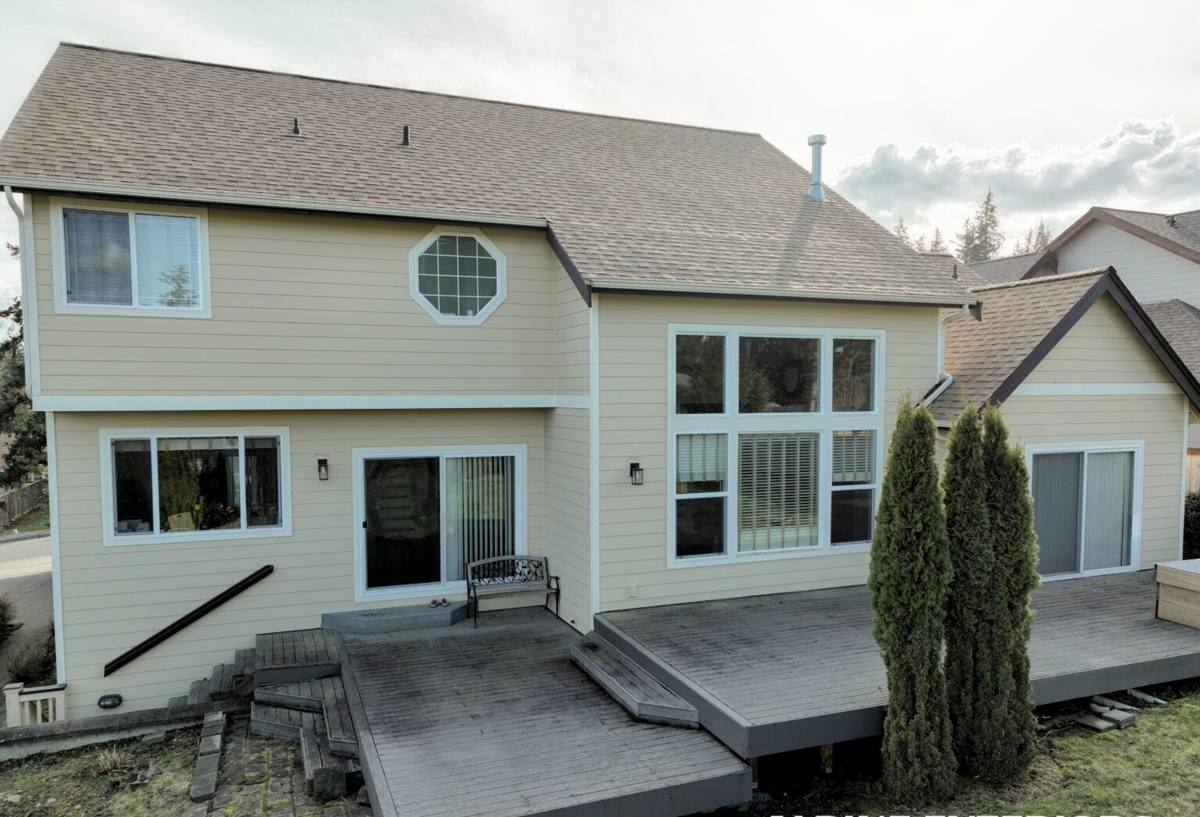
What South Hill's Climate Actually Does to a Deck
It helps to be specific about the failure modes we're designing against, because "the weather is wet here" undersells it.
Moisture that doesn't leave
Driving rain pushes water sideways, not just down, which means it gets up under rail caps, behind fascia boards, and into ledger connections that a straight-down rain would never reach. Combine that with tree cover and lake-area humidity, and shaded sections of a deck can stay damp for days after a storm passes.
Moss and algae growth
A long moss season isn't just cosmetic. Moss and algae hold moisture against the decking surface, and on wood that means accelerated rot; on composite it means a slick, dark film that has to be cleaned off before it stains permanently. Decks with poor airflow underneath or tight board spacing green up faster and stay green longer.
Salt-tinged air and fastener corrosion
Air moving through this part of Whatcom County carries enough salt content to matter over the life of a fastener. Cheap or mismatched hardware corrodes, stains the surrounding wood, and eventually loses grip strength. This is one of the most common shortcuts we see on older or poorly built decks in the area.
Freeze-thaw cycling
It doesn't get brutally cold here, but it doesn't need to. Repeated freeze-thaw on saturated wood and undersized footings works joints loose over several winters, which is why footing depth and post connections matter more here than in a drier climate.
What a Correctly Built Deck Needs in This Environment
Ledger flashing done right
The ledger board — where the deck attaches to the house — is the single most common point of failure on decks in wet climates. It needs proper flashing that directs water out and away from the house sheathing, not caulk alone. Caulk fails; flashing, installed correctly, doesn't rely on staying intact to keep water out.
Fasteners and hardware rated for the conditions
We spec stainless or heavy hot-dip galvanized structural hardware for connections exposed to weather, and coated fasteners matched to whatever decking material is going on top. Mixing incompatible metals causes galvanic corrosion — a slow problem that shows up as staining and weakened joints a few years down the road.
Footings sized for the soil and slope
South Hill's terrain means more decks on a grade than on a flat pad. Footings need to be sized and set to local frost depth and soil conditions, not just poured to the minimum a spec sheet allows. On sloped lots we also pay attention to drainage around footings so water isn't pooling against concrete through the wet months.
Airflow and drainage underneath
Ground-level and low-clearance decks need enough airflow underneath to let wood framing dry out between rain events. Where clearance is tight, we look at grading, gravel beds, or a drainage system rather than just building over damp ground and hoping for the best.
Choosing a Decking Material for South Hill Conditions
There's no single "best" decking material — there's the right material for your budget, sun/shade exposure, and how much upkeep you actually want to do. Here's how the common options hold up in this climate specifically:
| Material | Upfront Cost | Moss/Moisture Behavior | Maintenance |
|---|---|---|---|
| Pressure-treated wood | Lowest | Needs sealing regularly or it holds moisture and greens up fast in shade | Annual cleaning and re-sealing recommended |
| Cedar | Mid | Naturally more rot-resistant but still needs finish maintained to keep that resistance | Periodic cleaning and refinishing |
| Composite decking | Higher | Doesn't rot, but can develop surface mold/algae film in constant shade if not cleaned | Occasional washing, no sealing/staining |
| PVC decking | Highest | Fully moisture-resistant board; best option for deeply shaded, damp sections | Lowest — mostly just washing |
For a shaded South Hill lot near mature trees, we're often steering customers toward composite or PVC for the sections that stay damp longest, while wood remains a reasonable, honest choice for sunnier areas of the same deck if the budget calls for it. We'll walk your specific lot with you and point out which sections need the upgraded material and which don't — there's no reason to pay PVC prices for a section of deck that gets full sun all afternoon.
Our Process, Start to Finish
- On-site walk-through — we look at slope, sun/shade exposure, existing structure (for replacements), and how the deck ties into the house.
- Design and material selection — layout, railing style, and decking material chosen based on your budget and how that part of the yard actually behaves through the year.
- Permit and engineering — we handle the permit application and any required engineering for footings or elevated structures.
- Demo (if replacing an old deck) — old structure removed, ledger area inspected for hidden rot before anything new goes up.
- Framing and flashing — footings, posts, beams, joists, and ledger flashing installed to code and to our own moisture-management standards.
- Decking, railing, and finish work — surface material installed, railings set, final details completed.
- Final walk-through — we go over the finished deck with you and cover basic care for the specific material you chose.
Permits and Whatcom County Requirements
Most new decks and many deck replacements require a building permit, and elevated structures typically need engineered footing and railing details. Requirements vary by structure height, size, and attachment method, so this isn't something to skip based on what a neighbor's deck did or didn't need. We handle the permit process as part of the job so you're not the one tracking down inspection requirements — this also protects you at resale, since an unpermitted deck can become a problem during a future home sale or insurance claim.
What Affects the Cost of a South Hill Deck
| Factor | Why It Matters |
|---|---|
| Size and layout | Square footage and shape (multiple levels, angles) drive material and labor directly |
| Height and slope of the lot | Taller decks and sloped sites need more substructure, footings, and often engineering |
| Decking material | Pressure-treated, cedar, composite, and PVC span a wide price range, as shown above |
| Railing style | Basic wood rail vs. metal, glass, or cable systems changes cost significantly |
| Soil and footing conditions | Difficult access or poor soil can require more footing work than a straightforward flat lot |
| Demo of an existing deck | Removing and disposing of an old structure adds labor before the new build even starts |
We give a written estimate that breaks these out so you can see where your money is going and what would change the price up or down — including which upgrades (like moving from wood to composite in shaded sections) are worth it for your specific yard and which are optional.
Keeping Your Deck Right Through the Wet Season
Whatever material you choose, a little seasonal attention goes a long way in this climate. A basic maintenance routine we recommend to South Hill customers:
- Sweep debris and leaves off the deck regularly through fall — trapped leaves hold moisture and accelerate moss growth
- Clean moss and algae off the surface at least once a year with a deck-safe cleaner, not just a pressure washer on high, which can damage wood fibers and composite surface layers
- Check and re-seal wood decking on the schedule appropriate to the product — don't wait until it's visibly gray and dry
- Inspect railing posts and ledger flashing yearly for movement, staining, or soft spots
- Keep gutters and downspouts near the deck clear so runoff isn't dumping extra water onto the structure
- Clear anything growing against or under the deck that's blocking airflow underneath
Why a Crew That Already Works South Hill Matters
A deck built by a crew unfamiliar with this specific terrain and climate tends to make the same mistakes: standard flashing details that don't account for driving rain, decking choices that look fine on a spec sheet but green up fast in shade, and footings sized for easier soil than what's actually on a South Hill slope. We work in Sudden Valley and the surrounding Whatcom County area regularly, which means we're not guessing at how a particular lot behaves through a wet winter — we've already seen it on the deck down the road. That local pattern recognition is worth more than a lower bid from a crew that has to relearn these lessons on your project.
If you're planning a new deck or need to replace one that's showing its age, we're happy to come take a look and walk you through what your specific lot needs. Reach out for a free, no-pressure estimate using the form below.