 Sudden Valley
 Sunnyland's Climate Puts Real Stress on Siding
Sunnyland sits in one of the wetter, greener pockets of Whatcom County, and that's exactly why siding choice matters more here than in a lot of places. The combination of salt-laden air moving in off the water, long stretches of driving rain, and heavy tree cover that keeps everything shaded and damp for months at a time creates conditions that most siding materials simply weren't built to handle year after year. Homes in this neighborhood don't fail because owners neglected them — they fail because the siding itself couldn't keep pace with the environment.
Salt air is corrosive to metal fasteners and trim, and it accelerates the breakdown of paint films and caulk joints. Driving rain, especially when it's pushed sideways by wind off the water, finds every gap in flashing, trim, and butt joints that a calmer climate would never expose. And the moss and algae that thrive in Sunnyland's shaded, moisture-retaining yards don't stay in the lawn — they colonize north-facing walls, under eaves, and anywhere siding stays damp longer than it should. Over a few seasons, all three of these factors compound on each other.
Why We Only Install James Hardie Here
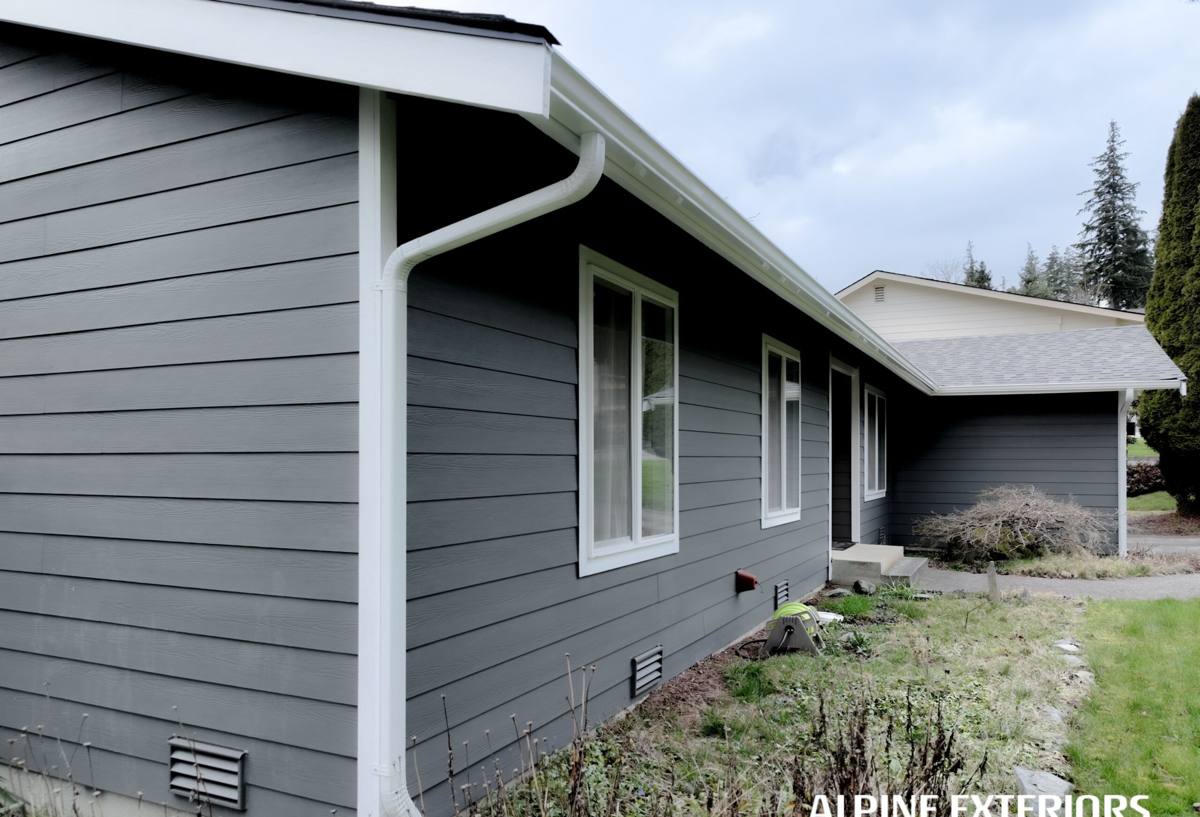
We install James Hardie fiber cement siding exclusively — not vinyl, not LP SmartSide, not cedar or primed spruce, not Cemplank or Allura. That's a deliberate standard, not a sales pitch. Hardie's fiber cement is non-combustible, dimensionally stable in wet-dry cycling, and manufactured with a factory-applied ColorPlus finish that resists the fading and peeling that field-painted materials struggle with in a marine climate. For a neighborhood dealing with constant moisture exposure, those aren't marginal advantages — they're the difference between siding that holds up for decades and siding that needs attention every few years.
Hardie also makes climate-engineered product lines, including HZ5 formulations designed specifically for wetter, harsher regions like the Pacific Northwest. That engineering shows up in how the board resists moisture absorption and swelling, which matters directly in an area where siding rarely gets a long dry stretch to fully recover between rain events.
What Homeowners Actually Notice
Practically speaking, homeowners in Sunnyland who've switched to Hardie tell us the same few things stand out: the color doesn't chalk or fade the way painted wood or older vinyl does, moss and algae don't get the same foothold on the harder cementitious surface, and they're not repainting or recaulking every few years just to keep the walls looking presentable.
Signs Your Current Siding Is Losing the Fight
Before recommending a full replacement, we look for specific evidence that siding has reached the end of its useful life rather than just cosmetic wear. In Sunnyland's climate, these are the patterns we see most often:
- Persistent green or black staining on north- and west-facing walls that returns within weeks of cleaning
- Soft or spongy spots where you can press a finger into the material, especially near the bottom courses and around windows
- Cupping, warping, or visible gaps opening up between boards
- Paint that's peeling or bubbling rather than just fading evenly
- Corroded or rust-streaked fasteners and trim pieces
- Interior signs like peeling paint or musty smells on exterior-facing walls, which often mean moisture has already gotten behind the siding
Any one of these on its own might just need a repair. Several of them together, especially on a home more than fifteen or twenty years old, usually means the whole assembly — siding, house wrap, and flashing — needs to come off and be redone correctly rather than patched.
What a Correct Installation Actually Involves
Hardie siding performs the way it's supposed to only when it's installed to spec. A lot of the moisture problems we get called out to fix on other companies' work trace back to shortcuts taken during install, not the product itself. For a Sunnyland home, correct installation means:
Water Management Comes First
Before a single board goes up, the weather-resistant barrier and flashing details around windows, doors, and penetrations need to be right. In a climate with sustained driving rain, this layer is doing more work than the siding itself — it's the last line of defense if any water gets past the surface.
Fastening and Clearances
Hardie specifies exact nailing patterns, fastener types, and minimum clearances from grade, roof lines, and decks. Skipping the recommended clearance from soil or hardscaping is one of the most common shortcuts we see, and in a wet climate it invites wicking and rot at the bottom edge within a few years.
Joints, Caulking, and Paint
Butt joints need to be properly flashed or sealed with a product rated for the application, not just caulked over and hoped for. ColorPlus finished boards need touch-up with Hardie's matched touch-up product at cut edges — using ordinary exterior paint compromises the factory finish's warranty and its resistance to fading.
James Hardie vs. Other Siding Materials in This Climate
| Material | Salt Air / Moisture Resistance | Moss & Algae Resistance | Maintenance Burden | Typical Lifespan Here |
|---|---|---|---|---|
| James Hardie fiber cement | Engineered for wet climates (HZ5) | Hard surface resists colonization | Occasional rinse; no repainting for years | 30+ years with correct install |
| Vinyl | Can warp, crack in temperature swings | Moss and algae adhere readily | Low cost, but seams and edges trap moisture | 15-25 years, shorter if damaged |
| Cedar / primed spruce | Absorbs moisture, prone to rot | Highly susceptible in shade | Regular repainting, staining, sealing | 10-20 years without heavy upkeep |
| LP SmartSide (engineered wood) | Wood-based core sensitive to sustained moisture | Moderate; depends on coating condition | Repainting and edge sealing over time | 20-30 years, install-sensitive |
None of these other materials are inherently bad products — they just carry trade-offs that show up faster in a climate like this one, where siding rarely gets a real chance to dry out between weather events. That's the practical reason we standardized on Hardie rather than offering all of them.
Our Process for Sunnyland Projects
Because we work regularly in and around Sudden Valley and the surrounding Whatcom County neighborhoods, our process is built around the conditions here rather than generic assumptions.
- Walk-through and moisture check: We inspect existing siding, trim, and any visible interior signs of water intrusion before quoting anything.
- Assessment of sun exposure and tree cover: Shaded walls that stay damp longer get called out specifically, since they may need extra attention to house wrap and ventilation detailing.
- Product and color selection: We help homeowners choose the right Hardie plank profile and ColorPlus color, factoring in how each performs against moss growth and fading in shaded versus sun-exposed elevations.
- Tear-off and inspection of sheathing: Old siding comes off fully so we can check the sheathing underneath for hidden rot before closing the wall back up.
- Installation to manufacturer spec: Proper flashing, clearances, fastening, and joint treatment, not just fast board coverage.
- Final walk-through: We go over touch-up procedures and what routine maintenance should look like going forward.
Maintenance in a Moss-Prone, Salt-Air Environment
Hardie siding is genuinely low-maintenance compared to the alternatives, but "low-maintenance" doesn't mean "no maintenance" in a climate like this one. A short annual routine keeps it performing the way it's designed to:
- Rinse siding with a garden hose (not a pressure washer aimed directly at joints) once or twice a year, more often on shaded, moss-prone walls
- Keep gutters clear so overflow doesn't run down and saturate wall sections repeatedly
- Trim back tree branches and shrubs that keep siding shaded and damp longer than necessary
- Inspect caulk joints around windows, doors, and trim annually and recaulk if you see cracking or separation
- Address any bare or cut edges with Hardie's matched touch-up product promptly, before moisture can get into the exposed core
- Watch for early moss or algae growth and treat it before it spreads across a wider section of wall
Why Hiring a Crew That Already Works Here Matters
Siding installation looks similar on paper everywhere, but the details that actually matter — how much clearance to leave at grade, how aggressively to flash a butt joint, which walls need extra attention because of shade and tree cover — are learned by working the same climate and the same kinds of homes repeatedly. A crew that installs Hardie across a range of climates might get the fastening pattern right and still miss the water-management details that matter most in a place like Sunnyland, where the siding is rarely given a long dry period to recover from a mistake. Working this neighborhood regularly means we've already seen how these homes age, where the moisture problems tend to start, and what it actually takes to keep a Hardie installation performing for its full service life here.
If you're weighing a siding replacement or just want an honest read on whether your current siding still has useful life left in it, we're happy to take a look. There's no pressure and no cost to get our assessment — fill out the form below and we'll set up a time to come out.