 Sudden Valley
 Why Ferndale Roofs Wear Differently Than Roofs Inland
Ferndale sits close enough to Bellingham Bay and the Strait of Georgia that salt-laden air is a real factor in how a roof ages, not just a coastal-town talking point. Salt air accelerates corrosion on exposed metal — nails, flashing, vent stacks, drip edge — long before the shingles themselves show their age. Add Whatcom County's driving rain, which tends to come in sideways off the water during winter storms, and any weak point in the underlayment, flashing, or fastening pattern becomes a leak point much sooner than it would in a drier, calmer climate.
Then there's shade. A lot of Ferndale properties back up to conifers, sit on partially wooded lots, or are tucked in low, moist pockets near the river and surrounding farmland. Combine that shade with our long, wet moss season — realistically eight or nine months of the year with meaningful moisture on the roof — and you get ideal conditions for moss and algae growth that a sunnier, drier roof would never deal with.
None of this means asphalt shingles are a poor choice for Ferndale. They're not. It means the installation details that get glossed over on an easy job matter a lot more here, and the roofer doing the work needs to actually understand what this climate does to a roof over ten, fifteen, twenty years.
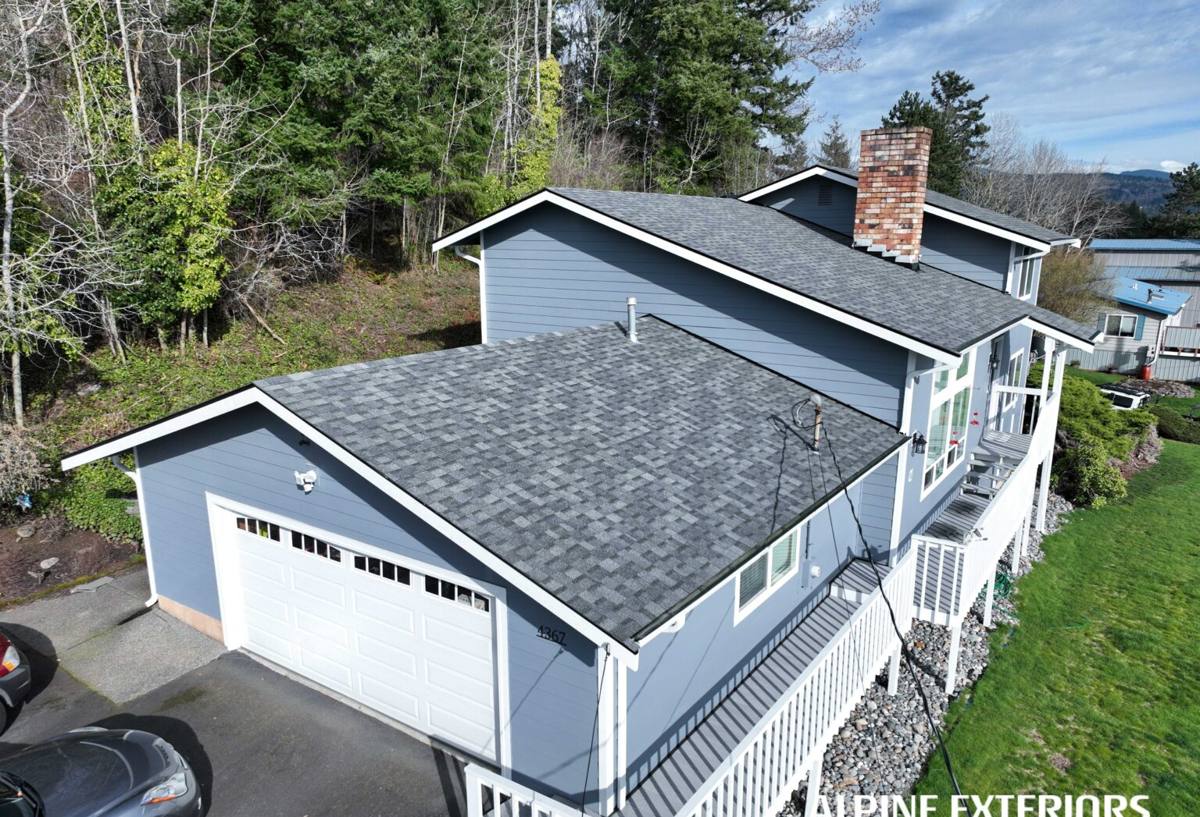
What a Correct Asphalt Shingle Roof Needs in This Climate
Underlayment That Can Handle Wind-Driven Rain
Standard felt underlayment is not what we reach for on a Ferndale roof. Synthetic underlayment holds up better to the wet-dry cycling our climate puts it through, and we pay close attention to lap and fastening patterns because wind-driven rain will find gaps that a calmer climate would never expose.
Ice-and-Water Barrier Where It Actually Matters
Whatcom County doesn't see deep, sustained freezes most winters, but we do get cold snaps combined with heavy rain, and low-slope sections, valleys, and eaves are where water backs up and works its way under shingles. We install self-adhering ice-and-water membrane at eaves, valleys, and any roof-to-wall transition — not as a blanket upsell, but because those are the specific spots that fail first when a roof isn't built for this weather.
Ventilation That Matches Our Humidity
A roof deck that can't breathe traps moisture, and trapped moisture is what feeds rot, mildew, and premature shingle failure from underneath. Balanced intake and exhaust ventilation — soffit vents paired with ridge or roof vents sized correctly for the attic volume — is not optional in a climate this damp. We check existing ventilation on every reroof and correct it when it's undersized, which is common on older Ferndale homes.
Flashing and Fasteners That Resist Salt Corrosion
This is where a lot of roofs quietly fail. Cheap or mismatched flashing and fasteners corrode faster near the water, and once flashing starts to fail at a chimney, skylight, or wall transition, water gets behind the shingles no matter how good the shingles themselves are. We use corrosion-resistant flashing and fastener materials appropriate for a marine-influenced climate, not whatever is cheapest at the yard.
Choosing the Right Shingle for Ferndale Conditions
Not every asphalt shingle line handles algae and moss pressure the same way. For Ferndale homes, we generally steer customers toward:
- Algae-resistant shingles (look for AR-rated or copper-infused granules) to slow the black streaking that shaded, damp roofs are prone to
- Architectural (dimensional) shingles over basic 3-tab where budget allows, for better wind resistance and a longer realistic service life in wet, blustery conditions
- A manufacturer warranty structure that actually covers algae staining in a coastal climate, since not all product lines do
We're upfront about trade-offs rather than steering everyone to the priciest option. A well-installed mid-tier architectural shingle with proper ventilation and flashing will outperform a premium shingle installed with shortcuts, every time. The installation is what protects the investment.
Our Process on a Ferndale Reroof
- On-site inspection — we walk the roof, check the deck for soft spots or rot (common under long-standing moss), assess current ventilation, and look at flashing conditions around every penetration
- Written scope and honest estimate — what's being replaced, what underlayment and flashing package is going in, and why, in plain language
- Tear-off and deck inspection — old material comes off down to the deck so we can actually see what's underneath before covering it back up
- Deck repair as needed — any soft or water-damaged sheathing gets replaced, not shingled over
- Underlayment, ice-and-water barrier, and flashing installation — done to the standards this climate requires, not the regional minimum
- Shingle installation — correct nailing pattern, exposure, and sealing for wind and rain resistance
- Ventilation correction — intake and exhaust balanced if the existing setup is inadequate
- Final walkthrough — we show you what was done and answer questions before we consider the job finished
Moss, Algae, and What Actually Helps Long-Term
Moss doesn't just look bad — it holds moisture against the shingle surface, lifts shingle edges as it grows, and shortens roof life if it's left unmanaged. In a climate like ours, a moss-free roof is a maintenance outcome, not a one-time fix.
Zinc or copper strips installed near the ridge are a reasonable long-term deterrent, since rainwater carries trace metal ions down the roof slope and slows regrowth. We also make sure branches are trimmed back where practical, since shade and debris buildup are the biggest drivers of moss pressure on Ferndale roofs. What we don't recommend is aggressive pressure-washing to remove moss — it can strip granules and shorten shingle life faster than the moss itself would.
Simple Maintenance Habits That Extend Roof Life Here
- Clear gutters and valleys of needle and leaf debris at least twice a year — clogged gutters back water up under the shingle edge
- Have moss growth addressed while it's light, not after it's matted and holding water
- Walk the attic after major storms and check for daylight, staining, or damp insulation near penetrations
- Keep an eye on flashing around chimneys, skylights, and vent pipes — these fail before the shingle field does
- Trim back overhanging branches that keep sections of the roof shaded and slow to dry
Signs Your Roof Needs Attention
- Granules collecting in gutters or at downspout outlets
- Shingles that look cupped, curled, or are missing tabs after a windstorm
- Visible moss mats, especially on north-facing or shaded slopes
- Dark streaking that keeps returning after cleaning
- Water stains on interior ceilings, especially near chimneys, skylights, or exterior walls
- Soft or spongy spots when walking the roof deck
- Daylight visible through the roof deck from inside the attic
Cost Factors on a Ferndale Asphalt Shingle Roof
Every roof is priced from its own measurements and condition, but the factors below are what typically move the number up or down on jobs in this area.
| Factor | Why It Matters Here |
|---|---|
| Roof size and pitch | More steep or complex rooflines take longer and require more safety setup and material waste |
| Deck condition | Rot from long-term moss or past leaks means sheathing replacement before shingles go on |
| Number of penetrations | Chimneys, skylights, and multiple vents each need individual flashing work, which is labor-intensive |
| Underlayment and ice-and-water package | A climate-appropriate package costs more upfront but prevents the leaks that cost far more later |
| Shingle tier | Algae-resistant, architectural shingles cost more per square than basic 3-tab but hold up better against moss and salt air |
| Ventilation corrections | Adding or rebalancing intake/exhaust vents is common on older Ferndale homes and adds to scope |
| Access and layout | Steep lots, tree cover, or tight setbacks near the water can affect equipment access and setup time |
Why It Matters That We Already Work in Ferndale
A roofing crew that only occasionally works this far north treats every job like a generic install. A crew that regularly works Ferndale and the surrounding Sudden Valley and Whatcom County area already knows which details can't be skipped: where ice-and-water barrier actually needs to go given our storm patterns, how much ventilation a typical local attic needs, and which flashing and fastener grades hold up against the salt air coming off the bay. That local knowledge shows up in fewer callbacks and a roof that's actually built for the weather it has to survive, not just the weather on the installation day.
We also know that homeowners here have seen contractors come through for one storm-chasing season and disappear. We live and work in this region, and we stand behind the roofs we install here.
If your Ferndale home needs a roof inspection, a repair, or a full asphalt shingle replacement, we're happy to take a look and give you an honest, no-pressure estimate. Use the form below to get started.