 Sudden Valley
 Why Bellingham Siding Takes a Beating
Bellingham sits at the intersection of a few tough conditions for exterior siding: proximity to salt water, heavy annual rainfall, and long stretches of overcast, damp weather that keep moss and algae thriving on north-facing walls for most of the year. None of that is unusual for Whatcom County, but it adds up faster than most homeowners expect. Siding that would hold up fine in a drier climate can start failing here within a decade if it wasn't installed correctly or wasn't built for wet-climate service in the first place.
Salt-laden air moving in off the water accelerates corrosion on fasteners, flashing, and any exposed metal trim. Driving rain — especially the kind that comes in sideways during fall and winter storms — pushes water into seams, laps, and butt joints that would stay dry in a calmer climate. And a moss season that can run eight months or longer keeps organic growth and trapped moisture sitting against the siding surface, which is exactly the environment that causes rot, paint failure, and substrate breakdown.
Signs Your Siding Needs Repair, Not Replacement
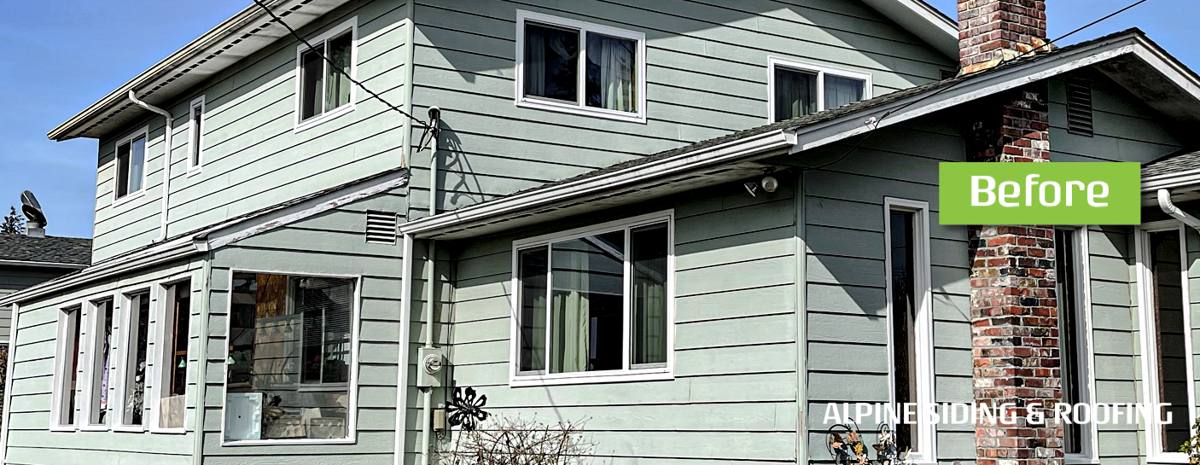
Not every siding problem means a full re-side. A lot of damage in this climate is localized — a few boards, a corner, an area under a leaking gutter — and can be corrected without touching siding that's still performing well. Here's what we look for when we're deciding whether repair makes sense:
- Soft, spongy, or visibly swollen boards, usually near the ground, under windows, or at inside corners
- Cracked, split, or delaminating boards from age, impact, or improper original installation
- Persistent moss or algae staining that keeps returning even after cleaning
- Paint or finish that's bubbling, peeling, or chalking in specific areas rather than across the whole house
- Gaps at seams, corners, or trim where caulking has failed and water is getting behind the siding
- Visible fastener corrosion or rust streaks running down the wall
- Soft trim boards or window casings adjacent to otherwise sound siding
If the damage is scattered and the rest of the siding is structurally sound, targeted repair is usually the right call. If we're finding rot in multiple areas, or the underlying water-resistive barrier has clearly failed in more than one spot, that's a different conversation — and we'll tell you honestly which situation you're in rather than sell you a repair that won't hold.
What a Correct Repair Actually Involves
A siding repair that actually lasts in this climate is more than swapping a damaged board for a new one and caulking the edges. Done right, it means:
Diagnosing the Cause, Not Just the Symptom
Rotten siding is almost always a symptom of a water problem somewhere else — a failed flashing detail, a clogged gutter, a missing kickout flashing, or a seam that was never properly lapped. Replacing the board without fixing what let water in means the same spot fails again in a year or two. We look at what's behind the siding before we decide what goes back up.
Checking for Hidden Damage
Visible rot is often smaller than what's happening underneath. We check the sheathing, house wrap, and framing in the repair area for moisture damage that isn't visible from the outside. Patching over a wet wall assembly just hides the problem temporarily.
Matching Material and Method
Whatever goes back into the wall needs to match the reveal, profile, and finish of the surrounding siding, and it needs to be installed with proper flashing, correct fastener spacing, and factory-specified gaps and sealant — not just nailed up tight to whatever's next to it.
Repair or Replacement? What Actually Decides It
Homeowners often ask us to just give a straight answer on repair versus full replacement. The honest answer is that it depends on a handful of factors, laid out below.
| Factor | Leans Toward Repair | Leans Toward Replacement |
|---|---|---|
| Extent of damage | Isolated to a few boards or one wall section | Recurring rot in multiple areas across the house |
| Age of existing siding | Under 15-20 years, still structurally sound elsewhere | Original siding is at or past its service life |
| Underlying material | Fiber cement or sound wood with a fixable finish issue | Failing wood composite, or material known to have widespread moisture issues |
| Water-resistive barrier condition | Intact and functioning behind the repair area | Compromised or missing in multiple locations |
| Cause of damage | A single fixable flashing or gutter issue | Systemic issues (grade, drainage, original installation quality) |
We'll walk the exterior with you, explain what we're seeing, and give you a straight recommendation. If repair is the right call, that's what we'll quote. If the underlying problem is bigger than the visible damage suggests, we'll explain why and let you decide how to proceed — there's no benefit to either of us in a repair that doesn't hold.
Our Repair Process
Our approach on a Bellingham repair job generally follows the same sequence:
- Inspection and diagnosis — we identify every area of concern, not just the spot you called about, and check for hidden moisture damage.
- Removal of damaged material — we pull damaged boards and trim, along with enough surrounding material to expose the full extent of the problem.
- Correcting the water path — flashing, house wrap, or drainage details get fixed before anything new goes back on the wall.
- Sheathing and framing repair — any rotted structural or sheathing material is replaced, not just covered over.
- Reinstallation to spec — new siding is installed with correct fastener placement, gapping, and sealant, matched to the surrounding profile.
- Finish work — caulking, priming, and finish coating (or factory-finished material where used) so the repair blends in rather than standing out.
Why We Repair With James Hardie Fiber Cement
When a repair calls for new siding material, we use James Hardie fiber cement — the same material we install on full re-sides — rather than trying to source a patch in vinyl, primed spruce, or cedar to match an existing wall. There's a practical reason: fiber cement is non-combustible, dimensionally stable, and engineered for exactly the wet, moss-prone conditions Bellingham deals with, so a Hardie repair holds up the same way the rest of a Hardie-clad house does. It resists moisture absorption far better than wood or wood composite products, and its ColorPlus factory finish holds color and resists the fading and chalking that plain paint on wood trim runs into after a few damp Pacific Northwest winters.
We don't install LP SmartSide, vinyl, or cedar siding, and we're upfront about why: those products each have real trade-offs in this climate — moisture sensitivity, maintenance burden, or seams and expansion behavior that don't hold up as well over time in a marine environment. When we're repairing a home that already has a different siding material, we'll be honest about whether a like-for-like patch is realistic or whether that section is a good candidate to transition to fiber cement.
Why a Crew That Already Works Bellingham Matters
Siding repair in this area isn't the same job as siding repair in a dry inland climate, and a crew that hasn't worked Whatcom County conditions regularly can miss things that matter here — like how far moss and algae actually travel up a north wall, how aggressive the flashing detail needs to be under a valley that dumps water onto a lower roof, or how quickly a small gap turns into a rot problem when it's exposed to months of driving rain. Working in Sudden Valley and the greater Bellingham area consistently means we're not guessing at these details — we're applying what we already know holds up here.
It also means we know what correct work looks like on this coastline specifically: fastener types that won't corrode in salt air, flashing laps sized for the rain this area actually gets, and finish products rated for the humidity and UV exposure of a Pacific Northwest exterior. A patch job that would be fine somewhere drier can fail here in a season.
After the Repair: Keeping It From Happening Again
A good repair should outlast the conditions that caused the original damage, but a little homeowner follow-through helps it stay that way:
- Keep gutters clear so water isn't overflowing onto the siding below
- Trim back vegetation and tree branches that keep a wall section shaded and damp
- Rinse moss and algae growth off siding annually, especially on north- and west-facing walls
- Re-caulk seams and trim joints if you notice cracking or separation before it becomes an entry point for water
- Walk the exterior once a year, especially after storm season, and flag anything that looks different
If you're seeing soft spots, staining, or gaps in your siding anywhere on the house, it's worth having it looked at before the next round of fall rain. We offer free, no-pressure estimates for siding repair in Bellingham and the surrounding Sudden Valley area — walk us through what you're seeing and we'll give you a straight assessment of what it actually needs.